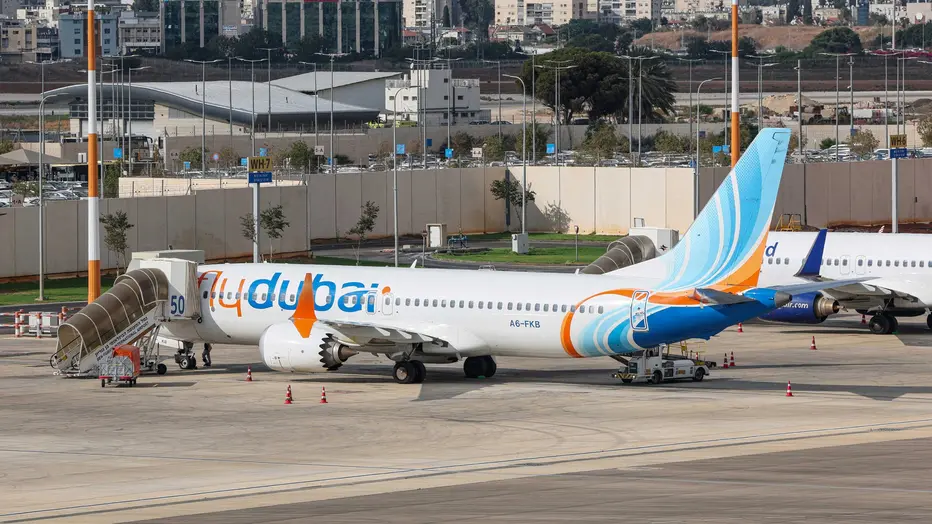
A routine commercial flight from Dubai to Tel Aviv turned into a terrifying mid-air emergency when the flydubai co-pilot attack 2026 sent Flight FZ1073 into a dramatic descent after the co-pilot allegedly attacked the captain inside the cockpit. The Boeing 737 MAX 8 eventually landed safely in Saudi Arabia after the injured captain managed to open the cockpit door, allowing passengers and additional pilots on board to intervene. UAE authorities have described the incident as an attempted terrorist act, while investigators continue examining the suspect’s background, motive and possible security failures.
The incident has raised urgent questions about cockpit security, pilot screening and how a passenger aircraft carrying more than 180 people was brought back under control after violence erupted among the flight crew.
What Happened on Flydubai Flight FZ1073?
Flydubai Flight FZ1073 was traveling from *Dubai to Tel Aviv on September 30, 2026*, when an altercation broke out inside the cockpit.
According to the UAE investigation, the co-pilot attacked Captain Smit Machchhar using the aircraft’s emergency crash axe and attempted to seize control of the aircraft. The captain was injured during the confrontation.
The situation quickly became critical.
Flight data showed that the Boeing 737 MAX 8 experienced a dramatic loss of altitude. Reuters reported that the aircraft plunged approximately *16,000 feet in around 30 seconds* before the descent was stopped.
Passengers reportedly experienced extreme forces during the descent.
For people inside the cabin, the sudden movement would have been terrifying. An aviation instructor who later recreated the event in a simulator for Reuters described the experience as similar to an extremely steep roller coaster, with passengers who were not properly restrained potentially being lifted from their seats.
Yet the aircraft did not crash.
Instead, the crew and passengers managed to regain control.
The Captain’s Critical Decision
One of the most important moments occurred when the injured captain managed to open the cockpit door.
According to accounts reported by multiple media organizations, this allowed passengers and additional crew members to enter the cockpit and help overpower the alleged attacker.
That action appears to have been crucial.
The aircraft had already entered a dangerous descent, and the normal two-person cockpit crew was no longer functioning normally.
Once additional people were able to enter the flight deck, control of the aircraft could be restored.
The incident demonstrates how quickly an apparently manageable cockpit confrontation can become an emergency involving everyone on board.
Why Were There Extra Pilots on the Plane?
One of the most remarkable details of the flydubai flight FZ1073 incident is that additional qualified pilots were reportedly traveling on the aircraft.
These pilots were not originally operating the flight but were traveling as passengers, sometimes described in aviation terminology as “deadheading” crew.
Their presence proved extremely important.
After the cockpit confrontation, additional crew members were able to assist with controlling the aircraft. Reuters reported that a reserve crew eventually landed the aircraft safely after the passengers had helped overpower the co-pilot.
Without additional aviation-trained personnel already on board, the situation could have been considerably more complicated.
The presence of qualified pilots gave the aircraft an additional layer of human capability at exactly the moment it needed it.
How Did the Plane Survive the Sudden Dive?
The aircraft’s descent was severe.
Reuters reported that the plane lost around 16,000 feet in approximately 30 seconds, creating substantial aerodynamic and physical forces.
The Boeing 737 MAX 8 is designed to withstand significant aerodynamic loads, but a rapid high-speed descent can still place substantial stress on an aircraft.
The aircraft eventually leveled out.
Once the crew regained control, the pilots diverted the aircraft toward Saudi Arabia rather than continuing to Israel.
The flight landed at *Prince Sultan bin Abdulaziz International Airport in Tabuk*, northwestern Saudi Arabia.
Saudi authorities said the aircraft landed safely at approximately *9:45 a.m. local time*, carrying 174 passengers and eight crew members.
Why Did the Plane Land in Saudi Arabia?
The aircraft was originally traveling from Dubai to Tel Aviv.
After the emergency, however, continuing to the planned destination was no longer the priority.
The crew diverted to Saudi Arabia because the aircraft required an emergency landing after the cockpit confrontation.
Tabuk provided a suitable airport for the aircraft to land and for the injured pilots to receive medical treatment.
Saudi Arabia’s Interior Ministry said that both the captain and co-pilot were taken to hospital following the incident.
The other passengers later continued their journey on a replacement Flydubai aircraft.
What Happened to the Co-Pilot?
The co-pilot was identified by Reuters sources as *Hammam al-Hammami*, an Omani national.
However, investigators are still examining his background and the circumstances surrounding the attack.
Reuters reported that he had previously undertaken training with Royal Air Maroc in 2025 but was not subsequently hired by the airline. He had also completed a distance-learning aviation management course at Buckinghamshire New University in the United Kingdom.
Australian authorities have also begun examining his links to Australia because he reportedly studied at a university in Melbourne.
These details have attracted international attention because investigators are attempting to determine whether warning signs existed before the flight.
Questions About Previous Security Concerns
Perhaps the most troubling part of the investigation is the question of whether concerns about the co-pilot had previously been identified.
Some reports say he had been restricted from flying for Oman’s national carrier because of concerns about his views.
The Washington Post reported that a person familiar with the matter said he had previously been blocked from flying for Oman Air because of radical views and had subsequently worked in a desk role before resigning. That information has not been fully confirmed publicly by all authorities involved.
The question now being examined is whether information held by authorities in different countries was properly shared.
That issue could become one of the most important elements of the investigation.
How Was He Allowed to Fly?
The flydubai co-pilot attack 2026 has raised questions about international pilot vetting.
Flydubai operates under the regulatory oversight of the United Arab Emirates’ General Civil Aviation Authority.
Pilots are required to meet professional licensing, medical and operational standards.
However, aviation security experts note that screening systems cannot necessarily predict every future action by an individual.
Al Jazeera reported that aviation analysts emphasized the difficulty of identifying behavioral risks that may emerge after a pilot has already passed formal screening.
This is one reason the incident has generated discussion far beyond Flydubai.
It raises questions about how airlines and regulators exchange security information when pilots work across different countries.
Israel Orders a Security Review
The incident has also triggered a security review in Israel.
Prime Minister Benjamin Netanyahu ordered a review of security procedures for foreign civil aviation following the attack.
The review will examine how foreign flight crews are screened and whether additional security measures are required for aircraft arriving in Israel.
The issue is particularly sensitive because the flight was traveling to Tel Aviv and the suspected attacker was an Omani national.
Israel and Oman do not have diplomatic relations.
That has generated additional questions about how foreign crew members assigned to flights entering Israel are vetted.
However, some claims circulating about specific Israeli requirements for foreign pilots remain disputed or unverified.
Was This a Terrorist Attack?
The UAE Attorney General has classified the incident as an attempted terrorist act.
That is an official characterization, but the broader investigation into the motive remains ongoing.
Authorities are examining whether the attack was individually motivated, ideologically motivated or connected to a wider organization.
It is therefore important not to treat every early claim about the suspect’s motives as established fact.
Reuters reported that the UAE investigation is continuing, while Flydubai has said it cannot provide further details while authorities investigate.
Determining motive could take considerably longer than establishing what happened inside the cockpit.
What Passengers Experienced
For passengers, the incident began with something that few people could understand immediately.
The aircraft suddenly dropped.
People reportedly screamed as the plane descended rapidly.
Passengers did not initially know that the problem was occurring inside the cockpit.
The later revelation that one pilot had allegedly attacked another made the experience even more alarming.
The fact that passengers themselves became involved in subduing the attacker illustrates how extraordinary the situation became.
The successful landing depended on several separate actions happening correctly: the captain surviving the attack, the cockpit door being opened, passengers and crew entering the flight deck, additional pilots helping control the aircraft and the plane being diverted to a suitable airport.
The Captain Is Being Credited With Preventing Disaster
Captain Smit Machchhar has received widespread praise for his actions.
Despite suffering injuries, he reportedly managed to open the cockpit door, enabling others to enter.
Indian and Israeli officials have described him as a hero for helping prevent a much larger tragedy.
Machchhar is an experienced commercial pilot who previously worked for SpiceJet before joining Flydubai.
His aviation experience became particularly important during the emergency.
The captain’s ability to act despite being injured may have provided the crucial opportunity for other people to intervene.
Why the Boeing 737 MAX 8 Did Not Crash
Another question surrounding the *flydubai flight FZ1073 incident* is how the aircraft survived the extreme descent.
Modern commercial aircraft are designed with significant structural margins.
However, no aircraft is designed to make uncontrolled high-speed descents indefinitely.
The important point is that the aircraft was leveled before the situation became irreversible.
Reuters’ simulator reconstruction indicated that the aircraft’s autopilot had disconnected before the plunge, allowing the aircraft to accelerate rapidly.
Once human control was restored, the aircraft could be stabilized and diverted.
The safe outcome therefore resulted not simply from the strength of the airplane, but from the actions of the crew and passengers who intervened.
The Role of Passengers
Passengers rarely expect to participate directly in an aviation emergency.
In this case, however, some passengers reportedly helped overpower the co-pilot after the cockpit door was opened.
That intervention was critical.
Aviation security procedures are designed to prevent unauthorized access to the cockpit, but this incident presented the opposite problem: the cockpit itself became the source of the threat.
Once the captain opened the door, passengers and crew had an opportunity to help regain control.
Their response became one of the most important factors in the aircraft’s survival.
Could This Happen Again?
The incident has already triggered questions throughout the aviation industry.
Commercial aviation has multiple layers of safety, including pilot licensing, medical examinations, airline security systems, cockpit-door procedures and operational oversight.
But the *flydubai co-pilot attack 2026* demonstrates that even a highly regulated system can face unexpected human threats.
Investigators will likely examine:
– The co-pilot’s recruitment history
– Previous aviation employment
– Medical and psychological screening
– Security background checks
– Information-sharing between countries
– Access to cockpit emergency equipment
– Cockpit-door procedures
– The response of the additional pilots
– Communication between the aircraft and ground authorities
– The decision to divert to Saudi Arabia
The answers could influence future aviation-security procedures.
International Investigation Expands
The investigation is no longer limited to the UAE and Saudi Arabia.
Australian authorities are examining the suspect’s links to Australia, while Israeli officials are reviewing the security arrangements surrounding flights entering the country.
The suspect’s previous aviation training in Morocco and education in the United Kingdom are also being examined as investigators reconstruct his background.
This illustrates the international nature of modern aviation.
A pilot can be trained in one country, educated in another, employed by an airline based in a third country and operate flights connecting several more.
That makes intelligence-sharing between national authorities increasingly important.
What Happens Next?
The investigation is expected to focus on three major questions.
1. What Was the Motive?
Investigators need to establish why the co-pilot allegedly attacked the captain.
Was the incident personal, ideological or part of a wider plan?
At this stage, the investigation has not publicly established every aspect of the motive.
2. Were There Warning Signs?
Authorities will examine whether previous employers or governments had information that should have triggered additional scrutiny.
This could become a major international aviation-security question.
3. Should Pilot Screening Change?
Governments and airlines may review whether current security and psychological screening procedures are sufficient to identify potential threats.
Any changes would need to balance security with the practical realities of international aviation employment.
A Flight That Nearly Became a Disaster
The *flydubai flight FZ1073 incident* is extraordinary because the aircraft came dangerously close to becoming a catastrophic aviation accident but ultimately landed safely.
The sequence was remarkably fast.
A cockpit attack was followed by a steep descent.
The captain was injured.
The aircraft lost thousands of feet.
The cockpit door was opened.
Passengers intervened.
Additional pilots helped regain control.
The aircraft diverted.
And the Boeing 737 MAX 8 landed safely in Saudi Arabia.
The survival of everyone on board was therefore the result of several critical decisions and fortunate circumstances coming together.
Conclusion
The *flydubai co-pilot attack 2026* has become one of the most serious aviation-security incidents of the year.
Flight FZ1073 was traveling from Dubai to Tel Aviv when the co-pilot allegedly attacked Captain Smit Machchhar with a crash axe. The aircraft subsequently entered a dramatic descent, losing approximately 16,000 feet in around 30 seconds.
The captain managed to open the cockpit door, allowing passengers and additional pilots to intervene. The aircraft was eventually stabilized and diverted to Tabuk, Saudi Arabia, where it landed safely with 174 passengers and eight crew members on board.
The incident has now raised major questions about pilot screening, international intelligence-sharing and aviation security.
The UAE has described the attack as an attempted terrorist act, but investigators are still working to establish the full motive and determine whether there were previous warning signs.
For passengers, the most important fact is that the aircraft landed safely.
For the aviation industry, however, the investigation has only just begun.
The final findings could influence how airlines, regulators and governments around the world assess the security risks posed by cockpit personnel and how they prepare for an emergency that almost nobody expects to happen.
, , , , , , , , , , , ,