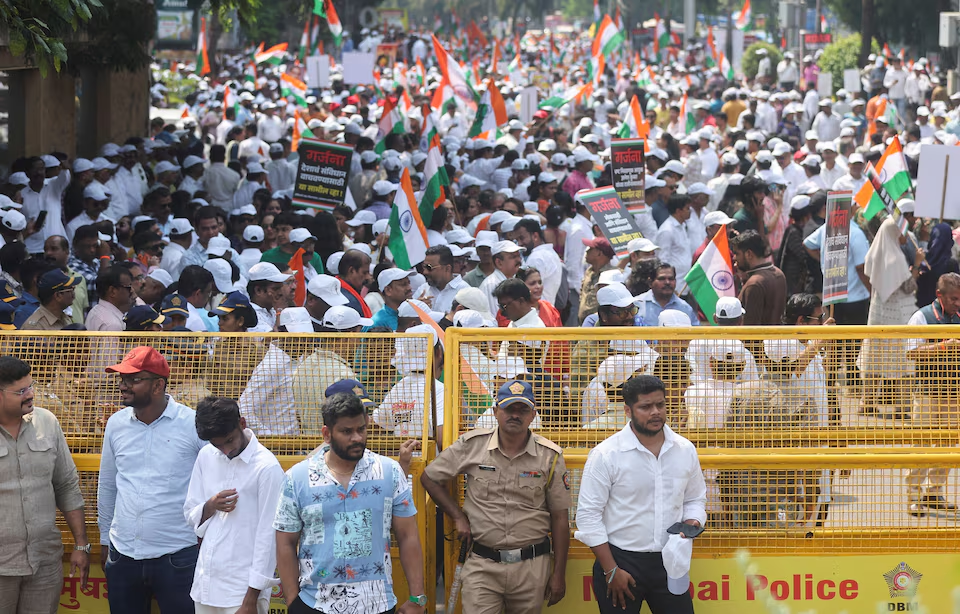
India is facing growing political and public demonstrations over the country’s electoral system, with thousands taking to the streets in Delhi and Mumbai to protest against the Election Commission of India (ECI). The India election protests 2026 have focused heavily on changes to electoral rolls, the resignation of Chief Election Commissioner Gyanesh Kumar and concerns about whether eligible citizens could be removed from voter lists. The Election Commission rejects allegations of political manipulation and says its voter-verification exercise is intended to ensure that electoral rolls contain eligible voters.
The demonstrations have brought together opposition parties, student groups, civil-society activists and a growing youth-led movement. Police have detained protesters in Delhi, while demonstrations have continued in Mumbai and other parts of the country.
At the center of the dispute is the Election Commission’s Special Intensive Revision (SIR) of electoral rolls.
Why Are Thousands Protesting?
The immediate reason for the demonstrations is the controversy surrounding the SIR process.
The Election Commission says the exercise is designed to verify voter eligibility and clean electoral rolls by identifying people who may have died, moved away, been registered more than once or otherwise become ineligible.
Opposition parties and civil-society groups, however, argue that the process could remove legitimate voters from the electoral register.
This disagreement has transformed what would normally be an administrative voter-verification exercise into a major political controversy.
Reuters reported that protesters accuse the electoral authorities of changing voter rolls in a way that could disenfranchise millions of eligible citizens. The allegations have been rejected by both the Election Commission and the ruling Bharatiya Janata Party (BJP).
That dispute explains why the demonstrations have expanded beyond political parties.
For many protesters, the issue is no longer simply about individual voter names. They see it as a broader question about transparency, accountability and confidence in India’s electoral institutions.
What Is the Special Intensive Revision?
The Special Intensive Revision, commonly known as SIR, is a process through which electoral rolls are examined and updated.
The Election Commission says voter lists must be regularly maintained because India’s population is highly mobile. People move between cities and states, names can appear more than once and records can become outdated.
The current controversy began with the implementation of SIR in Bihar and later expanded across much of India.
According to an Indian Express investigation, more than 13 crore names were struck from draft voter rolls across 30 states and Union Territories during the nationwide process. However, the figure refers to names affected in draft rolls and does not mean that every one of those people has been permanently removed from the final electoral register.
That distinction is important.
The Election Commission has provided mechanisms for citizens to check their names, submit documents and appeal decisions. Its official voter portal includes services for searching voter names, submitting documents against notices and filing appeals.
Still, critics argue that the documentation requirements and verification process could create difficulties for legitimate voters, particularly disadvantaged communities.
Why Is the Election Commission Under Pressure?
The protests have increasingly focused on Chief Election Commissioner Gyanesh Kumar.
Opposition leaders and activists are demanding his resignation, accusing the Election Commission under his leadership of failing to provide sufficient transparency over the voter-roll revision.
The controversy intensified after reports of disagreements inside the Election Commission itself.
An Indian Express investigation reported that Election Commissioners Sukhbir Singh Sandhu and Vivek Joshi had formally raised objections on multiple occasions concerning decisions related to voter additions, deletions and electoral systems. The newspaper reported at least 14 recorded objections over a 10-month period.
These reports have added another dimension to the India voter roll controversy.
The Election Commission, however, maintains that its decisions are being taken according to the applicable legal framework and has rejected claims that the voter-roll exercise is politically motivated.
The competing accounts have made the independence and internal functioning of the electoral authority an important part of the national debate.
Protests Spread Across Delhi and Mumbai
The demonstrations became particularly visible in Delhi and Mumbai.
In Delhi, opposition parties, student groups and civil-society organizations attempted to demonstrate near Jantar Mantar, one of the capital’s designated protest locations.
Police detained hundreds of people during some demonstrations as authorities restricted access to the area.
Indian Express reported that more than 550 people were detained during one Delhi protest on October 2.
Mumbai saw another major demonstration.
On October 4, Shiv Sena (UBT) leader Uddhav Thackeray and Maharashtra Navnirman Sena leader Raj Thackeray jointly led a march demanding Gyanesh Kumar’s resignation and opposing the SIR process in Maharashtra. Protesters were asked to carry the Indian national flag rather than party flags.
The decision to emphasize the national flag was significant because organizers sought to present the demonstration as a wider civic issue rather than a normal party political rally.
The Youth Movement Behind the Protests
One of the most unusual elements of the protests is the involvement of a youth-led movement known as the Cockroach Janta Party (CJP).
The movement originally emerged online as a satirical response to youth unemployment and concerns surrounding examination paper leaks.
It later became involved in street demonstrations and developed a much larger political presence.
The CJP is now demanding the resignation of the chief election commissioner and greater transparency in the electoral-roll process.
The movement’s involvement has brought a younger generation into a debate that might otherwise have remained concentrated among established political parties.
Associated Press reported that the group previously participated in protests connected to examination issues and is now organizing demonstrations over voter-list revisions.
The movement has also threatened to continue its campaign rather than limit demonstrations to a single day.
Why Voter Rolls Matter So Much
A voter list determines who can participate in an election.
That makes changes to electoral rolls particularly sensitive.
If an eligible citizen’s name is missing, that person may face difficulties voting unless the error is corrected before election day.
The Election Commission argues that accurate voter lists are essential because they help prevent duplicate or invalid registrations.
Critics respond that the verification process must also protect legitimate voters from wrongful exclusion.
This creates a difficult balance.
An electoral roll that contains duplicate or ineligible entries can create problems. But a verification system that makes it unnecessarily difficult for eligible citizens to remain registered can also undermine public confidence.
That is why the India voter roll controversy has become much larger than a technical administrative dispute.
Opposition Parties Accuse the Government of Political Bias
India’s opposition parties have made some of the strongest accusations against the Election Commission.
They argue that the voter-roll changes could disproportionately affect communities that traditionally support opposition parties.
Some opposition leaders have accused the government and election authorities of attempting to influence future elections through changes to voter registration.
The BJP and Election Commission reject those allegations.
Reuters reported that protesters claim the revisions could disenfranchise millions in a manner that benefits Prime Minister Narendra Modi’s BJP, while the Election Commission and BJP deny wrongdoing.
It is important to distinguish between an allegation and an established fact.
The political parties involved have very different interpretations of the SIR process, and the disputed claims are part of an ongoing political and legal debate.
Police Response Adds Another Layer to the Controversy
The response of authorities has also become a major issue.
In Delhi, police prevented some protesters from reaching Jantar Mantar and detained large numbers of demonstrators.
Amnesty International criticized the authorities’ handling of the protests and called for the right to peaceful assembly to be protected. It also raised concerns about internet restrictions associated with demonstrations.
Indian authorities, meanwhile, have emphasized maintaining public order and controlling large gatherings.
Mumbai has seen a somewhat different approach.
The Indian Express reported that Maharashtra authorities chose a more restrained response to demonstrations compared with the crackdown seen in Delhi.
The contrasting approaches have themselves become part of the political discussion.
The ECI Says Voter Verification Is Necessary
The Election Commission has not accepted the protesters’ central accusations.
Its position is that electoral rolls must be accurate and that the SIR exercise is part of the normal responsibility of election authorities.
The official voter-services portal provides citizens with tools to search their names, submit required documents, register as new voters and appeal decisions.
This process is particularly important because draft-roll exclusions can potentially be challenged.
The debate therefore revolves partly around implementation: how voters are notified, what documents they must provide, how quickly appeals are processed and how transparent the final lists will be.
Why the Issue Could Become Bigger
The controversy comes at an important moment in Indian politics.
Upcoming state elections mean that electoral-roll questions have immediate political significance.
Opposition parties have already announced additional demonstrations and campaigns demanding greater transparency.
Reuters reported that the protests are part of a wider challenge to the Election Commission’s handling of voter verification, while additional rallies have been planned.
If demonstrations continue to grow, the dispute could become one of the country’s most important political issues during the coming months.
The government and Election Commission will face pressure to explain the process in greater detail.
Opposition parties will likely continue demanding independent scrutiny.
Civil-society groups are expected to focus on whether citizens can easily verify and restore their voting rights.
What Could Happen Next?
Several developments could shape the next stage of the controversy.
More Street Protests
Organizers have indicated that demonstrations will continue.
The youth-led CJP has discussed sustained protests, while opposition parties have announced additional programmes targeting the Election Commission.
Legal Challenges
The controversy has already moved beyond the streets and into India’s courts.
Petitions have been filed challenging aspects of the Election Commission’s decisions and seeking greater scrutiny of the SIR process.
Court decisions could therefore play an important role in determining how voter-list revisions proceed.
Greater Scrutiny of the Election Commission
The reports of disagreements among election commissioners could result in greater public attention on how the ECI reaches decisions.
The commission’s independence is a fundamental part of India’s electoral system, making internal disputes particularly significant.
Voter Verification
For ordinary citizens, perhaps the most practical issue is whether their names appear on the electoral roll.
The Election Commission has encouraged voters to use its official services to check their registration status and complete required procedures.
A Debate About Democracy and Electoral Trust
The India election protests 2026 are ultimately about more than one election official or one voter-list revision.
They reflect a broader debate about trust in democratic institutions.
India has one of the world’s largest electorates, making the accuracy of its voter rolls an enormous administrative challenge.
The Election Commission must simultaneously prevent fraudulent or duplicate registrations and ensure that eligible citizens are not wrongly excluded.
Protesters are demanding stronger transparency and accountability.
The Election Commission says its verification process is necessary to maintain accurate electoral rolls.
Both sides therefore agree on the importance of reliable elections, but they sharply disagree over whether the current process protects or threatens that objective.
What This Means for Indian Voters
For ordinary voters, the controversy has one immediate practical lesson: checking voter registration status is increasingly important.
The Election Commission’s official portal provides tools for searching voter names, reviewing polling information, submitting documents and filing appeals.
Citizens who discover problems with their registration can use the official procedures rather than relying solely on political organizations or social-media information.
That distinction is particularly important during a period when competing claims about voter lists are circulating widely.
Conclusion
India’s electoral system is facing one of its most visible public controversies of 2026.
The India election protests 2026 have brought thousands of people onto the streets, with demonstrations in Delhi, Mumbai and other locations focused on the Election Commission, Chief Election Commissioner Gyanesh Kumar and the Special Intensive Revision of voter rolls.
At the center of the India voter roll controversy is a fundamental question: how can India ensure that its electoral rolls are accurate without excluding citizens who have a legal right to vote?
The Election Commission says the SIR process is designed to verify voter eligibility and improve the accuracy of electoral rolls. Opposition parties and activists argue that the process lacks sufficient transparency and could result in eligible voters being excluded. Those claims remain contested.
The protests, legal challenges and political campaigns show that the dispute is unlikely to disappear quickly.
As India moves toward upcoming elections, public confidence in the voter-registration system could become just as important as the voter lists themselves.
For now, the streets of Delhi and Mumbai have become a visible expression of a much larger national debate over electoral transparency, institutional independence and the right to vote.