The Mecca defence pact 2026 is entering a new stage as senior officials from Saudi Arabia, Pakistan and Turkey meet in Riyadh on October 5 to discuss regional security and the future of their newly established defence framework. The Strategic Political and Defence Committee brings together the three countries’ foreign ministers, defence ministers and military chiefs, with the meeting taking place as Saudi Arabia faces renewed security pressure from Yemen and Iran-backed Houthi forces.
The Riyadh meeting is important because the agreement signed in Makkah in August is moving from a political declaration toward a more organized security structure. The three countries have already agreed to establish a secretariat in Saudi Arabia and expand cooperation in defence industries, technology development and military coordination.
The alliance does not formally describe itself as being directed against a particular country. Pakistan has specifically characterized the agreement as defensive and intended to strengthen collective deterrence and protect the sovereignty and territorial integrity of its members.
What Is the Mecca Defence Pact?
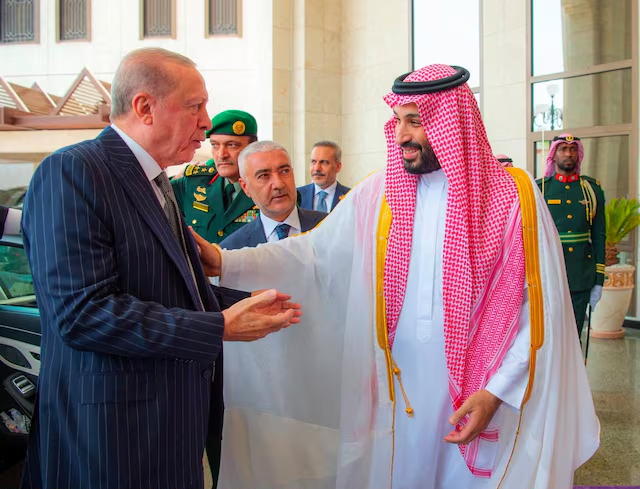
The agreement was signed on August 7, 2026, in Makkah by Saudi Crown Prince and Prime Minister Mohammed bin Salman, Turkish President Recep Tayyip Erdoğan and Pakistani Prime Minister Shehbaz Sharif.
The official agreement states that an armed attack against any one of the three countries will be regarded as an attack against all three. It also calls for greater cooperation across defence-related areas.
The agreement therefore goes beyond a conventional bilateral military relationship.
Saudi Arabia brings its strategic position, economic influence and extensive defence resources. Pakistan brings a large military establishment and longstanding defence relationships with both Saudi Arabia and Turkey. Turkey contributes a major defence industry, NATO experience and growing capabilities in drones, aerospace, naval systems and military technology.
Together, the three countries are attempting to create a framework for closer security coordination.
Why Is Riyadh Meeting Now?
The timing of the October 5 meeting is significant.
Saudi Arabia is facing renewed attacks from Iran-backed Houthi forces in Yemen. The Houthis have launched missile and drone attacks, while the Saudi-backed Yemeni government has announced a major military operation aimed at taking territory controlled by the group.
At the same time, Pakistan has publicly stated that it is prepared to defend Saudi Arabia under the new agreement.
Pakistan’s Defence Minister Khawaja Muhammad Asif said Islamabad would make available “whatever means are available” to defend Saudi Arabia, although he did not publicly confirm whether Pakistan had been asked to participate in specific air operations.
That distinction is important.
The defence agreement creates a mutual commitment, but the exact mechanisms for responding to an attack are still being developed.
The Riyadh meeting could therefore help determine how the agreement works in practical terms.
The Saudi-Pakistan-Turkey Alliance Takes Shape
The Saudi Pakistan Turkey alliance has developed rapidly.
The first major step came with the August Makkah agreement.
On August 31, the three countries’ foreign ministers, defence ministers and military chiefs met in Istanbul as the Strategic Political and Defence Committee established under the agreement.
At that meeting, they agreed to institutionalize cooperation and establish a permanent secretariat in Saudi Arabia. The secretariat is initially being headed by a Pakistani secretary-general for three years.
The countries also agreed to deepen defence-industrial cooperation, joint technology development and production.
That means the alliance is not limited to military responses to crises.
It could gradually become a platform for defence manufacturing, technology partnerships, military exercises and coordinated strategic planning.
Pakistan’s Role Is Especially Important
Pakistan occupies a distinctive position within the alliance.
It is geographically located between the Gulf, South Asia and the wider Middle East. It also has long-standing political, economic and military ties with Saudi Arabia.
Pakistan has historically maintained close defence cooperation with Saudi Arabia, including military training and personnel exchanges.
The new agreement gives those relationships a more formal multilateral structure by bringing Turkey into the framework.
Pakistan has also maintained diplomatic channels with Iran despite the tensions surrounding the Houthis.
That balancing role could become important.
Reuters reported that Iran has proposed political engagement with the Houthis, an idea that the Mecca pact committee is expected to discuss during its Riyadh meeting.
Pakistan therefore faces the challenge of supporting Saudi security while continuing to advocate diplomatic solutions to regional conflicts.
Turkey Brings Defence Technology
Turkey’s role is different from Pakistan’s.
Turkey has developed a substantial domestic defence industry over the past decade, including unmanned aerial systems, missiles, armoured vehicles, naval platforms and aerospace technologies.
The country is also a NATO member.
That gives the alliance access to a different set of military and technological relationships.
Turkish Foreign Minister Hakan Fidan, Defence Minister Yaşar Güler and Chief of General Staff General Selçuk Bayraktaroğlu are expected to participate in the Riyadh meeting.
Turkey has indicated that it is prepared to help meet Saudi military needs, particularly in technical areas, although Ankara has taken a more cautious public position regarding direct military intervention.
This distinction could become important if the regional security situation deteriorates.
Saudi Arabia Wants Stronger Regional Security
For Saudi Arabia, the agreement comes at a time when regional security threats have become increasingly complicated.
The kingdom faces risks from missile and drone attacks, instability in Yemen and wider tensions involving Iran and its regional partners.
Saudi Arabia also hosts the two holiest sites in Islam, Makkah and Madinah.
The security of those cities has been repeatedly raised by Saudi officials as a major national concern.
The new defence arrangement provides Saudi Arabia with stronger political and military relationships with two important partners.
It also creates another layer of regional security cooperation at a time when Gulf states are reassessing how they manage threats.
Is the Pact Directed Against Iran?
This is one of the most important questions surrounding the alliance.
The answer requires some caution.
The official documents describe the Makkah agreement as a defensive arrangement designed to strengthen collective deterrence and regional stability. Pakistan has explicitly said that the agreement is not directed against any particular country.
However, the agreement’s development is taking place against a backdrop of serious tensions involving Iran, Yemen and Saudi Arabia.
The Houthis are backed by Iran, according to Saudi and Western governments, while Tehran has repeatedly denied directing the group’s actions in the manner alleged by its opponents.
As a result, analysts are watching the alliance closely for signs of how it will handle Iran-related security challenges.
The Riyadh meeting may provide more information about whether the three countries intend to focus primarily on deterrence or develop more active mechanisms for responding to regional threats.
The Houthi Factor
The situation in Yemen is particularly important.
The Houthis have established control over significant parts of northern Yemen and have repeatedly used missiles and drones against targets in the region.
Their activities have also affected maritime security around the Red Sea and Bab el-Mandeb, one of the world’s important shipping routes.
Saudi Arabia has accused the group of threatening the kingdom and religious sites.
Pakistan has now pledged to defend Saudi Arabia under the Makkah agreement, while also maintaining that diplomatic engagement remains important.
Reuters reported that Pakistan’s foreign minister said Iran had suggested political engagement with the Houthis, and the proposal was expected to be discussed by the committee in Riyadh.
That creates an unusual situation in which military deterrence and diplomatic engagement could develop simultaneously.
Defence Industries Could Become a Major Part of the Alliance
One of the most important long-term elements of the agreement may not be a military operation at all.
It could be defence production.
The three countries agreed in August to expand cooperation in defence industries, joint technology development and production.
Turkey has become an increasingly important exporter of military technology.
Pakistan has experience in producing aircraft, missiles, armoured vehicles and other defence equipment.
Saudi Arabia, meanwhile, has ambitious plans to develop its domestic defence industry and reduce reliance on imported weapons.
These interests could complement one another.
Joint production could eventually involve technology transfers, local manufacturing, research projects and training.
If that happens, the Saudi Pakistan Turkey alliance could develop an economic dimension alongside its security role.
Why the Secretariat Matters
The establishment of a permanent secretariat may appear administrative, but it could be one of the most important decisions taken by the three countries.
Military alliances require institutions to coordinate meetings, intelligence-sharing arrangements, exercises, planning and communications.
The August committee meeting agreed that a secretariat would be established in Saudi Arabia, initially headed by a Pakistani secretary-general.
That means the agreement is moving toward a permanent organizational structure rather than remaining a one-time political declaration.
The effectiveness of the pact will depend partly on how much authority and coordination capacity this secretariat eventually receives.
Could Other Countries Join?
The alliance may not necessarily remain limited to three countries.
Turkish Foreign Minister Hakan Fidan previously indicated that the framework could remain open to participation by additional countries in the region.
That possibility could make the Makkah agreement more significant over time.
However, expansion would also create new diplomatic challenges.
Different countries have different relationships with Saudi Arabia, Turkey, Iran, the United States and other major powers.
Adding new members could therefore increase the alliance’s regional reach while making consensus more difficult.
For now, the immediate priority appears to be strengthening cooperation among the original three members.
The United States Factor
The emergence of the Mecca defence pact 2026 is also being watched in Washington.
For decades, the United States has played a major security role in the Gulf and wider Middle East.
But regional governments have increasingly sought additional security relationships and greater strategic autonomy.
The new Saudi-Pakistan-Turkey framework does not necessarily mean that Saudi Arabia is abandoning its relationship with the United States.
Instead, it could represent an effort to diversify security partnerships.
Saudi Arabia can maintain its relationship with Washington while simultaneously developing stronger defence ties with Pakistan and Turkey.
This reflects a broader trend toward more multipolar security arrangements in the Middle East.
Economic Implications Could Follow
Security agreements can eventually create economic opportunities.
Saudi Arabia is investing heavily in defence localization as part of its broader economic transformation.
Turkey wants to expand defence exports.
Pakistan is also seeking investment, technology cooperation and export opportunities in its defence sector.
A closer relationship could therefore generate contracts and partnerships across aviation, drones, electronics, cybersecurity, naval technology and other defence industries.
The economic impact will depend on how quickly the three countries move from political commitments to concrete projects.
What the Riyadh Meeting Could Decide
The October 5 meeting is expected to address several important questions.
First, the three countries must determine how their defence coordination will operate.
Second, they need to develop mechanisms for responding to threats.
Third, they can discuss defence-industrial cooperation and technology development.
Fourth, they must assess the changing situation in Yemen.
And fifth, they may discuss diplomatic approaches to the Houthi issue.
The meeting therefore comes at a critical moment.
It is not simply another diplomatic gathering.
It is an opportunity for the three governments to begin turning the Makkah agreement into a functioning security framework.
A New Security Framework for the Region?
The Mecca defence pact 2026 represents a significant development in relations between Saudi Arabia, Pakistan and Turkey.
The agreement creates a mutual-defence commitment, while the subsequent meetings have begun establishing institutions to support it.
Its future importance will depend on implementation.
If the three countries successfully develop joint military planning, defence production, technology cooperation and crisis-response mechanisms, the agreement could become a lasting regional security institution.
If coordination remains mainly political, its practical military impact could be more limited.
The current security environment will provide an early test.
The renewed Houthi threat to Saudi Arabia is putting the agreement under pressure sooner than many might have expected.
Conclusion
The Saudi Pakistan Turkey alliance is entering a new phase as senior officials meet in Riyadh under the Makkah Joint Defence Agreement.
Signed in Makkah on August 7, the agreement states that an armed attack against one member will be regarded as an attack against all three. The countries have since agreed to establish a permanent secretariat and expand cooperation in defence technology, military coordination and defence production.
The timing is particularly important because Saudi Arabia is facing renewed attacks linked to the conflict in Yemen, while Pakistan has pledged to support Saudi Arabia and Iran has proposed political engagement with the Houthis.
Saudi Arabia, the pact provides another layer of security cooperation.
For Pakistan, it strengthens an important relationship with Riyadh while expanding strategic ties with Ankara.
For Turkey, it creates a new platform for defence cooperation and regional diplomacy.
Whether the agreement eventually becomes one of the Middle East’s most important security frameworks will depend on what happens next.
The Riyadh meeting is therefore an important early test of whether the Mecca defence pact 2026 can move from a signed agreement to a functioning alliance capable of coordinating responses to an increasingly complex regional security environment.