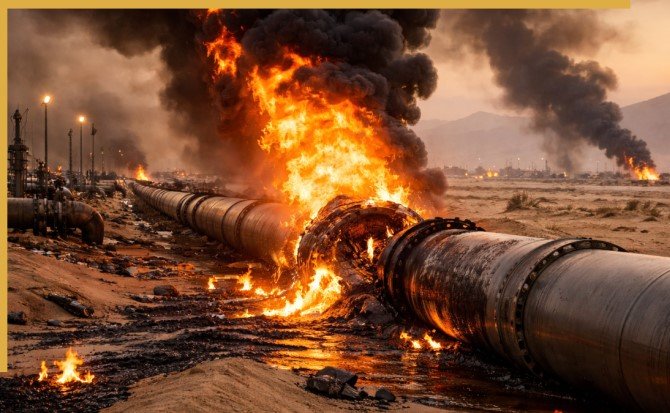
Photorealistic editorial news photograph of Saudi Arabia’s vast oil infrastructure at sunset, a major crude oil pipeline running through the desert toward a distant refinery and Red Sea export terminal, subtle signs of emergency response and security activity in the distance, dramatic but realistic atmosphere, global energy crisis mood, documentary photography style, ultra-realistic, 16:9 widescreen, no readable text, no logos, no watermark.
The global oil market is facing another major supply threat after a Saudi oil pipeline attack forced the temporary shutdown of a critical route for exporting crude. The incident has created fresh concerns about Saudi Arabia oil supply at a time when the global energy market is already struggling with disruptions across the Middle East.
Saudi Arabia’s East-West pipeline is especially important because it provides an alternative route for moving crude toward the Red Sea when shipments through the Strait of Hormuz face restrictions.
The latest disruption therefore creates a dangerous question for global markets: What happens if Saudi Arabia loses another major route for getting oil to international buyers?
The answer could involve higher crude prices, tighter fuel supplies and another wave of inflation.
What Happened to Saudi Arabia’s Oil Pipeline?
Saudi Arabia shut its major East-West oil pipeline after it came under an aerial attack.
The pipeline normally carries roughly 4 million barrels of crude oil per day toward the Red Sea port of Yanbu. That route allows Saudi Arabia to move oil toward international markets without sending all of it through the Strait of Hormuz.
The shutdown has therefore become much more important than a single infrastructure incident.
Saudi Arabia is one of the world’s largest oil producers. Any prolonged disruption to its ability to transport crude can quickly affect expectations across global energy markets.
The timing makes the situation even more serious because oil prices were already above $100 per barrel.
Why the East-West Pipeline Matters
The East-West pipeline is strategically important because it was designed to reduce Saudi Arabia’s dependence on the Strait of Hormuz.
That matters because Hormuz remains one of the world’s most important energy chokepoints.
Before the current war, roughly 125 large vessels could pass through the Strait each day. Recent traffic has fallen dramatically as attacks and security concerns have discouraged shipping. Reuters reported only a small number of vessel movements through the waterway over the weekend.
This creates a difficult situation for Saudi Arabia.
If Hormuz is restricted and the East-West pipeline is also unavailable, the kingdom has fewer options for moving crude to global customers.
That is why the Saudi oil pipeline attack has attracted such strong attention from oil traders.
Saudi Arabia Oil Supply Faces a New Test
The biggest concern is not necessarily the initial shutdown.
The bigger issue is how long the pipeline remains offline.
Reuters reported that Saudi storage at Yanbu could support exports for only around five to seven days if the pipeline remains unavailable.
That does not mean Saudi Arabia will automatically lose all of that oil from the global market.
Saudi Arabia has other production and transportation options.
However, the incident demonstrates how quickly the country’s export system could come under pressure when several regional routes are disrupted simultaneously.
This is why concerns about Saudi Arabia oil supply have become a major factor in the latest oil-price rally.
Oil Prices Move Above $100 Again
Oil markets reacted quickly to the latest developments.
Brent crude moved above $100 per barrel, while prices climbed more than 3% on Monday following new attacks involving Saudi Arabia and the Strait of Hormuz. Reuters reported Brent around $107.82 during the latest trading session.
The price movement reflects more than one attack.
Traders are now pricing in the possibility that Middle Eastern supply disruptions could last much longer than initially expected.
That changes the market calculation.
Instead of asking whether a few days of disruption can be absorbed, traders are increasingly asking whether the world has enough spare supply and transportation capacity to withstand a prolonged crisis.
The Four Percent Global Supply Risk
One of the most concerning figures surrounding the incident is the potential impact on global oil supply.
Reuters reported that the pipeline outage could threaten as much as 4% of global oil supply if the disruption continues.
Four percent may sound relatively small compared with total global production.
It is not.
Oil markets are extremely sensitive to relatively small changes in available supply because production cannot immediately adjust when infrastructure is damaged or shipping routes become dangerous.
A sustained loss of several million barrels per day could therefore create a major price shock.
Saudi Arabia Is Already Producing Less Oil
The pipeline incident comes at a difficult moment for Saudi production.
Reuters reported that Saudi oil output had already fallen significantly, from about 10.9 million barrels per day in February to 6.2 million barrels per day in August.
That means the kingdom is entering the latest disruption with less production capacity being used than earlier in the year.
The combination of lower production, transportation problems and regional attacks makes the situation particularly sensitive.
Markets do not only care about how much oil Saudi Arabia produces.
They also care about how much oil can actually reach international customers.
Hormuz and Saudi Arabia Create a Dangerous Combination
The pipeline problem cannot be separated from the wider Strait of Hormuz crisis.
Hormuz normally handles a huge share of global energy transportation.
However, shipping activity through the strait has collapsed since the war began.
Reuters reported that traffic remains far below normal levels, with recent vessel movements only a fraction of the pre-war level.
The East-West pipeline was supposed to provide Saudi Arabia with an alternative route.
Now that alternative is temporarily unavailable.
This creates a dangerous situation in which two different transportation routes are under pressure at the same time.
The Red Sea Is Also Becoming More Important
The other major factor is the Red Sea.
Saudi Arabia’s East-West pipeline terminates at Yanbu on the Red Sea, making that region increasingly important to global energy transportation.
At the same time, Iran-aligned Houthi forces in Yemen have increased their pressure around the Red Sea and Bab el-Mandeb region.
Reuters has reported that Houthi advances have created another challenge for Gulf states and international shipping.
That means the global oil market is dealing with several interconnected risks:
- Strait of Hormuz disruption
- Saudi pipeline damage
- Red Sea security problems
- Houthi attacks
- Reduced tanker traffic
- Lower available Middle Eastern exports
Together, these risks are much more serious than any single disruption.
Why Global Fuel Prices Could Rise Further
Crude oil is only the beginning of the problem.
When crude prices rise, refineries and fuel distributors face higher costs.
Those costs can eventually reach consumers through higher prices for:
- Gasoline
- Diesel
- Jet fuel
- Shipping
- Transportation
- Plastics
- Industrial products
- Food distribution
The effect can therefore spread far beyond the oil industry.
For countries that import most of their energy, the impact can be particularly painful.
Higher fuel costs can also increase inflation at a time when central banks are trying to control price growth.
The Inflation Problem Is Back
The oil shock could create a difficult situation for central banks.
Higher oil prices increase transportation and production costs.
Those costs can push consumer prices higher.
At the same time, expensive energy can weaken economic growth because households and businesses have less money available for other spending.
That creates a combination economists often fear:
higher inflation + weaker growth.
The latest oil shock is already affecting financial markets.
Reuters reported that energy prices and geopolitical uncertainty have contributed to higher bond yields and increased concerns about the economic outlook.
What Happens If the Pipeline Reopens Quickly?
A rapid reopening would reduce some of the immediate pressure.
Saudi Arabia could restore the transportation route and begin rebuilding stocks at Yanbu.
Oil prices could then give back some of their recent gains.
However, the broader risk would remain.
Hormuz traffic is still severely restricted, regional attacks continue and the Red Sea remains vulnerable.
Therefore, reopening the East-West pipeline would solve one problem without necessarily solving the larger energy crisis.
What If the Pipeline Stays Closed?
A prolonged shutdown would be much more serious.
Saudi Arabia could face increasing pressure on its export inventories.
If the country cannot move enough crude toward the Red Sea, it could eventually have to reduce production because storage capacity and transportation options are limited.
That could remove additional barrels from the international market.
The result could be another sharp increase in crude prices.
This is the scenario that oil traders are watching most closely.
Could Oil Reach $120 or Higher?
It is too early to say where oil prices will go.
However, the possibility of another major price increase cannot be ignored if several supply routes remain disrupted.
Brent has already climbed above $100.
If Saudi exports fall further while Hormuz remains restricted, traders could push prices significantly higher.
A move toward $120 would become more plausible if the market loses several million barrels per day for an extended period.
But prices would also depend on demand, emergency stock releases, alternative producers and diplomatic developments.
The United States Faces a Difficult Choice
Washington also has a major interest in the situation.
The United States wants to prevent a global energy shock while maintaining pressure on Iran.
At the same time, Washington must consider the security of Saudi Arabia and other Gulf partners.
The Saudi pipeline attack therefore creates another strategic problem for the Trump administration.
Trump has blamed Iran for the attack, although the situation remains politically and militarily complicated.
The United States must now balance military deterrence with the risk that a wider regional conflict could send oil prices even higher.
Saudi Arabia’s Strategic Importance
Saudi Arabia remains one of the most important countries in the global energy system.
Its importance comes from both its production capacity and its ability to influence the amount of oil available to international markets.
That is why attacks on Saudi energy infrastructure have historically caused immediate reactions in financial markets.
The latest Saudi oil pipeline attack demonstrates another vulnerability.
Even when crude remains underground and production facilities remain intact, transportation infrastructure can become a major bottleneck.
Oil only has economic value to producers when it can reach buyers.
The World Has Less Room for Another Oil Shock
The global economy is entering this crisis with limited room for additional energy inflation.
Consumers are already dealing with high living costs.
Businesses face higher transportation and financing expenses.
Airlines, shipping companies and manufacturers are particularly sensitive to fuel prices.
A prolonged disruption to Saudi Arabia oil supply could therefore affect economic activity around the world.
The longer the disruption lasts, the greater the chance that temporary energy inflation becomes a broader economic problem.
Could Other Oil Producers Fill the Gap?
Other producers may increase output, but replacing Saudi barrels quickly is difficult.
The global oil market does have some spare capacity.
However, production cannot always increase immediately because of infrastructure, technical and logistical constraints.
More importantly, additional production does not automatically solve transportation problems.
If the main challenge is getting oil safely from the Middle East to international buyers, producing more crude somewhere else may be only part of the solution.
The Bigger Lesson From the Attack
The latest incident shows how dependent the world remains on a small number of energy routes.
The Strait of Hormuz is one.
The East-West Saudi pipeline is another.
Bab el-Mandeb is another.
When several of these routes face problems at the same time, the global energy system becomes much more fragile.
That is the real significance of the latest crisis.
The world is not simply facing an oil shortage.
It is facing a transportation and security problem involving the infrastructure that moves oil around the planet.
What Investors Should Watch Next
Investors will be watching several developments closely over the coming days.
First, they will want to know when Saudi Arabia can restart the East-West pipeline.
Second, they will watch Saudi export inventories at Yanbu.
Third, traders will monitor vessel traffic through Hormuz.
Fourth, they will follow developments around Bab el-Mandeb and the Red Sea.
Finally, markets will watch for any diplomatic agreement involving Iran and Gulf countries.
Reuters reported that diplomatic efforts concerning a proposed arrangement for shipping through Hormuz have faced delays, adding another layer of uncertainty to the energy market.
The Global Energy Shock Could Get Worse
The Saudi oil pipeline attack has arrived at one of the worst possible moments for the global energy market.
Hormuz remains severely disrupted.
Red Sea security is deteriorating.
Oil prices have already moved above $100.
And Saudi Arabia’s alternative export route has now been temporarily knocked offline.
If the pipeline returns to operation quickly, the immediate pressure could ease.
But if the disruption lasts for days or weeks while other regional routes remain under threat, the consequences could become much larger.
The key issue is therefore not simply the attack itself.
It is how long the disruption lasts and whether additional energy infrastructure is targeted.
Conclusion
The latest Saudi oil pipeline attack has turned a regional security crisis into an even bigger global energy concern.
Saudi Arabia’s East-West pipeline is a critical alternative route that helps the kingdom transport crude toward the Red Sea without depending entirely on the Strait of Hormuz.
Its shutdown has raised concerns about Saudi Arabia oil supply and the amount of crude available to international markets.
The potential loss of up to 4% of global oil supply would be significant if the disruption continues.
For consumers, the biggest concern is higher fuel prices.
For businesses, it is rising transportation and production costs.
For governments, it is the possibility of another inflationary shock.
And for oil traders, the central question is becoming increasingly clear:
Can Saudi Arabia restore its critical export route before the global oil market runs out of room?
For now, the answer remains uncertain.
And that uncertainty is exactly what is keeping oil prices elevated.
Frequently Asked Questions
What happened in the Saudi oil pipeline attack?
Saudi Arabia shut its East-West oil pipeline after an aerial attack damaged or threatened the critical transportation route. The pipeline normally carries around 4 million barrels of crude per day toward the Red Sea.
Why is the Saudi East-West pipeline important?
The pipeline provides Saudi Arabia with an alternative route for transporting oil toward the Red Sea without relying entirely on the Strait of Hormuz.
How could the attack affect global oil prices?
If the pipeline remains offline for an extended period, Saudi export capacity could fall, potentially tightening global crude supplies and pushing oil prices higher.
How much global oil supply could be affected?
Reuters reported that the outage could threaten up to 4% of global oil supply if the disruption continues.
How long can Saudi Arabia continue exporting without the pipeline?
Reuters reported that Saudi storage at Yanbu could support exports for roughly five to seven days if the pipeline remains offline.
Why is Saudi Arabia important to the global oil market?
Saudi Arabia is one of the world’s largest oil producers and has historically played a major role in balancing global crude supply.
Could this push oil above $100?
Oil has already moved above $100 per barrel amid the broader Middle East supply crisis. A prolonged Saudi pipeline disruption could create additional upward pressure.
Could the Saudi oil pipeline restart soon?
That depends on the extent of the damage and the security situation. A quick restart would reduce immediate supply concerns, while a prolonged shutdown could create significantly greater market pressure.