The debate over Chinese cars in US showrooms is heating up after Hyundai Motor CEO José Muñoz warned that America could face a rapid influx of Chinese vehicles if trade protections and market-access restrictions are weakened. His warning comes as Chinese automakers continue expanding across Europe, where lower-priced vehicles are putting pressure on established car companies.
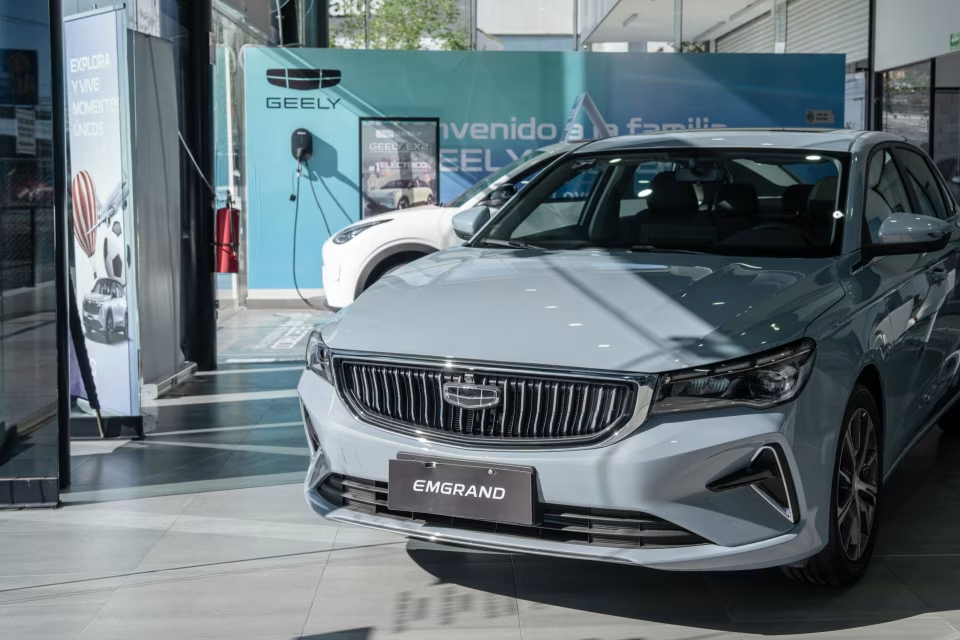
Chinese brands such as BYD, Geely and Chery have become increasingly visible in international markets. They have built their reputation around competitive pricing, electric vehicles, batteries and rapidly developing automotive technology.
The United States remains a different story.
Chinese-brand passenger vehicles are currently largely blocked from direct entry into the U.S. market by tariffs and federal connected-vehicle restrictions. But Hyundai’s warning highlights a bigger question: What happens if those barriers change?
Hyundai Warns the U.S. Could See a Chinese Car Surge
Hyundai CEO José Muñoz said on September 18 that the U.S. could experience a wave of Chinese vehicle imports similar to the disruption already seen in Europe if Washington does not maintain protective measures.
According to Reuters, Muñoz said Chinese vehicles are selling for around 30% to 40% less than comparable vehicles in some European markets, including Italy, Spain and France.
That price gap is important.
American automakers already face pressure to produce affordable electric and hybrid vehicles while dealing with high manufacturing costs and changing consumer demand.
If Chinese manufacturers eventually gain broader access to the American market, price competition could become another major challenge.
Chinese Cars Are Not Flooding U.S. Dealerships Yet
The headline about Chinese cars in US markets needs some context.
Chinese brand passenger vehicles are not currently available for normal retail sale across the United States. High tariffs and federal rules concerning connected-vehicle technology have made direct entry extremely difficult.
The United States imposed a 100% tariff on Chinese electric vehicles in 2024, in addition to other vehicle-related duties. A federal connected-vehicle security rule also restricts certain hardware and software linked to Chinese and Russian entities.
So American consumers generally cannot walk into a U.S. dealership today and purchase a BYD or Chery passenger vehicle.
That could change only if the regulatory and trade environment changes.
Why Europe Is Being Watched Closely
Europe provides an important example of what Chinese automakers can do when they have greater market access.
Chinese brands have expanded rapidly across European countries by combining competitive pricing with electric vehicles and increasingly sophisticated technology.
Muñoz pointed to the United Kingdom as an example of what can happen when Chinese manufacturers face fewer trade barriers. Reuters reported that Chinese brands now account for more than 9% of the European Union market and around 15% of the UK market.
The European experience is being closely watched by American automakers.
If Chinese manufacturers can build substantial market share in Europe, industry executives are asking whether similar strategies could eventually be used in the United States.
The Biggest Weapon May Be Price
The most important factor may not simply be the Chinese badge on a vehicle.
It could be the price.
Chinese automakers have developed large-scale supply chains for batteries, electric motors, electronics and other components.
Those supply chains can help manufacturers produce electric vehicles at competitive costs.
For consumers, lower prices can be attractive.
For established manufacturers, however, matching those prices without sacrificing profitability can be difficult.
That is one reason the US auto market China debate has become increasingly important.
China Has Built a Powerful EV Ecosystem
China’s automotive industry has developed an extensive electric-vehicle ecosystem.
The country has major battery manufacturers, component suppliers and EV producers operating at enormous scale.
Chinese automakers have also been able to experiment rapidly with vehicle software, battery technology and digital features.
The result is a group of companies that increasingly compete internationally rather than focusing only on China’s domestic market.
Companies such as BYD have expanded aggressively into overseas markets.
XPeng is taking another route by offering technology to foreign automakers. Reuters reported this week that XPeng plans to license technologies including electronic architecture, cockpit systems, AI chips and driver-assistance software to international manufacturers.
That shows the competition is no longer limited to selling finished cars.
Chinese automotive technology itself is becoming an export product.
The U.S. Is Already Taking Precautions
American policymakers have already taken significant steps to limit potential Chinese vehicle penetration.
The connected-vehicle rules introduced by the U.S. government restrict certain Chinese-linked hardware and software in connected vehicles.
Tariffs provide another barrier.
These measures have helped keep Chinese-brand passenger vehicles largely out of American showrooms.
The issue has also moved into Congress.
In July, the U.S. Senate Commerce Committee approved legislation aimed at strengthening restrictions on Chinese automakers entering the American market. Reuters reported that the proposed legislation still required changes before becoming law.
Major automotive industry groups have also urged Congress to establish stronger legal restrictions.
Automakers Are Asking Congress for More Protection
The Alliance for Automotive Innovation, which represents major automakers including Hyundai, General Motors, Ford, Toyota, Volkswagen and Honda, urged Congress earlier this month to pass legislation restricting Chinese vehicles and related technology.
The group argued that Chinese automakers are expanding globally with heavily supported vehicles and connected technology.
This is an important part of the story because the concern is not coming from Hyundai alone.
Major automotive companies are watching the same international developments.
At the same time, the companies have different strategies for dealing with China’s rise.
Some are focusing on local production and supply chains. Others are developing partnerships or purchasing technology.
Trump Has Left Open Another Possibility
The U.S. policy debate became even more complicated earlier this month when President Donald Trump said he would be open to Chinese automakers building vehicles inside the United States if they employed American workers.
Trump said he would not favor Chinese vehicles being manufactured in Mexico and then shipped into the United States.
At the same time, he rejected reports that his administration was preparing to simply allow Chinese vehicles into the U.S. market.
That creates a potential distinction between Chinese-made cars entering America and Chinese companies manufacturing cars inside America.
The two scenarios could have very different economic consequences.
Could Chinese Automakers Build Cars in America?
If Chinese automakers eventually establish U.S. manufacturing operations, they could potentially avoid some of the problems associated with direct vehicle imports.
Local factories could create American jobs while allowing Chinese companies to operate closer to U.S. customers.
However, questions would remain about ownership, technology, batteries, software, supply chains and national-security concerns.
The connected nature of modern vehicles makes these issues more complicated than they were decades ago.
A modern car can contain cameras, sensors, communications systems, navigation technology and software capable of collecting and transmitting large amounts of information.
That is one reason the U.S. debate is not purely about tariffs.
Why Hyundai Is Particularly Concerned
Hyundai has a large presence in the American market and is investing heavily in its U.S. operations.
The company is also adjusting its product strategy as American consumers balance gasoline vehicles, hybrids and EVs.
Hyundai has been expanding its hybrid offerings while adapting to weaker-than-expected U.S. EV demand.
That makes the arrival of a low-cost Chinese competitor potentially significant.
If Chinese companies eventually enter the U.S. market with competitively priced hybrids or EVs, Hyundai and other established manufacturers would have to respond through pricing, technology, product development or manufacturing efficiency.
The Chinese Threat Is Bigger Than EVs
The US auto market China debate often focuses on electric vehicles.
But the potential competition could eventually extend beyond EVs.
Chinese manufacturers are developing hybrids, plug-in hybrids, gasoline vehicles, autonomous-driving technology and automotive software.
That gives them more ways to compete if market-access restrictions change.
The technology side could be just as important as the vehicle itself.
Chinese companies are increasingly developing advanced driver-assistance systems, digital cockpits, battery-management systems and vehicle operating platforms.
What Consumers Could Gain From More Competition
If Chinese automakers eventually receive greater access to the U.S. market, consumers could potentially see more vehicle choices and greater price competition.
That is a straightforward market effect of adding new manufacturers.
However, the policy debate involves additional considerations, including domestic manufacturing, employment, supply-chain security, data security and the strategic importance of the automotive industry.
Those competing factors explain why access to the U.S. market remains politically and economically sensitive.
Could Canada Become a Gateway?
Canada’s trade relationship with China is also being watched.
Earlier this year, Canada agreed to reduce tariffs on Chinese electric vehicles substantially from previous levels, creating another North American market with greater Chinese EV access.
That has raised questions about whether Chinese manufacturers could eventually establish North American production or supply chains.
Rules governing regional content and trade would determine whether vehicles produced in Canada could qualify for favorable treatment when entering the United States.
For now, those possibilities remain part of a broader policy debate rather than an established route into the American passenger-car market.
The Bigger Battle Is About the Future of Cars
The debate over Chinese cars in US markets is ultimately about more than where cars are manufactured.
It is about who controls the technologies behind the next generation of vehicles.
Batteries, software, artificial intelligence, autonomous driving, electric motors and connected-car systems are becoming increasingly important.
China has developed significant capabilities in several of these areas.
The United States, meanwhile, remains home to major automakers, technology companies and a large automotive consumer market.
The competition between these ecosystems could shape the global automobile industry for years.
What Happens Next?
The immediate question is whether the United States maintains its current restrictions or changes them.
If restrictions remain strong, Chinese-brand vehicles are likely to remain largely outside the American retail market.
If Washington allows greater access, Chinese automakers could have an opportunity to test whether their cost and technology advantages translate into American consumer demand.
A third possibility is Chinese companies building vehicles in the United States while complying with American manufacturing and technology requirements.
Each path would create a different competitive environment.
Final Thoughts
The warning from Hyundai’s CEO does not mean Chinese cars are already flooding American dealerships.
They are not.
Instead, the Chinese cars in US debate is about what could happen if trade barriers and market-access restrictions change.
China’s automotive industry has demonstrated its ability to compete aggressively in international markets, particularly with affordable electric vehicles. European sales have given Chinese manufacturers experience in competing against established global brands.
For the US auto market China debate, the next stage could depend on tariffs, connected-vehicle rules, potential legislation and whether Chinese companies pursue local U.S. manufacturing.
For American automakers, the issue is therefore not simply about today’s market.
It is about preparing for a possible future in which Chinese automotive technology and manufacturing have a much larger presence in North America.