A new kidney cancer radiation trial 2026 is raising hopes for patients facing one of the most challenging forms of kidney cancer. Researchers at UT Southwestern Medical Center tested a treatment strategy that delivers highly focused radiation before surgery when kidney cancer grows into a major vein near the heart.
The approach uses stereotactic radiotherapy before surgery to target cancerous tissue extending into the inferior vena cava, the body’s largest vein. Surgeons then remove the affected kidney and extract the tumour growth inside the vein.
The phase 2 clinical trial, published in JAMA Oncology on October 15, 2026, found that doctors could combine the radiation treatment with surgery and reported encouraging early results for recurrence-free survival. However, the study involved a small group of patients and lacked a randomised comparison with surgery alone. Larger studies must establish whether this strategy improves long-term outcomes.
What Did the Kidney Cancer Radiation Trial Discover?
The study investigated whether targeted radiation could help treat renal cell carcinoma that grows into the inferior vena cava.
This condition creates what doctors call an inferior vena cava tumour thrombus. Unlike an ordinary blood clot, this growth consists of cancerous tissue extending into the vein.
Removing the kidney and the tumour inside the vein can require extensive surgery. The procedure carries significant risks, and some patients experience cancer recurrence even after surgeons remove the visible disease.
The research team explored whether radiation could target the tumour tissue inside the vein before the operation.
Of the 23 patients who received preoperative radiation, 22 subsequently completed surgery. Researchers included 21 patients in the main recurrence-free survival analysis.
At one year, the recurrence-free survival rate reached 71.4%. The researchers compared this figure with a historical benchmark of 55.7% for surgery alone.
The result met the trial’s predefined phase 2 screening criterion. However, researchers did not randomly assign patients to radiation-plus-surgery or surgery alone. The comparison therefore offers an encouraging signal rather than definitive proof that radiation prevents more recurrences.
Why Is Kidney Cancer That Reaches a Major Vein So Difficult to Treat?
Kidney cancer sometimes spreads beyond the kidney and grows into nearby blood vessels. When a tumour enters the inferior vena cava, treatment becomes more complicated.
The inferior vena cava carries blood from the lower body back to the heart. Surgeons must remove the cancer while protecting surrounding structures and managing blood flow through this major vessel.
The difficulty depends on how far the tumour extends into the vein. Some patients need more extensive vascular surgery than others.
Even when surgeons successfully remove the visible cancer, the disease can return. This risk makes treatment strategies that might improve cancer control particularly important.
The new trial focuses on this high-risk group, not everyone diagnosed with kidney cancer.
That distinction matters. The findings do not suggest that every kidney tumour needs radiation before surgery or that doctors should routinely use this approach for early-stage disease.
How Does Stereotactic Radiotherapy Before Surgery Work?
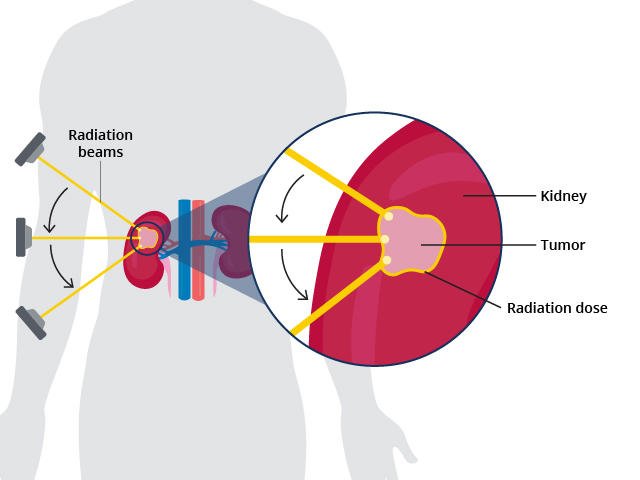
Stereotactic ablative radiotherapy, also known as SABR, delivers highly focused doses of radiation to a defined target.
Specialised equipment and detailed imaging help clinicians direct radiation towards the intended tissue while limiting exposure to nearby healthy structures. Doctors generally deliver treatment in a small number of sessions.
In the UT Southwestern trial, doctors targeted the tumour growth inside the inferior vena cava before removing the kidney and the tumour tissue within the vein.
Patients received one of two radiation schedules: 40 gray in five fractions or 36 gray in three fractions. A gray measures the amount of radiation absorbed by tissue.
The radiation did not replace the operation. Instead, researchers added it before surgery to investigate whether it could improve treatment for this particularly high-risk form of kidney cancer.
The team also examined biological markers to understand how tumours responded to radiation. These analyses included Ki-67, a marker associated with cell proliferation, and tumour-informed circulating tumour DNA, which can help researchers detect genetic material that cancer cells release into the bloodstream.
These laboratory findings may help researchers study treatment response. However, they have not yet established which patients will benefit most.
What Were the Trial’s Main Results?
The study reported several findings that support further research.
1. One-year recurrence-free survival reached 71.4%.
Among the 21 patients in the primary analysis, an estimated 71.4% remained alive without a recorded recurrence at one year. This result exceeded the historical surgery-alone benchmark of 55.7% and met the trial’s predefined screening criterion.
However, the study did not randomly compare the two treatment strategies. Researchers must therefore treat the result as an encouraging signal, not definitive proof that adding radiation improves recurrence-free survival.
2. Most patients proceeded to surgery.
Of the 23 patients who received preoperative radiation, 22 completed the planned operation. This finding supports the feasibility of combining the two treatments in carefully selected patients.
3. No deaths occurred within 90 days of surgery.
Researchers reported no perioperative deaths within 90 days. This observation provides useful early safety information, although the small sample cannot rule out uncommon but serious complications.
4. Researchers reported no severe toxic effects attributed specifically to radiation.
The study reported no radiation-attributed grade 4 or grade 5 toxic effects. However, the team reported four grade 4 treatment-attributed events overall. The findings therefore do not show that the entire treatment pathway carries no risk of serious complications.
Together, these results suggest that doctors can investigate preoperative radiation as part of a treatment plan for selected patients with difficult kidney cancer. Larger studies must establish its advantages and risks compared with existing approaches.
Could Radiation Make Kidney Cancer Surgery Less Invasive?
Researchers hope that treating tumour tissue before an operation might eventually reduce surgical complexity for some patients.
Radiation can change a tumour’s biological activity. The research team is investigating whether these changes could help surgeons manage the disease more effectively.
However, the current trial does not show that patients can routinely undergo smaller operations or avoid complex surgery altogether. Participants still underwent planned kidney removal and surgery to extract tumour tissue from the inferior vena cava.
The possibility of less invasive surgery remains a question for future research, not an established outcome of this study.
Researchers need additional evidence to identify patients who might safely benefit from a modified operation and to determine whether that approach maintains effective cancer control over time.
Until then, specialists must individualise decisions about surgery and radiation according to the tumour’s extent, the patient’s overall health and the recommendations of the cancer treatment team.
How Is This Different From Radiation Used to Treat Kidney Tumours Directly?
Researchers also study radiation as a direct treatment for kidney tumours, particularly in people who cannot safely undergo surgery.
One example is the FASTRACK II trial, which evaluated stereotactic ablative radiotherapy for primary kidney cancer in patients who faced high surgical risks, could not undergo surgery or declined an operation.
That research addresses a different clinical question from the UT Southwestern study.
FASTRACK II investigated radiation as a non-surgical treatment for selected primary kidney tumours. The 2026 UT Southwestern trial investigated radiation before surgery specifically for cancer extending into the inferior vena cava.
This distinction matters because evidence from one patient group cannot automatically apply to another.
Doctors must consider the cancer’s location and extent, the treatment goal and the available clinical evidence. Depending on the situation, radiation may serve as an alternative to surgery, a treatment before surgery or a way to manage disease that has spread.
What Happens Next for This Treatment?
Researchers must now confirm whether these promising findings hold up in larger patient groups and more rigorous comparisons.
Future studies need to establish whether preoperative radiation improves recurrence-free survival compared with current treatment. They must also examine complication rates and identify the patients most likely to benefit.
Long-term follow-up will play an essential role. A one-year result offers useful early information, but kidney cancer can return later. Researchers must continue monitoring patients to understand the treatment’s longer-term effects.
Additional studies may also clarify how tumours respond biologically to radiation and whether blood-based markers can help predict outcomes.
Until stronger evidence becomes available, doctors should regard this strategy as an investigational approach for a highly specific and complex form of kidney cancer.
Patients considering treatment should discuss their circumstances with a multidisciplinary cancer team, including urologic surgeons and radiation oncologists. A news report or early trial result cannot determine the best treatment for an individual patient.
Conclusion: A Promising Step, but More Evidence Is Needed
The kidney cancer radiation trial 2026 offers encouraging evidence that doctors can deliver highly targeted radiation before surgery for selected patients whose cancer has grown into the inferior vena cava.
The study reported a one-year recurrence-free survival rate of 71.4% among the 21 patients in its main analysis. The result met a predefined phase 2 screening criterion, but the small, non-randomised study cannot prove that radiation before surgery works better than surgery alone.
Nevertheless, the research gives scientists a foundation for investigating how radiation might improve the treatment of difficult kidney cancer.
For now, stereotactic radiotherapy before surgery remains a strategy that requires further evaluation. Larger studies must determine whether it reduces recurrence, improves safety or allows less extensive operations.