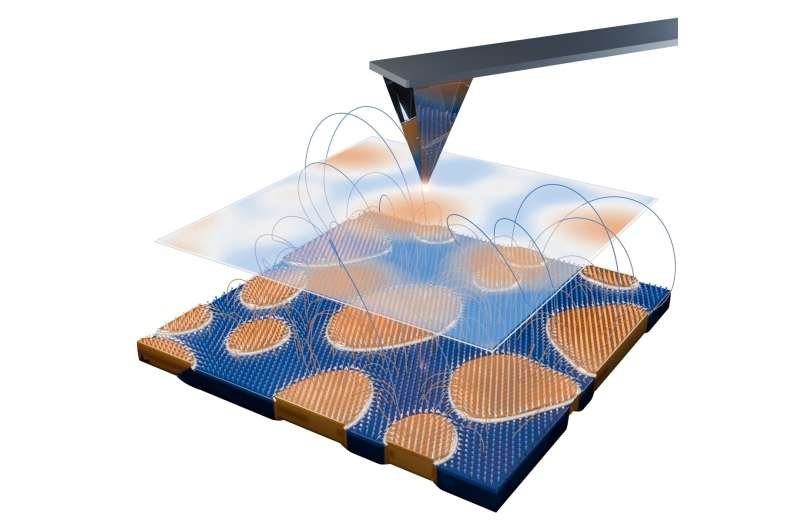
A new magnetic imaging breakthrough 2026 could help scientists understand how magnetic patterns form inside some of the world’s thinnest materials. Researchers led by the University of Vienna have developed a physics-guided machine-learning method that reconstructs hidden magnetic structures using measurements of the magnetic field outside a material.
The research addresses a longstanding challenge in materials science. Even advanced microscopes cannot always reveal the exact arrangement of magnetism inside an ultrathin material because they measure the magnetic field around it rather than directly observing every internal magnetic direction.
By combining the laws of magnetism with machine learning, the researchers developed a method that identifies physically realistic magnetic patterns from these external measurements. The approach also estimates the distance between the sensor and the sample, helping reduce a major source of measurement uncertainty.
The findings, published in Physical Review Letters and announced by the University of Vienna in October 2026, could support research into next-generation data storage, magnetic materials and energy-efficient electronics.
What Is the Magnetic Imaging Breakthrough of 2026?
The magnetic imaging breakthrough 2026 focuses on a problem known as magnetic reconstruction.
Magnetic microscopes can measure tiny fields produced by magnetic materials. However, translating those measurements into an accurate picture of the material’s internal magnetization is not straightforward.
Different internal magnetic arrangements can produce very similar magnetic fields outside a sample. As a result, researchers may struggle to determine which hidden configuration actually exists.
The Vienna-led team addressed this problem by combining machine-learning techniques with fundamental physical laws. Instead of allowing an algorithm to choose any pattern that resembles the measurements, the method evaluates which possible magnetic configuration is consistent with the observations and has a physically realistic energy.
This additional constraint helps eliminate solutions that might fit the measured field mathematically but would not represent a realistic magnetic state.
The result is a more reliable reconstruction of the underlying magnetic structure, rather than simply a clearer image of the field surrounding the sample.
How Does Quantum Diamond Sensor Technology Work?
Quantum diamond sensor technology uses special atomic defects inside diamond to detect extremely small magnetic fields.
One important example is the nitrogen-vacancy, or NV, centre. This defect forms when a nitrogen atom occupies a position next to a missing carbon atom in the diamond’s crystal structure.
The defect has quantum properties that respond to magnetic fields. Scientists can use carefully controlled light and microwave signals to measure those changes and calculate information about the magnetic environment.
In a quantum diamond microscope, the sensor detects the magnetic field near a sample. Researchers can then create a map showing how that field varies across the material.
These measurements are valuable because magnetic behaviour can reveal information about a material’s electronic properties, internal structure and interactions between its constituent particles.
However, the sensor does not automatically reveal every magnetic direction inside the sample. Scientists must reconstruct that information from the measured field.
That is where the new physics-guided method becomes important: it helps translate the sensor’s measurements into a more realistic picture of the magnetism beneath the surface.
How Did Scientists Test the New Method?
The research team tested its approach using measurements from an ultrathin magnetic material identified as Fe₃₋ₓGaTe₂.
The material was synthesised at the National University of Singapore, while the relevant measurements came from work at the Max Planck Institute for Chemical Physics of Solids in Dresden.
For the experiments, researchers used a diamond-based quantum sensor containing nitrogen-vacancy centres to measure the magnetic field above the material.
The sensor sat only tens of nanometres above the magnetic layer. At such small distances, even a modest error in the sensor’s height can affect the interpretation of the measured magnetic field.
The researchers therefore designed their reconstruction method to estimate two things together: the hidden magnetic configuration and the distance between the sensor and the sample.
The method identified a sensor-to-sample distance of approximately 81 nanometres in the demonstrated experiment.
That result matters because the sensor’s position affects how the measured magnetic field weakens with distance. Estimating the height directly from the magnetic data can reduce uncertainty when reconstructing the underlying pattern.
The experiment demonstrates how combining physical principles with data analysis can improve the interpretation of measurements from existing quantum-sensing equipment.
Why Is Mapping Hidden Magnetism So Difficult?
Magnetic materials do not always behave like tiny bar magnets pointing in one direction.
Their internal magnetization can form complex arrangements known as magnetic domains. Within these regions, magnetic moments tend to align in particular directions, while the boundaries between domains can contain intricate transitions.
In extremely thin materials, these structures may influence how electrons move and how the material responds to external conditions.
The difficulty is that magnetic fields spread beyond their sources. As a field travels away from a material, some details of the underlying structure become harder to distinguish.
Consequently, several different internal configurations may produce similar measurements at the sensor’s location.
This creates an inverse problem: scientists know the field they measured but must work backwards to determine the structure that produced it.
The new method uses physical constraints to narrow the possibilities. Instead of treating every mathematically possible answer equally, it favours configurations that match the observations while respecting the material’s magnetic energy.
That does not eliminate every limitation of magnetic imaging, but it offers a more disciplined way to reconstruct complex patterns.
Could This Improve Future Computers and Data Storage?
One potential application is the development of smaller and more energy-efficient electronic technologies.
Magnetic materials are important in data storage, magnetic memory and several emerging electronic systems. As engineers explore materials only a few atomic layers thick, understanding their magnetic behaviour becomes increasingly important.
Researchers need to know how magnetic domains form, how their boundaries behave and how those patterns change under different conditions.
Improved magnetic reconstruction could help scientists compare experimental results with theoretical predictions and identify promising materials for further investigation.
For example, a more accurate map could help researchers understand why a particular ultrathin magnet forms a specific domain arrangement or how changes in its structure influence its magnetic properties.
However, the new method is a research tool, not a finished computer technology. The October 2026 announcement does not establish that it will immediately produce faster computers, lower electricity bills or commercial storage devices.
Its potential value lies in giving materials scientists a more reliable way to study the magnetic behaviour that future technologies may depend on.
Could the Method Be Used Beyond Diamond Sensors?
The researchers say the approach is not limited to quantum diamond sensors.
Its central principle is to combine measured magnetic fields with the physical laws governing magnetic materials. That principle could potentially be adapted to other magnetic imaging techniques that face similar reconstruction challenges.
The team also made its reconstruction software openly available, allowing other research groups to examine the method and explore whether it works for their own experiments.
Open-source scientific tools can be particularly valuable because independent researchers can test the approach on different materials, compare its performance and identify situations in which it needs improvement.
The team is also preparing to extend the framework to three-dimensional X-ray imaging of complex magnetic nanostructures.
Such work could test whether the same physics-guided strategy can help reconstruct more complicated structures beyond the two-dimensional magnetic system demonstrated in the initial study.
Future experiments will determine how broadly the method can be applied and how reliably it performs under different measurement conditions.
What Are the Limitations of the Discovery?
Although the findings represent a promising advance, several questions remain.
First, the method must be tested on additional materials and experimental datasets to establish how consistently it reconstructs magnetic structures.
Second, reconstruction depends on the quality of the measurements and the accuracy of the physical model used by the algorithm. No computational technique can recover every missing detail if the available data do not contain enough information.
Third, researchers must evaluate how well the approach performs when magnetic structures become more complex or when experimental noise affects the measurements.
The estimated sensor height of 81 nanometres is a result from the reported experiment, not a universal measurement that applies to every quantum diamond microscope.
Further research will help establish the method’s practical limits and identify which types of magnetic materials benefit most from it.
These distinctions are important because a successful laboratory demonstration does not automatically guarantee an immediate industrial application.
Conclusion: A Clearer Picture of the Magnetic World
The magnetic imaging breakthrough 2026 offers scientists a new way to reconstruct hidden magnetic structures from measurements collected outside a material.
By combining machine learning with the fundamental laws of magnetism, the University of Vienna-led team demonstrated a method that can recover a realistic magnetic pattern while estimating the sensor’s distance from the sample.
The research also highlights the growing importance of quantum diamond sensor technology, which allows scientists to measure very small magnetic fields using atomic defects inside diamond.
Although practical applications in electronics and data storage remain a longer-term possibility, more reliable magnetic maps could help researchers understand the materials needed for future technologies.
The next challenge is to test the approach across more materials, imaging systems and complex magnetic structures. If those tests succeed, physics-guided reconstruction could become a valuable addition to the scientific tools used to explore the hidden magnetic world.
Follow TopTenDose for more science discoveries, technology breakthroughs, space news and research updates from around the world.