What if some of the earliest birds were never interested in becoming better flyers? A remarkable Jurassic bird tiny wings discovery in southeastern China is challenging scientists’ understanding of how birds evolved and whether flight was essential to their early success.
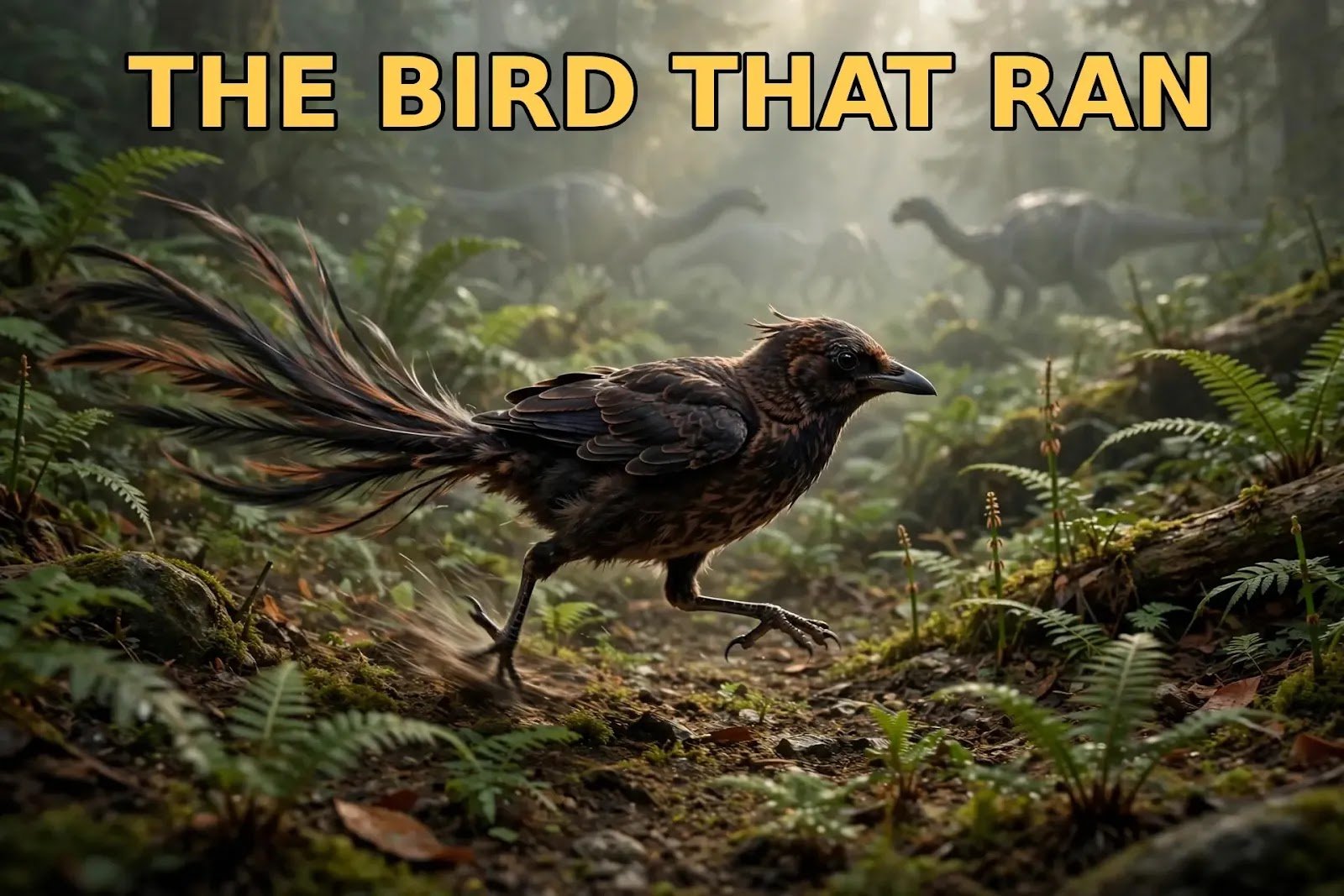
The newly identified species, Yuezhuornis yangyuanensis, lived approximately 150 million years ago during the Late Jurassic period. Unlike the image many people have of primitive birds spreading their wings and taking to the skies, this ancient animal appears to have been adapted for life on the ground.
Its fossil reveals unusually short forelimbs, long hind limbs, sharp teeth and a specialised toe claw resembling features found in predatory dinosaurs. Together, these characteristics suggest that the animal probably spent much of its time walking or running rather than flying.
The findings, published in the journal Nature on October 14, 2026, raise a fascinating question: did flightless birds emerge much earlier in evolutionary history than scientists previously recognised?
What Did Scientists Discover in China?
The Yuezhuornis yangyuanensis fossil was discovered in Zhenghe County, Fujian Province, in southeastern China. Researchers identified it as a previously unknown species of early bird after examining its preserved skeleton and comparing its anatomical features with those of other ancient birds and dinosaurs.
The animal lived during a period when early birds were beginning to diversify into different forms and ecological roles. Fossils from this stage of evolution remain relatively rare, making every well-preserved specimen valuable.
Scientists estimate that Yuezhuornis weighed around 800 grams, roughly comparable to a modern crow. Despite its modest size, it possessed a surprising combination of characteristics.
Its skull and pelvis displayed bird-like features, while its teeth, toe structure and limb proportions retained traits associated with other predatory dinosaurs.
Most strikingly, its forelimbs were unusually short compared with its hind limbs. The researchers concluded that this body structure was consistent with a terrestrial, flightless lifestyle.
The discovery matters because it provides evidence that early birds explored a wider range of lifestyles than researchers had previously understood.
Why Were Its Wings So Small?
In modern birds, wings support powered flight, although their shape and size vary considerably between species. The wings of an eagle, for example, serve a different purpose from those of a penguin or an ostrich.
In Yuezhuornis, the forelimbs were disproportionately short relative to the rest of the body. This suggests they were not suited to sustained, powered flight.
Researchers compared the animal’s limb proportions with those of 377 living bird species. Their analysis found similarities with ground-dwelling birds, including species that rely heavily on walking and running.
However, scientists cannot reconstruct every detail of the animal’s behaviour from its skeleton alone. The evidence supports a terrestrial lifestyle, but questions remain about exactly how it moved, hunted and interacted with its environment.
The discovery also challenges the assumption that every early bird evolved under strong pressure to become a more capable flyer.
Instead, different evolutionary paths may have favoured different combinations of movement, feeding strategies and habitat use.
Did This Ancient Bird Lose the Ability to Fly?
The question in the headline gets to the heart of the discovery, but the answer requires some care.
There are two broad possibilities. One is that Yuezhuornis descended from ancestors capable of flight and subsequently lost that ability. The other is that it belonged to an early branch of bird evolution that developed a terrestrial lifestyle without evolving effective powered flight in the first place.
The fossil alone cannot settle every aspect of this evolutionary history. Scientists use comparisons with related species and evolutionary family trees to investigate where the animal fits and how its physical characteristics developed.
The research places Yuezhuornis among early members of Avialae, the evolutionary group that includes modern birds and their extinct relatives. Its anatomy indicates that a flightless lifestyle existed very early in this group’s history.
If the species descended from flying ancestors, it would represent an early example of flightlessness evolving within bird evolution. If it followed a separate path, it would show that some early birds diversified into ground-based lifestyles without relying on flight.
Either possibility complicates the traditional picture of bird evolution as a straightforward progression towards increasingly sophisticated flying abilities.
Sharp Teeth and a Dangerous Claw Tell Another Story
The tiny wings are not the only unusual feature of Yuezhuornis. Its teeth and feet provide additional clues about its possible lifestyle.
Unlike modern birds, which generally lack teeth, this Jurassic species possessed closely spaced, serrated teeth. Such teeth could have helped it grip or cut animal prey, although the fossil does not establish its exact diet.
Its second toe is even more intriguing. The toe could extend backwards unusually far, and it carried a curved claw resembling the specialised claws found in some predatory dinosaurs.
Comparable features occur in groups such as dromaeosaurids, which include famous dinosaurs such as Velociraptor. However, this resemblance does not mean that Yuezhuornis was itself a Velociraptor or belonged to the same immediate dinosaur group.
Instead, the combination of traits suggests that the early evolution of birds involved a complex mixture of inherited characteristics and adaptations to different environments.
Scientists believe Yuezhuornis may have been a ground-dwelling animal that hunted small prey. Its teeth, long hind limbs and specialised toe are consistent with that interpretation, although its precise hunting behaviour remains uncertain.
How Does It Compare With Archaeopteryx?
Any discussion of early bird evolution inevitably brings up Archaeopteryx, the famous feathered animal from the Late Jurassic of Germany.
Archaeopteryx lived around the same broad period as Yuezhuornis and is widely recognised as one of the most important fossils in the study of the dinosaur-to-bird transition.
Its preserved feathers and wing anatomy provide evidence of early flight-related adaptations, although scientists continue to debate how effectively it could fly.
Yuezhuornis presents a very different picture. Rather than showing a body strongly adapted for aerial movement, it had short forelimbs and proportions associated with terrestrial animals.
The research places it on an early branch of bird evolution and suggests that it may be more closely related to modern birds than Archaeopteryx is.
This does not mean one species directly evolved from the other. They represent different branches in a much larger evolutionary history.
Their contrasting anatomies show that early birds were not all following the same path. Some possessed features associated with flight, while others appear to have occupied ecological roles on the ground.
What Does the Fossil Reveal About Bird Evolution?
For decades, scientists have investigated how the distinctive features of modern birds emerged from their dinosaur ancestors. Flight has played a central role in many explanations because it affects the shape and development of wings, muscles, bones and other parts of the body.
The new research suggests that this process was more complicated than a simple march towards improved flight.
Early birds could explore different ecological opportunities, including life on the ground. Natural selection favours traits that improve survival and reproduction in a particular environment, not necessarily traits that make an animal better at flying.
For a ground-dwelling animal, effective running, feeding and avoiding predators may have mattered more than developing larger wings.
The discovery also illustrates why fossils are so important. Researchers cannot observe these extinct animals directly, so they reconstruct their evolutionary relationships and lifestyles using preserved bones, anatomical comparisons and statistical analyses.
One fossil cannot explain the entire origin of modern birds. Nevertheless, a specimen with such an unusual combination of features can challenge assumptions and help scientists refine their understanding of the evolutionary process.
Why Is This Jurassic Bird Tiny Wings Discovery Important?
The significance of the Jurassic bird tiny wings discovery extends beyond a single unusual species.
First, it provides evidence that early birds occupied different ecological niches during the Jurassic period. Their evolutionary history included more variety than a simple progression from small feathered dinosaurs to increasingly powerful flyers.
Second, it highlights the complexity of evolutionary relationships. Features associated with birds and predatory dinosaurs can appear together in unexpected combinations, making it essential to examine entire skeletons rather than rely on one characteristic.
Third, the discovery demonstrates the value of continued fossil exploration in China. The Zhenghe region preserves evidence of ancient terrestrial ecosystems and offers opportunities to investigate a relatively poorly documented stage of bird evolution.
There is also an important limitation: the species is known from a single incomplete specimen. More fossils could reveal additional anatomical details, clarify its place in the evolutionary tree and help scientists determine how its lifestyle developed.
Future discoveries from the same region may provide evidence about other early birds and their relationships with nearby dinosaur groups.
Conclusion: Evolution Did Not Always Mean Better Flight
The Yuezhuornis yangyuanensis fossil challenges a familiar assumption about the earliest stages of bird evolution. With unusually short wings, long hind limbs, serrated teeth and a specialised claw, this Jurassic animal appears to have been adapted for life on the ground rather than sustained flight.
The Jurassic bird tiny wings discovery does not prove exactly when or how this species became flightless. Instead, it reveals that early bird evolution involved several possible paths, including lifestyles that placed little emphasis on flying.
That finding changes how researchers think about the diversity of birds during the Jurassic period. Flight was an important evolutionary development, but it was not necessarily the defining advantage for every early bird.
As scientists discover and study more fossils, the story of how birds evolved from their dinosaur ancestors will continue to become more complex and more fascinating.
Follow TopTenDose for the latest discoveries in paleontology, dinosaur science, evolution and the natural world.