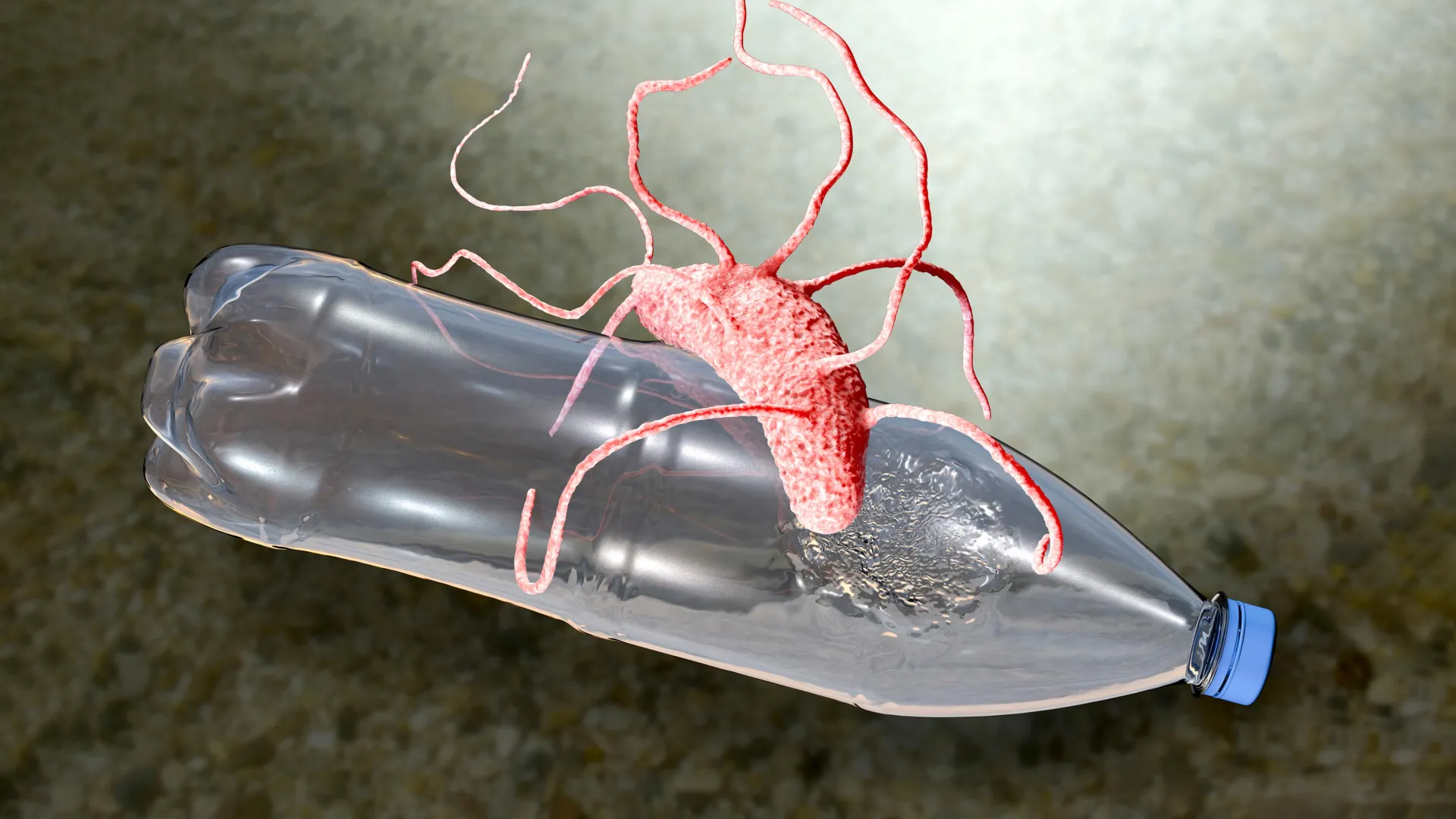
A plastic-eating enzyme 2026 discovery is giving scientists a new clue in the fight against one of the world’s most persistent environmental problems. Researchers at the University of Konstanz in Germany have identified an unusual bacterial enzyme nicknamed “Pac-Man” because of the wide opening in its active site, where chemical reactions occur. The enzyme can break down certain biodegradable polyester plastics and also split penicillin under laboratory conditions. However, the discovery comes with an important limitation: it does not make ordinary plastic disappear.
Published in The ISME Journal, the research explores how microorganisms can break down particular plastic materials and reveals a surprising connection between plastic degradation and antibiotic chemistry. The findings could help researchers design better biodegradable materials and develop future recycling methods. Yet the study does not demonstrate a ready-to-use technology that can clean oceans, landfills or streets of plastic waste.
What Is the “Pac-Man” Enzyme?
Enzymes are biological molecules that help chemical reactions happen. Different enzymes perform different tasks, from digesting food to helping cells build and repair essential structures.
The newly identified enzyme belongs to a group called esterases. These enzymes can break certain chemical bonds known as ester bonds, which occur in natural substances and some biodegradable plastics.
Researchers named it the Pac-Man enzyme because its active site has an unusually wide opening. This structure may help it interact with long polymer chains and break them into smaller chemical building blocks.
The enzyme also has an interesting position within the bacterial cell. Its biological instructions direct it outside the cell, while a lipid anchor keeps it attached to the cell membrane. This arrangement may allow bacteria to attack nearby plastic material without relying entirely on enzymes released freely into their surroundings.
That feature could help explain how some microorganisms interact directly with biodegradable plastic films.
How Scientists Discovered the Plastic-Eating Enzyme
The research team investigated how microbial communities break down a class of biodegradable materials known as long-chain aliphatic polyesters, or LCAP.
These materials contain chemical bonds that certain microorganisms can attack.
To investigate, the team buried small pieces of LCAP bioplastic film about 10 centimetres beneath the surface of forest soil at the University of Konstanz’s botanical garden. They also conducted controlled laboratory experiments using soil collected from the same environment.
The researchers monitored microbial activity and examined the genetic material of the organisms living in the soil. By comparing microbial communities exposed to different materials, they identified a gene that became especially abundant in soil containing LCAP.
Further analysis showed that this gene encoded the unusual esterase now known as the Pac-Man enzyme.
The team also examined the recovered plastic films using electron microscopy. They found tiny holes that resembled the size and shape of individual bacterial cells. The researchers proposed that bacteria carrying plastic-degrading enzymes on their surfaces could be breaking into the material itself.
This evidence helped the scientists investigate not only whether biodegradable plastic was decomposing, but also how microorganisms might accomplish the task.
Some Biodegradable Plastics Broke Down Within a Year
One of the study’s most important findings concerns the difference between biodegradable materials and conventional plastics.
In the experiments, the researchers found that the tested biodegradable plastics including LCAP and comparison materials such as PHBV and PCL were completely degraded in the soil-based laboratory tests within approximately 250 to 330 days.
By comparison, cellulose, a natural material found in plant cell walls, broke down in about 80 days. High-density polyethylene, or HDPE, showed virtually no degradation under the tested conditions.
These results are encouraging for the development of materials that microorganisms can process. However, they do not mean that every product labelled “bioplastic” will disappear within a year. The results apply to the materials and conditions examined in this particular study.
The distinction matters because many everyday items, including shopping bags, containers, packaging and household products, use plastics with chemical structures that resist microbial breakdown.
The plastic pollution breakthrough therefore lies in identifying a biological mechanism that can act on certain polymers not in discovering a universal enzyme that can digest every type of plastic.
Why Ordinary Plastic Is Still a Major Problem
Plastic pollution remains difficult to control because different polymers behave differently in the environment.
Some biodegradable polyesters contain bonds that enzymes can break apart. Other common plastics, including polyethylene, have highly resistant chemical structures that microorganisms struggle to digest.
When conventional plastic enters the environment, sunlight, heat, waves and physical wear can gradually fragment it into smaller pieces. However, fragmentation does not necessarily mean that the material has been fully biodegraded. Tiny particles can persist and contribute to microplastic pollution.
The Pac-Man enzyme does not solve that problem by itself.
In fact, the researchers’ comparison with HDPE highlights one of the central challenges facing biological plastic recycling: an enzyme that works on one polymer may have little or no effect on another.
Scientists will therefore need to identify or engineer enzymes that target a wider range of materials, improve reaction efficiency and establish practical methods for collecting and processing waste.
The Surprising Connection to Penicillin
The enzyme’s second activity may be just as scientifically interesting as its ability to break down biodegradable plastics.
Researchers found that the enzyme also cleaved penicillin during laboratory experiments. Its structure shares similarities with beta-lactamases, a family of bacterial enzymes known for breaking down certain beta-lactam antibiotics.
Some bacteria use beta-lactamases to disable antibiotics, which can contribute to antibiotic resistance.
However, the findings require careful interpretation. Showing that the Pac-Man enzyme can chemically break down penicillin in a laboratory does not prove that the bacteria carrying it are resistant to antibiotics in real-world conditions.
Instead, the result raises a question for future research: could some biological systems involved in plastic degradation also have activities that affect antibiotics?
Scientists will need to investigate the enzyme’s role in living bacteria, its activity under natural conditions and whether the two functions have any meaningful connection to antibiotic resistance.
This unexpected result demonstrates why studying environmental microbes can reveal biological functions that researchers might not have anticipated.
Could the Enzyme Transform Plastic Recycling?
Potentially but considerable work remains.
One promising application would be to develop recycling systems that use enzymes to break suitable plastics into smaller chemical building blocks. If researchers can recover and reuse those building blocks, manufacturers could potentially produce new materials without always relying on fresh raw ingredients.
The Pac-Man enzyme could contribute to this research by helping scientists understand how bacteria attach to and degrade certain biodegradable polyesters.
Future work could investigate whether the enzyme can be improved, how temperature and other environmental conditions affect its activity, and whether it can operate efficiently in controlled industrial processes.
Researchers would also need to assess the cost of producing the enzyme, the energy required for treatment, the quality of recovered materials and the handling of any by-products.
Most importantly, the results do not yet demonstrate that the enzyme can process mixed plastic waste at commercial scale. The team studied particular materials under specific conditions, not the full variety of plastic found in household rubbish or the natural environment.
A successful recycling technology would need to work reliably, economically and at a scale large enough to make a measurable difference.
Why Designing Better Plastics May Be Just as Important
The research points towards a broader lesson: tackling plastic pollution may require changing both the waste-treatment process and the materials people produce.
For decades, many plastic products have been designed primarily for durability, affordability and convenience. Those qualities are useful during a product’s lifetime, but they can become a problem when the material is discarded and remains in the environment.
Scientists are increasingly investigating materials that preserve useful properties while containing chemical bonds that can be broken down under suitable conditions.
If manufacturers can design plastics for specific recycling or biodegradation systems, enzymes may become more effective tools.
However, biodegradable materials are not automatically harmless wherever they are discarded. Their breakdown can depend on temperature, moisture, microbial communities and other environmental conditions. A material designed for industrial composting, for example, may not degrade at the same rate in the ocean or in ordinary soil.
For that reason, better materials should complement effective waste collection, reuse and recycling rather than replace them.
Can a Plastic-Eating Enzyme Clean the Oceans?
Not on the evidence available from this study.
The Pac-Man enzyme has not been shown to remove plastic pollution from the ocean, rapidly digest floating rubbish or clean up existing garbage patches. The research focused on biodegradable materials and microbial activity in soil-based experiments.
Ocean environments also present difficult conditions for biological degradation. Temperature, sunlight, salinity, oxygen levels and the availability of suitable microorganisms can all affect how a material breaks down.
Researchers would need to establish whether an enzyme could function effectively in a particular environment before considering any practical application there. Releasing engineered microorganisms or enzymes into natural ecosystems would also require careful assessment of potential ecological effects.
A more realistic near-term possibility is controlled treatment, where researchers can manage the material, temperature, reaction conditions and recovery process.
That approach would make it easier to measure how much plastic is actually broken down and what happens to the resulting chemical products.
What Happens Next?
The next phase of research will need to answer several questions.
Can scientists improve the enzyme’s performance without making it less stable? Can they use it to process more biodegradable polyester materials? And can its plastic-degrading activity be separated from its ability to cleave penicillin if that proves necessary?
Researchers must also establish whether the process can move from laboratory experiments to a practical recycling system.
The discovery gives scientists a useful starting point, but it does not establish when or whether the enzyme will become part of a commercial solution.
Even so, understanding how microbes interact with particular polymers could help researchers design better materials and improve biological recycling technologies.
Conclusion
The plastic-eating enzyme 2026 discovery offers an intriguing new insight into how bacteria can break down certain biodegradable plastics. Nicknamed the Pac-Man enzyme, this unusual esterase can attack particular polyester materials and also cleave penicillin in laboratory tests.
The research could help scientists develop improved biodegradable plastics and explore new approaches to recycling. However, conventional HDPE remained largely unchanged in the study, and the enzyme has not been demonstrated as a large-scale solution for cleaning up plastic waste.
The real opportunity may lie in combining better material design with more effective recycling systems and carefully tested biological processes.
The plastic pollution breakthrough is therefore an important research step, not a final solution. Scientists have identified a promising biological tool, but turning it into a practical environmental technology will require further experiments, engineering and real-world testing.
Frequently Asked Questions
What is the plastic-eating Pac-Man enzyme?
It is a bacterial esterase identified by researchers at the University of Konstanz. It can break down certain biodegradable polyester plastics and cleave penicillin in laboratory tests.
Does the Pac-Man enzyme eat all plastic?
No. The study found that tested biodegradable plastics broke down in soil-based laboratory experiments, while conventional high-density polyethylene showed virtually no degradation.
How long did the tested biodegradable plastics take to break down?
The tested biodegradable plastics were completely degraded in the laboratory soil tests within approximately 250 to 330 days. This result should not be assumed to apply to every bioplastic or environment.
Why is the enzyme linked to penicillin?
Researchers found that the enzyme could also cleave penicillin in laboratory experiments. Its structure resembles that of beta-lactamases, but further research is needed to establish what this means for living bacteria and antibiotic resistance.
Can the enzyme solve plastic pollution?
Not by itself. The discovery could inform future biodegradable-material design and recycling research, but scientists have not shown that the enzyme can process mixed waste or clean up oceans at scale.
When this technology be used commercially?
There is no confirmed commercial rollout date. Researchers must first test performance, stability, cost, scalability and environmental safety.