A remarkable archaeological find in Egypt is bringing new attention to one of the most powerful rulers of the ancient world. The Ramesses II statues discovery 2026 has revealed the remains of two colossal royal statues in the village of Behbeit El-Hagar, in Egypt’s Nile Delta. Archaeologists have identified one statue as Ramesses II, while the second is believed to represent the same pharaoh.
The discovery began when a local resident found an inscribed stone while working on his land and alerted the authorities. Archaeologists from Egypt’s Supreme Council of Antiquities subsequently conducted rescue excavations, uncovering monumental statue fragments and a pink granite block carrying ancient Egyptian inscriptions.
Although the statues survive only in fragments, their size, royal symbols and inscriptions could help historians understand the religious importance of the region and the extent of Ramesses II’s building activities. The find also highlights how much of Egypt’s ancient history may remain hidden beneath modern settlements and agricultural land.
What Did Archaeologists Discover in Egypt?
The excavation uncovered remains of two enormous royal statues alongside a pink granite block bearing hieroglyphic inscriptions.
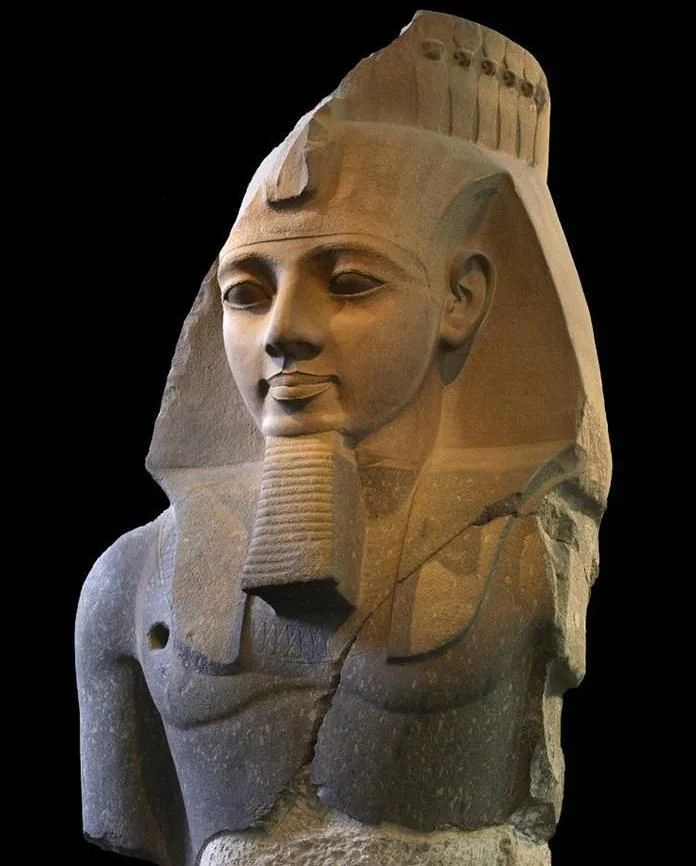
The first discovery consists of a massive stone head measuring approximately 1.6 metres in height. It depicts Ramesses II wearing the Double Crown, a royal symbol representing Upper and Lower Egypt.
Archaeologists also recovered part of the statue’s back pillar. An inscription on this section contains the pharaoh’s Horus name, providing important evidence for identifying the monument.
Based on the head’s dimensions, specialists estimate that the complete statue may originally have stood approximately 8.5 metres tall, including its base.
The second statue survives in a different form. Its largest recovered section measures approximately 2.4 metres and includes the upper body and head. Although its legs and base are missing, its facial features remain recognisable. The figure wears the traditional royal nemes headdress, and its face resembles that of the first statue.
Researchers believe the second monument may also depict Ramesses II, but further archaeological study will help establish the relationship between the two sculptures.
These findings make the Ramesses II statues discovery 2026 an important addition to the growing understanding of ancient Egyptian royal monuments in the Nile Delta.
Who Was Ramesses II, and Why Was He So Powerful?
Ramesses II, often called Ramesses the Great, ruled Egypt from approximately 1279 to 1213 BC. His reign lasted around 66 years, making him one of the longest-reigning pharaohs of ancient Egypt.
He belonged to Egypt’s Nineteenth Dynasty and became famous for ambitious construction projects, military campaigns and monumental representations of royal power.
His legacy survives at several major archaeological sites, including Abu Simbel and the Ramesseum, his mortuary temple near Luxor. These monuments demonstrate how Egyptian rulers used architecture, sculpture and inscriptions to communicate authority to their subjects and preserve their names for future generations.
Ramesses II also invested in temples and royal buildings across different parts of Egypt. His monuments were not simply decorative achievements. They connected the king with the gods, celebrated his rule and reinforced the political unity of the kingdom.
The newly discovered statues could provide further evidence of this activity in the Nile Delta, a region that played an important role in Egypt’s political, economic and religious life.
What Do the Statues Reveal About Ancient Egyptian Beliefs?
The royal symbols preserved on the statues offer clues about how ancient Egyptians represented their rulers.
The Double Crown worn by the first statue symbolised the union of Upper and Lower Egypt. Its presence communicated the pharaoh’s position as ruler of the united kingdom.
The nemes headdress on the second statue also carries royal significance. This striped headcloth appears in numerous depictions of Egyptian kings and helps distinguish royal imagery from ordinary representations of people.
The nearby pink granite block provides another important clue. Its inscriptions contain royal titles identifying Ramesses II as the King of Upper and Lower Egypt and the Son of Ra, referring to the sun god.
These titles linked the king’s political authority with Egypt’s religious traditions. They presented him as a ruler whose position was supported by divine order.
However, archaeologists must examine the inscriptions, sculpture fragments and surrounding remains together before determining precisely how the statues functioned within the original complex.
Why Is Behbeit El-Hagar an Important Archaeological Site?
Behbeit El-Hagar lies in Egypt’s Gharbia Governorate, within the fertile Nile Delta. The area is known for the remains of an important temple dedicated to Isis, one of the most widely worshipped goddesses in ancient Egypt.
Isis was associated with motherhood, healing, protection and magic. Her worship became influential across Egypt and eventually spread throughout parts of the Mediterranean world.
The temple complex at Behbeit El-Hagar contains substantial granite architectural remains. Although many of its surviving monumental structures are associated with later periods, evidence of Ramesses II’s royal monuments suggests that the site’s history may extend further back than some of its most visible remains indicate.
The new discoveries could help researchers investigate how the area developed across different periods of ancient Egyptian history.
They may also help establish whether the statues belonged to a particular temple structure, stood in a ceremonial setting or were moved during later building projects.
For now, these possibilities remain subjects for further investigation rather than established conclusions.
Could the Discovery Change What Historians Know About Ramesses II?
The discovery adds physical evidence to the study of Ramesses II’s presence in northern Egypt.
Historians already know that the pharaoh commissioned extensive construction projects and monumental sculptures. However, individual archaeological sites can preserve different pieces of that larger historical picture.
The newly recovered inscriptions are especially useful because royal names and titles help specialists identify ancient monuments. The surviving statue features also provide evidence of artistic techniques and royal imagery used during the period.
Researchers may compare the fragments with other known statues and inscriptions to investigate similarities in style, scale and presentation.
The discovery could also encourage further archaeological work around Behbeit El-Hagar. Additional fragments might reveal more about the original monuments, their placement and their relationship with the nearby temple complex.
Nevertheless, the findings do not automatically rewrite Egyptian history. Their greatest value lies in adding evidence that researchers can evaluate alongside existing archaeological and historical records.
How Did a Local Resident Help Make the Discovery?
An important part of this story began outside a formal archaeological excavation.
A local resident discovered an unusual inscribed stone while working on his land. Instead of keeping the object or attempting to remove it, he notified the relevant antiquities authorities.
Specialists examined the stone and confirmed its archaeological significance. Their investigation led to a rescue excavation by Egypt’s Supreme Council of Antiquities, which uncovered the statue remains and the inscribed granite block.
This response demonstrates why public awareness matters for archaeological preservation.
Ancient objects can remain buried beneath farmland, houses and expanding communities for centuries. When residents report unusual discoveries, specialists can document the objects and investigate their surroundings before important evidence disappears.
The context of a discovery is often just as valuable as the object itself. Its location, relationship with nearby structures and position within the soil can help archaeologists reconstruct the past.
What Happens Next at the Excavation Site?
Archaeological work at Behbeit El-Hagar is continuing as specialists study the fragments and investigate their relationship to the surrounding remains.
Researchers will need to document the inscriptions, examine the statues’ surviving surfaces and determine whether additional pieces remain buried nearby.
They must also consider the possibility that ancient builders or later communities moved or reused monumental stonework. Such practices can complicate efforts to reconstruct the original arrangement of a temple or royal monument.
Further discoveries could provide clearer answers about the statues’ original locations and their purpose.
Until those investigations progress, the estimated height of the first statue and the proposed identification of the second should be treated as archaeological assessments based on the evidence currently available.
Conclusion: Ancient Egypt Still Has Secrets to Reveal
The Ramesses II statues discovery 2026 offers a fascinating reminder that Egypt’s ancient history continues to emerge through careful archaeological investigation.
The remains of two colossal royal statues, together with inscriptions naming Ramesses II, provide valuable clues about royal authority, religious symbolism and construction activity in the Nile Delta.
The find also draws attention to Behbeit El-Hagar, a historically significant area whose buried remains may hold further evidence of Egypt’s changing religious and architectural landscape.
For historians, the next challenge is to establish how the monuments originally fit into the site and what additional information their inscriptions and surviving features can reveal.
More than three thousand years after Ramesses II ruled Egypt, discoveries like this continue to connect modern researchers with the people, beliefs and ambitions of the ancient world.
Follow TopTenDose for more archaeology discoveries, ancient history, science breakthroughs and fascinating stories from around the world.