The green star discovery 2026 is challenging one of astronomy’s most familiar ideas stars do not normally appear green. Astronomers have identified a remarkable white dwarf called WD J1330+6435 whose calculated colour is a ghostly shade of chartreuse green. Located approximately 280 light-years from Earth in the constellation Draco, this stellar remnant has an unusual chemical composition that changes how it emits light into space.
The explanation is stranger than the colour itself. After its original planetary system evolved, the white dwarf accumulated rocky debris containing elements such as sodium, calcium and lithium. Under the extreme conditions in its dense atmosphere, these elements interact with light in unusual ways, producing a colour that stands out from the familiar red, yellow, white and blue stars.
The finding does not mean astronomers have photographed a bright green star shining visibly in our night sky. Instead, researchers analysed the star’s spectrum and used models of human colour vision to calculate how it would appear. Their results, published in RAS Techniques and Instruments in October 2026, offer a fresh look at the surprisingly diverse colours of white dwarfs.
What Is the Green White Dwarf WD J1330+6435?
The green white dwarf WD J1330+6435 is a compact stellar remnant in the Milky Way. White dwarfs form when low or intermediate mass stars exhaust their nuclear fuel and shed their outer layers, leaving behind a dense core.
Our Sun is expected to follow a similar path billions of years from now. After its later stages of evolution, it will eventually leave behind a white dwarf rather than continue shining as it does today.
Despite their name, white dwarfs do not all have exactly the same colour. Their appearance depends on temperature, atmospheric composition and the way different atoms and molecules absorb or emit light.
WD J1330+6435 stands out because its atmosphere contains traces of heavy elements, including sodium and calcium. Its temperature is around 4,000–4,200°C, depending on the model used. Under its unusual atmospheric conditions, the star’s spectrum produces a greenish colour rather than the expected white or yellowish appearance.
Astronomers have known about this object before the 2026 announcement. The new research brings renewed attention to it by showing how updated atmospheric models can explain its unusual colour.
Why Does This Star Look Green?
To understand the mystery, it helps to know how astronomers determine the colour of a distant star.
A star produces light across a range of wavelengths. When scientists split that light into a spectrum, they can identify patterns that reveal its temperature and chemical composition.
Different elements absorb particular wavelengths. Under ordinary conditions, sodium produces familiar spectral features. However, WD J1330+6435 has an extremely dense atmosphere dominated by helium.
At such high densities, interactions between atoms and surrounding helium can broaden their absorption features. Sodium absorbs a broad range of orange and red light, while calcium affects parts of the violet region of the spectrum.
The combined effect changes the balance of visible light reaching a hypothetical observer nearby. The modelled colour consequently shifts towards chartreuse green.
In simple terms, the star does not need to generate green light in the same way a green lamp does. Its atmosphere removes certain parts of the visible spectrum more strongly than others, leaving a different overall colour balance.
This is the central scientific explanation behind the green star discovery 2026.
How Did the Star Become Enriched With Rocky Material?
The chemical clues point towards the remains of a planetary system.
When a star becomes a white dwarf, its transformation can disrupt the orbits of nearby asteroids and other rocky bodies. Some of this material can eventually fall onto the stellar remnant.
Astronomers call this process accretion. As rocky debris enters the white dwarf’s atmosphere, it can introduce elements that would otherwise be scarce there.
Scientists have found evidence of heavy elements in the atmosphere of WD J1330+6435, including sodium, calcium and lithium. These elements help explain its unusual spectrum.
The material may have originated from asteroids or other rocky bodies left over from the star’s former planetary system. However, the exact identity and history of every object involved remain uncertain.
This creates an intriguing possibility: even after a star’s main life has ended, its surrounding planetary material can leave a chemical signature that astronomers can still detect.
The green appearance therefore provides more than a visual curiosity. It helps researchers investigate the relationship between white dwarfs and the planetary systems that once surrounded them.
Why Astronomers Thought Green Stars Were Unusual
Stars come in a range of colours, largely because their surface temperatures differ.
Relatively cool stars often appear red or orange. Stars similar to the Sun generally appear white or yellowish, while much hotter stars can look blue.
Green is different. A star with a broad spectrum resembling that of a blackbody does not normally produce a distinctly green appearance. Its visible output generally includes enough red and blue light to make the combined colour appear closer to white.
That is why astronomers have long regarded a genuinely green-looking star as unusual.
White dwarfs offer an exception because their atmospheres can alter the spectrum in ways that differ substantially from a simple temperature-based colour model. Their intense gravity and high atmospheric densities can produce unusually broad absorption features.
WD J1330+6435 demonstrates how these conditions can shift the balance of visible wavelengths far enough to create a greenish appearance in a scientific colour model.
The discovery does not overturn the physics of stellar colour. Instead, it shows that temperature alone cannot explain the appearance of every star.
The Universe May Contain Pink, Purple and Cyan Stars Too
The green white dwarf is not the only unusual object highlighted by the research.
Scientists have modelled white dwarfs whose atmospheric chemistry produces colours including pink, purple, yellow and cyan. These differences provide further evidence that white dwarf colour depends on more than temperature.
Carbon-rich white dwarfs can appear pink or purple in models because carbon-related absorption changes the visible spectrum. Other white dwarfs contaminated by planetary debris may appear yellowish. Cooler objects with particular mixtures of hydrogen and helium can take on cyan or pale-blue tones.
The study also examined another unusual white dwarf, WD J0902+2010, whose carbon-rich atmosphere gives it a salmon-pink appearance in the researchers’ models.
These examples show that stellar remnants can preserve a wide variety of chemical signatures. Rather than being uniform white points in the sky, white dwarfs can display an unexpected range of calculated colours.
However, astronomers must distinguish between the colour inferred from a spectrum and the colour an observer can actually see. Many white dwarfs are too faint and distant for the human eye to detect their true colour directly.
Can You See the Green Star From Earth?
Unfortunately, you cannot expect to look up at the night sky and easily spot WD J1330+6435 as a green point.
The star lies roughly 280 light-years away, and its light is too faint for its unusual colour to be readily distinguished by the unaided human eye.
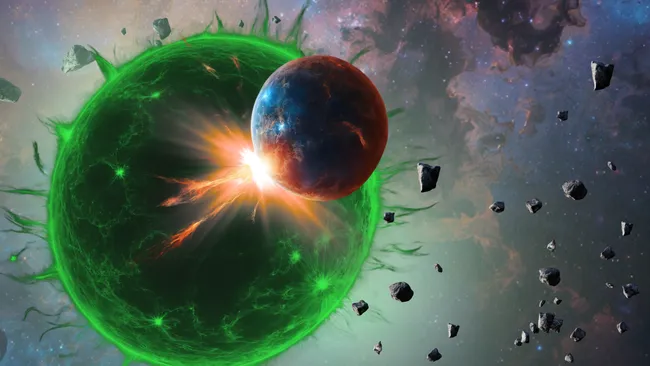
Astronomers establish its colour by studying its spectrum and modelling how the resulting light would be perceived. Scientific illustrations can then represent that calculated appearance, but they should not be confused with a close-up photograph showing a clearly resolved green stellar surface.
This distinction is important when interpreting dramatic astronomy images online. Some images show actual telescope data, while others are artistic reconstructions based on scientific measurements.
The green appearance of WD J1330+6435 is grounded in spectral analysis, but the visual representations of the star are model-based.
What This Discovery Means for Astronomy
The discovery could help astronomers improve their understanding of white dwarf atmospheres and the chemical remains of planetary systems.
By comparing spectra with atmospheric models, researchers can estimate which elements are present and investigate how those elements affect the light we receive.
Such work also helps scientists understand how planetary debris behaves after its original star has evolved. White dwarfs can act as laboratories for studying the composition of rocky material beyond our own Solar System.
The results may also encourage researchers to revisit other unusual white dwarfs. Objects previously considered ordinary or difficult to classify could reveal unexpected colours when scientists apply improved models.
Nevertheless, the research does not suggest that green stars are common in the same way as ordinary white or yellow stars. The green appearance depends on a particular combination of atmospheric composition, density and temperature.
More observations and improved models will help astronomers determine how many other white dwarfs share similar properties.
Conclusion
The green star discovery 2026 reveals how unusual chemistry can change the apparent colour of a stellar remnant. WD J1330+6435, a white dwarf approximately 280 light-years away, appears chartreuse green in scientific models because its dense, helium-rich atmosphere contains elements that absorb selected wavelengths of visible light.
The discovery does not mean astronomers have found a bright green star that can be seen with the naked eye. Instead, it highlights how spectral analysis can reveal surprising properties hidden inside faint, distant objects.
It also shows that the remains of planetary systems can continue to influence stars long after their most active stages have ended.
For astronomers, the green white dwarf is more than a colourful curiosity. It is a reminder that the universe can produce unexpected results when chemistry, gravity and light interact under extreme conditions.
Frequently Asked Questions
What is the green star discovered in 2026?
The star is WD J1330+6435, a white dwarf whose calculated colour is chartreuse green because of the unusual chemical composition and density of its atmosphere.
How far away is WD J1330+6435?
It is approximately 280 light-years from Earth, in the constellation Draco.
Why does the white dwarf look green?
Sodium absorbs a broad range of orange and red wavelengths in its dense atmosphere, while calcium affects violet light. Together, these effects shift the calculated visible colour towards green.
Can people see the green star with the naked eye?
No. The star is too faint for its green colour to be readily distinguished by unaided human vision. Astronomers calculated its appearance using spectral observations and models of human colour perception.
Is WD J1330+6435 a newly formed star?
No. It is a white dwarf, the compact remnant left after a star has passed through its main stages of evolution.
Are there other unusually coloured white dwarfs?
Yes. Researchers have modelled white dwarfs that appear pink, purple, yellow, cyan and other colours, depending on their atmospheric composition and temperature.