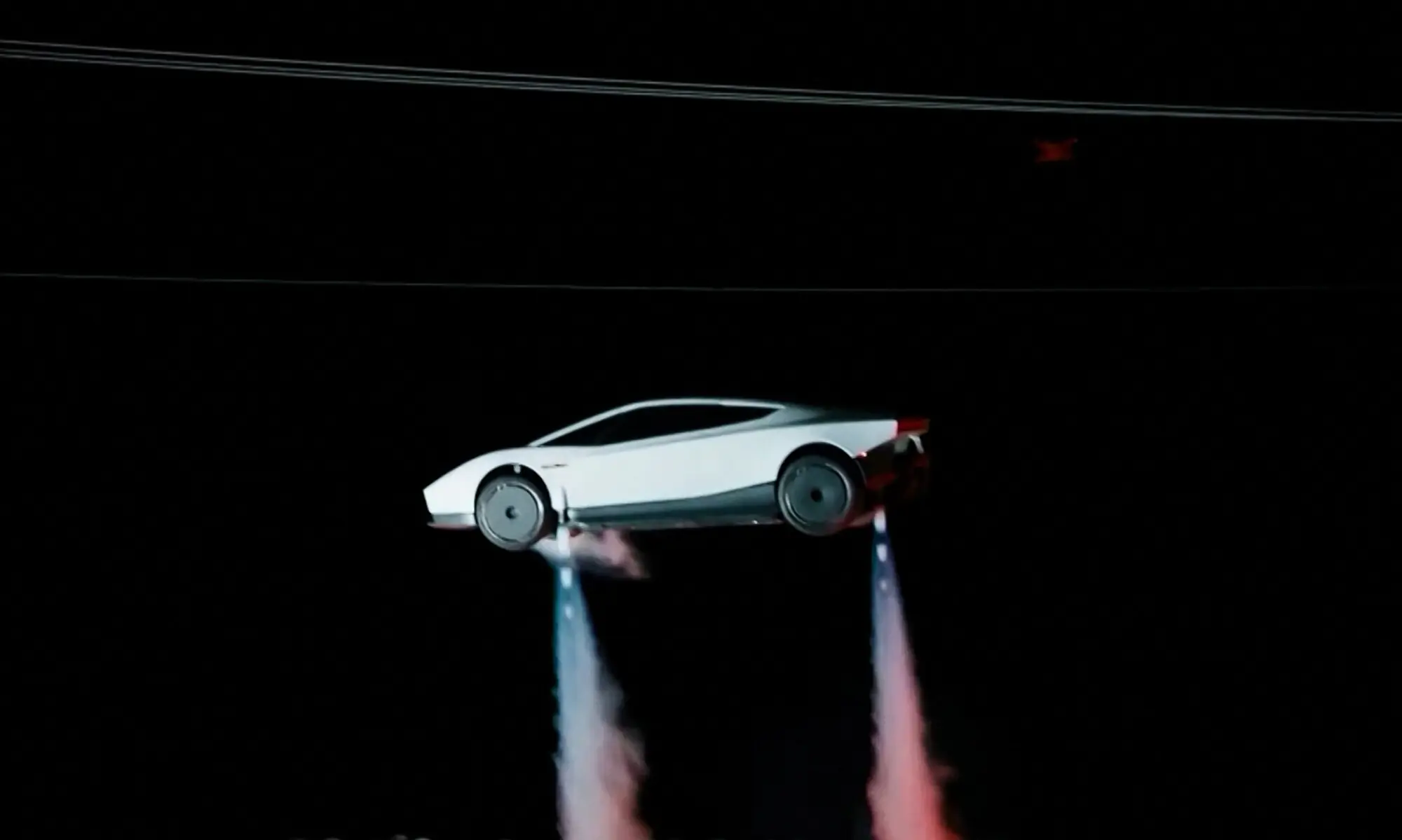
The Elon Musk flying car announcement has reignited the global debate about whether futuristic transportation is finally becoming reality. On October 15, 2026, Tesla unveiled its next-generation Roadster at a SpaceX facility in Texas, demonstrating a prototype that used rocket-style thrusters to launch into the air, flip and land.
The dramatic demonstration featured technology developed in collaboration with SpaceX, Elon Musk’s aerospace company. Tesla also presented the Roadster as an exceptionally fast electric sports car, with executives claiming it could accelerate from zero to 60 miles per hour in less than one second.
But there is an important catch. Although the demonstration showed the vehicle briefly leaving the ground, it did not establish that the car can fly over long distances like an aircraft. Tesla’s flying-capable version is not approved for public-road use, and the company says production is planned for 2028.
So, is this the beginning of the flying-car era, or is the Tesla Roadster an ambitious technology showcase? Here is what the announcement actually means.
What Did Tesla Reveal About Its Flying Car?
Tesla revealed its long-awaited second-generation Roadster at a demonstration held at a SpaceX testing facility in McGregor, Texas.
The event showcased a white electric sports car performing a series of unusual manoeuvres. In one demonstration, the vehicle climbed a curved ramp, remained upside down using a suction system and then launched into the air with the help of thrusters.
The prototype flipped and returned to the ground. Another demonstration showed it leaping over a lineup of vehicles.
The display was designed to highlight a combination of automotive engineering and aerospace technology that is rarely seen in a conventional passenger car.
Elon Musk described the vehicle as a machine capable of flying like a rocket. However, the demonstration did not establish that the Roadster can sustain controlled flight for extended periods.
That distinction matters. A vehicle that briefly lifts off using powerful thrusters is not necessarily equivalent to a flying car that can transport passengers through the air safely and reliably.
Tesla’s announcement nevertheless marks a notable development in the company’s long-running effort to create an exceptionally high-performance electric sports car.
How Can the Tesla Roadster Flying Car Leave the Ground?
The technology behind the Tesla Roadster flying car combines an electric vehicle platform with systems developed alongside SpaceX.
Tesla describes cold-gas thrusters that use pressurised gas to generate thrust. By directing gas through nozzles, a vehicle can produce forces that move or rotate it.
In aerospace applications, thrusters help spacecraft control their orientation and movement. Tesla intends to apply a related principle to the Roadster’s brief airborne manoeuvres.
The vehicle also features a multi-mode suction system designed to create substantial downward force. This system uses fans and airflow management to increase grip and allows the demonstrated prototype to travel upside down along a specially designed surface.
These features serve different purposes:
- Cold-gas thrusters: Generate thrust for the demonstrated airborne movements.
- Suction system: Helps the vehicle grip a surface, including during the unusual upside-down demonstration.
- Electric powertrain: Provides the acceleration associated with the Roadster’s high-performance driving.
- Aerospace engineering: Brings together technologies associated with Tesla and SpaceX.
The system is unusual, but it also presents significant engineering challenges. A production vehicle must operate predictably, protect occupants, manage its energy requirements and function under a range of real-world conditions.
A successful demonstration is only one step towards meeting those requirements.
How Fast Is Elon Musk’s New Roadster?
Tesla has made extraordinary performance claims for the new Roadster.
At the unveiling, company executives said the car could accelerate from zero to 60 miles per hour in less than one second. Tesla also presented a top speed exceeding 230 mph and a driving range of more than 300 miles per charge.
These figures would place the Roadster among the most ambitious high-performance electric vehicles announced by the company.
However, readers should distinguish between manufacturer claims and independently verified production specifications. The vehicle is not yet in production, and the final specifications may change before customer deliveries begin.
The claimed acceleration is particularly striking because a production car must manage traction, stability, braking and occupant safety while delivering extreme performance.
Tesla’s engineers will need to demonstrate that the final vehicle can deliver its advertised capabilities consistently, rather than only under controlled demonstration conditions.
For buyers, the most important questions will eventually include real-world range, charging performance, reliability, maintenance costs and how the vehicle behaves outside a test facility.
Is the Roadster Really a Flying Car?
This is the biggest question surrounding the announcement.
Tesla and Musk have used the term “flying car” to describe the vehicle’s thruster-assisted capabilities. The demonstration provided visual evidence that the prototype could leave a surface, rotate in the air and land.
However, it did not demonstrate sustained flight over a meaningful distance.
A conventional flying car would need to manage lift, stability, propulsion, navigation and safe landings under a wide range of conditions. It would also need to meet the applicable aviation and transportation requirements in the places where it operates.
The Roadster’s brief airborne manoeuvres do not, by themselves, establish that it can perform those tasks.
The distinction is important because a vehicle that jumps or briefly rises using thrusters presents different engineering and safety challenges from one that can carry passengers through the air like an aircraft.
Tesla’s own website describes the Rocket configuration as an “air ready” version but also states that it is not approved for public-road use.
For now, the most accurate description is a high-performance electric sports car with proposed thruster-assisted airborne capabilities, rather than a practical flying car ready for everyday travel.
When Will Tesla’s Flying Roadster Be Available?
Tesla says production is planned for 2028. That date remains a target, not a guarantee that customers will receive their vehicles in that year.
The second-generation Roadster has experienced a long development history. Tesla first unveiled the new generation in 2017 and previously announced delivery timelines that were repeatedly delayed.
The latest demonstration gives potential buyers a clearer picture of the company’s ambitions, but important milestones remain ahead.
Before production and customer deliveries, Tesla must finalise the design, validate the vehicle’s performance, establish manufacturing processes and address the regulatory requirements that apply to its different configurations.
The thruster-equipped version presents additional complications because airborne operation raises questions beyond those associated with an ordinary electric car.
Consequently, prospective buyers should treat the announced timeline as a plan that could change.
How Much Will the Tesla Roadster Cost?
Tesla’s reservation options indicate that the Roadster is aimed at a premium market.
Following the unveiling, Tesla listed a Performance version requiring a $50,000 deposit and a Thrust version requiring a $250,000 deposit. The company also described a Rocket configuration with a full flight system as available by invitation.
These deposits are substantial, and prospective buyers should carefully review the terms, refund policies, final pricing and delivery conditions before committing money.
The final retail prices and complete specifications may differ from earlier estimates or reservation details.
The Rocket configuration is particularly exclusive. Tesla describes it as a single-seat version, unlike the two-seat Performance and Thrust configurations.
It is also important to understand that a reservation does not guarantee a delivery date or prove that every advertised capability will be available in the final production model.
Why Is SpaceX Involved in a Tesla Car?
The collaboration between Tesla and SpaceX is central to the Roadster’s unusual features.
Tesla specialises in electric vehicles, batteries, power electronics and automotive manufacturing. SpaceX develops rocket engines, spacecraft and propulsion technologies.
Combining expertise from the two companies could help engineers explore applications of aerospace technology in road vehicles.
Cold-gas thrusters, for example, are designed to produce controlled forces using pressurised gas. Translating this principle into a passenger vehicle requires careful consideration of weight, energy, stability, structural integrity and safety.
The partnership also gives Tesla a way to showcase technology beyond conventional electric-car performance.
However, the collaboration does not automatically make the Roadster a practical aircraft. The final vehicle must still demonstrate that its propulsion system can operate safely and reliably within its intended environment.
Could Flying Cars Change the Future of Transportation?
The Roadster announcement highlights the continuing interest in vehicles that combine road travel with airborne capabilities.
Other companies are developing electric vertical take-off and landing aircraft, often called eVTOLs. These vehicles are designed specifically to take off and land vertically and potentially carry passengers on short trips.
The Tesla Roadster follows a different approach. Rather than presenting a conventional aircraft with road-driving capability, it uses a high-performance car platform with proposed thruster-assisted movements.
That difference affects how the vehicle might be used.
A practical flying transport system would need to address airspace management, pilot or operator requirements, emergency procedures, noise, energy use and suitable landing areas.
Even if a vehicle can briefly leave the ground, it does not follow that it can replace a car for daily commuting or operate safely above busy roads.
For flying vehicles to become a mainstream transport option, manufacturers and regulators will need to demonstrate that their designs meet demanding safety and operational standards.
What Are the Biggest Safety and Regulatory Challenges?
A road vehicle must protect its occupants and other road users. A vehicle capable of airborne manoeuvres faces additional risks.
Engineers must consider what happens if a thruster fails, propulsion becomes uneven, a control system malfunctions or the vehicle cannot land as intended.
They must also evaluate the effects of thrust, pressure systems, heat, debris and unexpected contact with nearby objects.
Regulatory approval is another major obstacle. A car that operates on public roads must meet applicable vehicle rules, while sustained flight can introduce aviation requirements. The precise regulatory treatment of a novel vehicle depends on its design, intended use and the jurisdiction involved.
Tesla has acknowledged that its flying-capable Roadster is not approved for public-road use. The company has not demonstrated that consumers can legally use the vehicle for routine airborne travel.
These limitations mean that the Roadster should currently be viewed as an experimental and high-performance technology project, not a ready-made solution to traffic congestion.
Conclusion: Elon Musk’s Flying Car Is Ambitious, but the Future Is Not Here Yet
The Elon Musk flying car announcement has captured attention because it combines electric-car performance with aerospace-inspired technology. Tesla’s Roadster prototype demonstrated brief airborne movements, flips and landings using thrusters, alongside a suction system designed to grip surfaces in unusual ways.
Yet the demonstration leaves important questions unanswered. It did not show sustained flight, the flying-capable configuration is not approved for public-road use, and production is not planned to begin until 2028.
The vehicle could become an important engineering showcase if Tesla turns its claims into a safe, reliable and commercially viable product. Until then, its most dramatic capabilities remain part of a developing project rather than an everyday transportation option.
For consumers, the key issue is not simply whether a car can leave the ground. It is whether it can do so safely, legally, reliably and affordably.
Tesla has presented a glimpse of an unusual automotive future. Whether that future includes practical flying cars will depend on what engineers can demonstrate next.