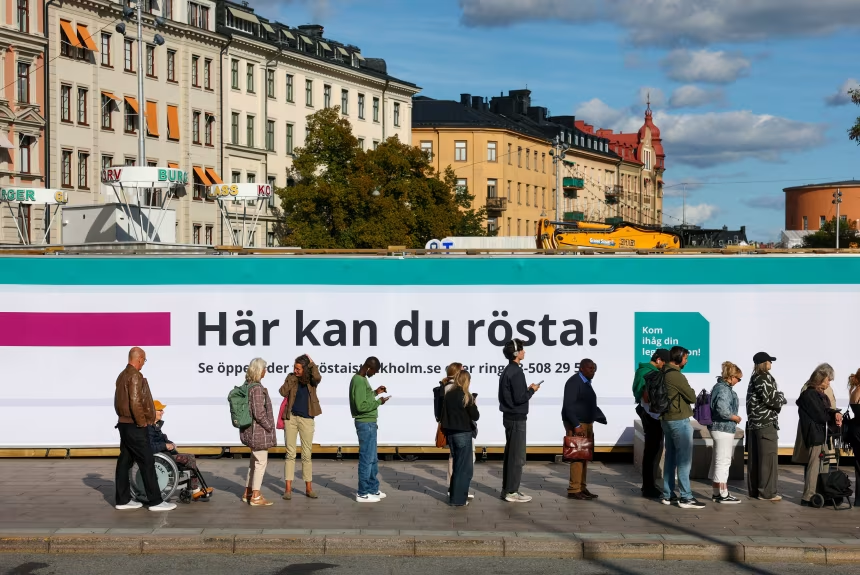
Sweden election 2026 has become one of Europe’s most closely watched political contests, with voters going to the polls on September 13 to decide the direction of the country for the next four years. The Swedish election has focused heavily on national security, crime, immigration, household finances, welfare and the future role of the Sweden Democrats in government.
The election has produced an exceptionally tight result. Preliminary figures indicate that the centre-left opposition is narrowly ahead of the governing right-wing bloc, with coalition negotiations expected to determine who can ultimately form Sweden’s next government.
Why the Sweden Election 2026 Matters
The Sweden election 2026 is important not only for domestic politics but also for Sweden’s position in Europe.
Sweden joined NATO in 2024, following Russia’s invasion of Ukraine, and national security has remained a major political issue. Both major political blocs support Sweden’s stronger defence posture and continued support for Ukraine, meaning a change of government is unlikely to produce a dramatic shift in the country’s overall Western security policy.
However, domestic priorities could change significantly depending on which parties eventually form the government.
Crime, immigration, welfare, taxation and household costs have all played major roles during the campaign.
Cost of Living Becomes a Major Election Issue
For many Swedish voters, economic pressure has been just as important as political ideology.
Higher household expenses, food prices, energy costs and concerns about economic security have put the cost of living at the centre of the campaign. Sweden’s government has also introduced measures intended to reduce pressure on households.
The government’s temporary reduction in food VAT, introduced in April 2026, was designed to help lower grocery costs before the election. Economic concerns have remained particularly important as Sweden has faced weaker growth prospects and higher energy costs linked partly to geopolitical tensions.
For voters, the key question is increasingly practical: which political leadership can improve household finances while maintaining Sweden’s strong welfare system?
Security and Crime Remain Central Concerns
Security has become another defining issue in the Swedish election.
Sweden has experienced years of political debate over organized crime, gang violence and the government’s response to criminal networks. The governing right-wing parties have emphasized tougher measures against crime and stronger law enforcement.
The issue has also influenced the debate over immigration and integration.
The right-wing bloc has argued that stricter policies are necessary to improve public safety, while centre-left parties have emphasized social investment, welfare and measures designed to address the underlying causes of crime.
Sweden Democrats Seek a Bigger Role
One of the most closely watched developments in the Sweden election 2026 is the position of the Sweden Democrats.
The party has supported Prime Minister Ulf Kristersson’s government from outside the cabinet since 2022. This election raised the possibility that the party could move into government and receive ministerial positions if the right-wing bloc retained power.
That possibility has made the election important beyond the usual competition between Sweden’s traditional political parties.
The Sweden Democrats have campaigned heavily on immigration, crime and national identity. Their potential entry into government has also generated concerns among opponents about the direction of Swedish immigration and civil-liberties policies.
Magdalena Andersson Attempts a Political Comeback
The centre-left opposition is led by Social Democratic leader Magdalena Andersson, who previously served as Sweden’s prime minister.
A centre-left victory could bring Andersson back to the prime minister’s office after four years in opposition. The Social Democrats have remained the largest party in the opposition camp, but forming a stable government could still require negotiations with other centre-left parties.
This makes the election more complicated than simply determining which party receives the most votes.
Sweden uses a parliamentary system, meaning the next government must be able to secure sufficient parliamentary support.
A Very Close Election Result
The latest preliminary figures show just how competitive the Swedish election has become.
According to projections based on the votes counted, the centre-left opposition bloc is narrowly ahead with around 175 seats in the 349-seat Riksdag, compared with approximately 174 seats for the right-wing bloc. Final results can still change as remaining votes, including overseas ballots, are counted.
The narrow margin means that coalition negotiations could become just as important as the election itself.
Neither side can simply assume that winning the largest number of seats automatically guarantees control of the government.
Election Security Also Draws Attention
The Swedish government has taken additional steps to protect the 2026 election from foreign interference and malicious information campaigns.
Swedish authorities have warned that the country’s security environment, rapid technological development and experiences from elections elsewhere in Europe require stronger protection against foreign influence.
Government agencies, security authorities, police and election officials have worked together to monitor potential threats and protect the electoral process.
This has added another dimension to an already high-stakes election.
What Happens Next?
The immediate focus will shift from voting to government formation.
If the centre-left bloc maintains its narrow lead, Magdalena Andersson could attempt to build a government with support from other parties. However, disagreements among potential coalition partners could make negotiations difficult.
If the right-wing bloc manages to retain control, Prime Minister Ulf Kristersson could attempt to form another government, potentially with a greater role for the Sweden Democrats.
Either scenario could produce difficult negotiations because neither political side has secured a commanding majority.
What the Sweden Election 2026 Means for Europe
The outcome of the Sweden election 2026 will be closely watched across Europe.
Sweden is an important NATO member, a major European economy and a significant voice on security, migration and regional cooperation. The election also comes at a time when right-wing and populist parties are gaining influence in several European countries.
A stronger role for the Sweden Democrats would therefore attract attention beyond Sweden, while a centre-left comeback could be seen as a different response to Europe’s broader political shift.
At the same time, Sweden’s commitment to NATO, defence spending and support for Ukraine is unlikely to change dramatically regardless of which bloc eventually forms the government.
The Bigger Question for Swedish Voters
The Swedish election ultimately reflects a broader question facing many European democracies: how should governments balance security, immigration, economic stability and social welfare?
Swedish voters have been asked to choose between competing approaches to crime, taxation, welfare and immigration while also considering the country’s international security responsibilities.
With the parliamentary balance extremely close, the final outcome could depend as much on negotiations between political parties as on the initial vote count.
For now, the Sweden election 2026 has delivered a dramatic political contest, and Sweden’s next government remains dependent on how the narrow parliamentary balance develops.
One thing is clear: Sweden’s political direction is being decided at a moment when security and household finances matter more than ever.
, , , , , , , , , , , , ,