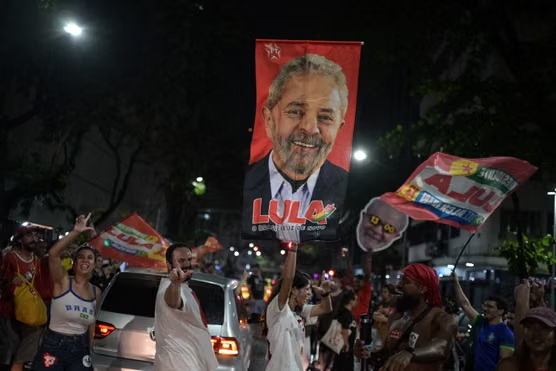
The Brazil election results 2026 have reshaped the political outlook for Latin America and drawn international attention to the future of the world’s seventh-largest economy by population. President Luiz Inácio Lula da Silva won re-election on October 25, defeating right-wing challenger Flávio Bolsonaro in a closely contested presidential runoff. The result gives Lula an unprecedented fourth, non-consecutive presidential term and keeps his government’s focus on social programmes, international cooperation and environmental protection. However, financial uncertainty, political opposition and difficult economic choices could limit his ability to deliver on those ambitions.
Lula secured 51.79% of valid votes, while Bolsonaro received 48.21%, according to Brazil’s Superior Electoral Court. The result has implications beyond Brazil’s borders because the country plays a major role in agricultural exports, climate negotiations, global commodity markets and the BRICS group of emerging economies.
The central question now is whether Lula can turn his electoral victory into economic stability, stronger environmental protection and greater international influence.
What Do the Brazil Election Results 2026 Reveal?
The Brazil election results 2026 delivered a narrow but decisive victory for Lula after a fiercely contested campaign.
His opponent, Flávio Bolsonaro, is the son of former president Jair Bolsonaro and represented a right-wing alternative to the incumbent government. The campaign exposed deep divisions over economic management, social welfare, environmental policy and Brazil’s international relationships.
Lula’s victory also interrupted a wider pattern of right-wing electoral gains across parts of Latin America. His campaign appealed to voters through promises focused on workers, lower-income households and social protection.
However, the result does not mean that Lula has secured unrestricted political power. Conservative and centre-right parties performed strongly in congressional elections, leaving the president dependent on negotiations with legislators to advance major proposals.
The election therefore produced two different messages: Lula retains the presidency, but a substantial part of the electorate continues to support political alternatives.
That division will influence how quickly the government can introduce reforms during its next term.
How Could Lula’s Re-Election Affect Brazil’s Financial Markets?
Financial markets reacted nervously to Lula’s victory as investors reconsidered the country’s fiscal outlook and future economic policies.
Some investors had positioned themselves for a Bolsonaro victory, expecting a potential shift in economic management. Lula’s re-election therefore triggered adjustments in Brazilian assets and renewed questions about government spending, borrowing costs and the national currency. Reuters reported that Brazilian financial markets were unsettled following the result.
Investors are particularly concerned about Brazil’s public finances. Government spending, interest payments and public debt will remain important factors in determining confidence in the economy.
Lula has defended social programmes and public investment as tools for improving living standards and supporting growth. Nevertheless, investors want evidence that these priorities can coexist with a credible plan for managing the budget.
If markets become concerned that public debt will rise without a convincing fiscal strategy, borrowing costs could remain elevated. That can make it more expensive for businesses to finance expansion and for households to obtain credit.
On the other hand, clear budget policies, predictable regulation and sustained investment could help rebuild confidence.
For ordinary Brazilians, the outcome matters because financial instability can affect borrowing costs, business investment, employment and the purchasing power of household income.
Why Is Brazil’s Economy Facing a Difficult Test?
Lula begins his new term with several competing economic priorities.
The government must support employment and household incomes while encouraging private investment and maintaining confidence in public finances. It also faces pressure to address household debt and the cost of living.
Social spending remains an important part of Lula’s political programme. Supporters argue that public investment and welfare measures can reduce poverty, stimulate demand and help disadvantaged communities access essential services.
Critics, however, warn that spending commitments require sustainable financing. If government revenue fails to keep pace with expenditure, the authorities may face difficult choices involving taxes, spending limits or borrowing.
A conservative Congress could also push for policies that differ from Lula’s preferred approach. As a result, negotiations over budgets and economic reforms could become a defining feature of the next administration.
The government’s challenge will be to demonstrate that social development and fiscal responsibility can reinforce rather than undermine each other.
What Does Lula’s Victory Mean for the Amazon Rainforest?
Environmental policy is one of the most internationally significant consequences of the election.
Brazil contains a large share of the Amazon rainforest, which stores carbon, supports extraordinary biodiversity and helps regulate regional and global climate systems. Protecting it is therefore important not only for Brazil but also for countries concerned about climate change.
Lula has sought to restore Brazil’s position as a global environmental leader through stronger forest protection, international climate diplomacy and efforts to attract financing for conservation.
Environmental organisations and Indigenous groups welcomed his re-election, viewing it as an opportunity to continue efforts to curb deforestation and protect forest communities.
However, major challenges remain. Illegal logging, land clearing, fires and pressure to expand agriculture can undermine conservation efforts. Effective enforcement requires resources, reliable monitoring and cooperation with local communities.
Lula must also manage a difficult contradiction: his government has supported expanding oil production, including offshore exploration near the Amazon region. Critics argue that new fossil-fuel projects could conflict with the country’s climate commitments.
This tension will test whether Brazil can pursue economic development while protecting its forests and reducing long-term environmental risks.
How Could Lula’s Re-Election Influence Global Climate Policy?
Brazil’s role in climate diplomacy gives Lula an opportunity to influence international negotiations.
The country hosted the COP30 climate summit in Belém in 2025 and has sought to encourage cooperation on forest conservation, climate finance and sustainable development.
Lula’s continued leadership could help Brazil maintain that diplomatic role. The government can work with other countries to attract funding for forest protection, expand renewable energy and support programmes that help communities adapt to climate impacts.
Brazil’s forests also give it leverage in negotiations with wealthy countries that want to reduce global emissions while protecting biodiversity.
However, international promises must translate into measurable domestic progress. Investors and environmental organisations will watch deforestation figures, enforcement actions, funding commitments and decisions on energy projects.
Brazil cannot protect the Amazon alone, either. The rainforest extends beyond its borders, making cooperation with neighbouring countries essential.
If Lula’s administration combines credible conservation policies with international partnerships, Brazil could strengthen its influence in climate diplomacy. If economic and political pressures weaken enforcement, that influence could be harder to sustain.
What Does Lula’s Victory Mean for the United States and China?
Brazil’s international relationships will also shape the wider impact of the election.
China is Brazil’s largest trading partner, buying substantial quantities of agricultural products and other commodities. The United States remains an important economic partner and a major source of foreign investment.
Lula has generally favoured maintaining relationships with both powers rather than aligning Brazil exclusively with either Washington or Beijing. Analysts expect that balancing strategy to remain important during his next term.
This approach could give Brazil room to negotiate trade agreements, attract investment and diversify export markets.
However, competition between the United States and China over technology, minerals, energy and supply chains could make that balancing act more difficult.
Brazil’s position in BRICS the grouping that includes Brazil, Russia, India, China and South Africa will also remain significant. Lula has supported greater cooperation among emerging economies and a stronger voice for the Global South in international institutions.
His re-election suggests continuity in that approach, although practical decisions will depend on economic interests and diplomatic circumstances.
Could Lula’s Victory Change Latin America’s Political Direction?
The election has broader symbolic significance because it interrupted a series of right-wing electoral successes in the region.
Lula’s victory gives left-leaning political movements renewed visibility and demonstrates that established leaders can retain support despite economic dissatisfaction and strong opposition campaigns.
Yet Brazil’s result should not be interpreted as proof that Latin America is moving uniformly in one political direction. Each country faces different economic conditions, security concerns and public expectations.
The narrow margin also shows that Brazil remains politically divided. Lula’s government will need to reach beyond its core supporters if it hopes to maintain stability and build support for major reforms.
Its performance could influence future debates across the region about welfare, public spending, business confidence, climate policy and international cooperation.
What Should Investors and the World Watch Next?
Several developments will help determine the practical impact of Lula’s re-election:
- Fiscal policy: Watch for budget decisions, spending commitments and plans to manage public debt.
- Currency and markets: Monitor the Brazilian real, bond yields and investor confidence as the government outlines its economic strategy.
- Amazon protection: Follow deforestation data, enforcement actions and policies affecting Indigenous territories.
- Energy policy: Look for decisions on offshore oil exploration and renewable energy investment.
- Congressional negotiations: Assess whether Lula can secure enough support to pass his main proposals.
- Foreign relations: Watch Brazil’s engagement with the United States, China, the EU and BRICS partners.
These indicators will offer a clearer picture of whether the election produces lasting economic and environmental change.
Conclusion: Lula’s Victory Brings Opportunity and Serious Risks
The Brazil election results 2026 have secured Lula another presidential term and reinforced Brazil’s importance in global politics, financial markets and climate negotiations.
His victory offers an opportunity to continue social programmes, strengthen environmental protection and expand Brazil’s diplomatic role. However, those goals face significant obstacles, including fiscal concerns, a divided electorate, a conservative Congress and competing demands over energy and economic development.
The Lula reelection global impact will ultimately depend on what the government does next. A credible fiscal strategy could improve investor confidence, while stronger forest protection could reinforce Brazil’s climate leadership. Constructive relations with both Washington and Beijing could also help the country attract investment and protect its trade interests.
For now, the election has settled who will lead Brazil but not how successfully the next government will address its most difficult challenges.
Follow TopTenDose for more world politics, financial market developments, climate news and global economic analysis.