President Donald Trump has once again stunned the world with a dramatic foreign policy reversal. In a series of statements over the weekend, Trump reveals that he canceled a massive military operation against Iran at the last minute.
According to the President, the operation would have been the biggest attack since WWII. Now, that decision to hold fire may open the door to a historic deal that could reshape the Middle East. Here is what really happened, why Gulf leaders intervened, and what a potential agreement could mean for global security.
Trump Reveals The Massive Attack Plan Was Ready To Go
President Trump confirmed on Sunday evening that Washington had prepared to launch an overwhelming assault on Iran. Speaking to reporters on Air Force One, Trump reveals that Gulf allies talked him down from executing the plan.
“The reason they asked is I think there’s a deal, there’s a deal on Hormuz and on the denuclearisation of Iran,” Trump said. He credited leaders from Saudi Arabia, UAE, and Qatar for urging restraint.
Trump did not hold back when describing the scale of what he canceled. He said the operation would have dwarfed any military action since the 1940s.
“It was going to be a massive attack. It was going to be an attack that would have been by far the biggest attack since WWII. But they asked us not to do it … and their neighbours said that too,” Trump stated.[Iran]
On Saturday night, he had already announced the decision on Truth Social. He wrote that the U.S. was “locked and loaded and ready to go against the Islamic Republic of Iran, at levels of Military Terror, Strength, and Power not seen since World War II.”
Immediately after that, Trump reveals he agreed to cancel the strike.
Why Did Trump Cancel The Strike At The Last Minute?
Three factors forced the last-minute U-turn. Understanding them explains how close the region came to an all-out war.
First, Gulf allies intervened directly. Crown Prince Mohammed bin Salman of Saudi Arabia spoke to Trump on Saturday, according to Axios. Saudi state media said the Crown Prince emphasized the necessity of prioritizing dialogue to de-escalate tensions and prevent a wider conflict. Leaders from Qatar and the UAE delivered similar messages.
Second, serious negotiations had already started behind the scenes. Trump said Washington was “talking to them in the form of a negotiation” and that talks would begin formally on Monday afternoon. Iranian officials reportedly conveyed messages through Pakistan, a key mediator.[Tehran]
Third, internal pressure inside the White House also played a role. CBS News reported that as Trump discussed strike plans at Camp David on Friday, several White House aides who focus on politics strongly opposed escalation. With the war now in its sixth month, officials worried about economic fallout and American casualties.
Just 24 hours earlier, Trump had sounded completely different. “We’ll be hitting them very hard. At some point, they’re going to say, ‘We just can’t take it anymore,’” he told reporters. The sudden shift follows a familiar pattern in his foreign policy approach.
What Would The Biggest Attack Since WWII Have Looked Like?
While the Pentagon has not released operational details, reporting and official hints paint a picture of an unprecedented assault. Before the weekend, analysts believed Washington and Israel were preparing to target Iranian energy and infrastructure.
Potential targets included oil refineries, power plants, missile production sites, and Revolutionary Guard bases. Such strikes would have marked a significant escalation from the limited retaliatory strikes seen earlier in the war.
Iran had already warned of severe retaliation. Tehran threatened to respond to any attack on its energy infrastructure by targeting energy facilities in Gulf countries and Israel. That threat alone could have sent oil prices above $150 and triggered a global energy crisis.
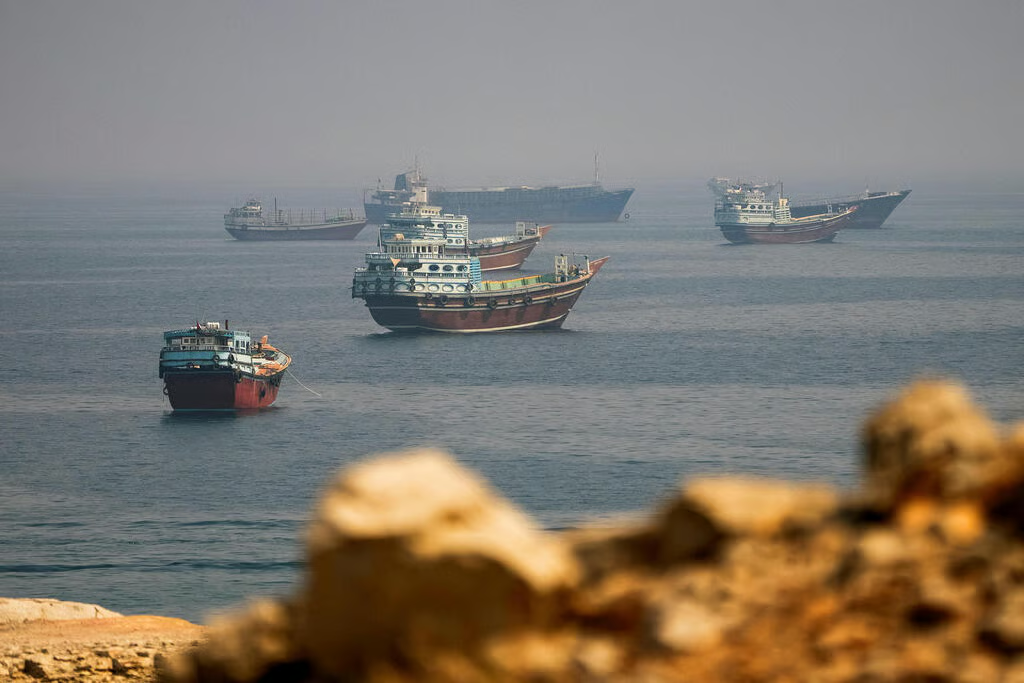
Moreover, the Strait of Hormuz remains a flashpoint. The narrow waterway carries about 20% of the world’s oil. Throughout the past week, tensions there have escalated. UK Maritime Trade Operations reported that one ship sustained damage after a projectile strike on Friday, while another reported a nearby explosion.
A full-scale assault would have likely closed the strait, crippled global shipping, and forced a direct confrontation between Iran and U.S. forces in the region.
That is why Trump’s statement carried so much weight. When he says biggest attack since WWII, he refers to a level of firepower that would involve hundreds of aircraft, naval assets, and cyber operations simultaneously.
How Gulf Allies Stopped The Attack
Saudi Arabia, the UAE, and Qatar had the most to lose from a massive war. Their economies depend on stable oil exports and safe shipping lanes. A regional war would devastate their Vision 2030 plans, tourism, and foreign investment.
According to the State Department, the U.S. issued security alerts for Americans in ten countries in the region just hours before Trump called off the attack, urging heightened caution. That alert suggests the military had already moved assets into position.
Gulf leaders offered Trump an alternative path: diplomacy with teeth. They argued that Iran was finally ready to make concessions under extreme military pressure. Saudi officials proposed a framework where Iran would agree to de-escalation in the Strait of Hormuz in exchange for a pause in strikes.
Trump accepted the logic. On Truth Social, he wrote: “Based on this request, I have agreed, for the further benefit of the WORLD and, likewise, the survival of a successful and prosperous Iran, to cancel the attack, subject to being able to rapidly make a DEAL.”
He added that Israel also committed to not attacking until negotiators reach a deal.
How This Move May Lead To A Historic Deal
Now the focus shifts from war to diplomacy. Trump reveals that negotiations for a new agreement will begin Monday. He described the framework as imminent and historic.
So what could a historic deal actually include? Three pillars have emerged from Trump’s comments and regional reporting.
1. A Deal On The Strait Of Hormuz
Iranian Foreign Ministry spokesman Esmaeil Baqaei told state media that Tehran and Oman are close to an understanding on a new shipping route through the waterway. He said both sides seek a route that “respects the sovereign rights of both sides and safeguards our national interests and security.”
A Hormuz deal would commit Iran to stop harassing tankers and allow free passage, while Gulf states might provide economic incentives. Oil markets reacted instantly. Oil prices tumbled more than $4 a barrel on Monday after Trump reveals he had called off the attack.
2. Denuclearisation Of Iran
This remains the core American demand. Trump said a deal on the “denuclearisation of Iran” was imminent. While details remain scarce, such an agreement would likely require Iran to halt uranium enrichment above civilian levels, allow intrusive inspections, and ship out its stockpile of highly enriched uranium.
In return, the U.S. would offer sanctions relief and a guarantee against future strikes. Vice President JD Vance could sign for the United States, Trump added, and the signing could happen digitally in Europe.
When reporters asked if Iran’s Supreme Leader Ayatollah Mojtaba Khamenei had approved the deal, Trump responded: “I understand the answer is yes.”
3. An End To The Shadow War
The war between Iran, Israel, and the U.S. has dragged on for six months through tit-for-tat strikes. A historic deal would freeze that cycle. Trump said the perimeters of a deal had already been agreed upon by the U.S., Iran, Israel, and other Middle Eastern countries.
If successful, this would represent the first comprehensive peace framework since the 2015 JCPOA nuclear deal, but far broader in scope because it includes regional security.
Is Iran Really Ready For A Deal? Mixed Signals
Iran has not officially confirmed Trump’s claim that a deal is close. Tehran’s messaging remains contradictory.
Acting Defence Minister Seyyed Majid Ibn al-Reza accused Trump of waging a “psychological and cognitive warfare campaign” and said Iran would “consider every threat to be real and take it seriously.”
Iran’s Fars state news agency pushed back harder, calling Trump’s demands a “wish list” and labeling his claims “nothing but a new lie.” The agency insisted Iranian armed forces remain “on high alert and ready for any eventuality.”
However, Chairman of the US House Foreign Affairs Committee Brian Mast rebutted those denials on Sunday. Speaking to Fox News, he said Iran wants to project strength and will “deny” anything that makes it look weak.
“I can’t tell you the specifics of what goes on in classified rooms, but I can tell you that every time the president speaks about making a deal, it’s because he’s in contact with Iran,” Mast said.
Foreign Minister spokesperson Baghaei also confirmed that Tehran conveyed its views to the American side “through Pakistan,” suggesting back-channel talks are indeed active.
What Happens If The Historic Deal Fails?
Trump made clear that the cancellation is conditional, not permanent. He instructed the military to remain ready to launch the biggest attack since WWII on a moment’s notice if negotiations collapse.
He wrote on Truth Social: “We will NOT be doing the scheduled attack of Iran tomorrow, but have further instructed them to be prepared to go forward with a full, large-scale assault of Iran, on a moment’s notice, in the event that an acceptable Deal is not reached.”
That threat keeps maximum pressure on Tehran. No previous administration has paired such extreme military threats with an open offer for a comprehensive deal.
For now, the world watches Monday’s talks. If Gulf mediation succeeds, Trump reveals a path that could avoid a catastrophic war and secure oil routes, nuclear limits, and regional stability in one stroke. If talks fail, the region could face the exact assault he just called off.
Do you think calling off the biggest attack since WWII for a deal was the right move? Share your analysis in the comments below.