Apple is taking a major new step in the artificial intelligence race.
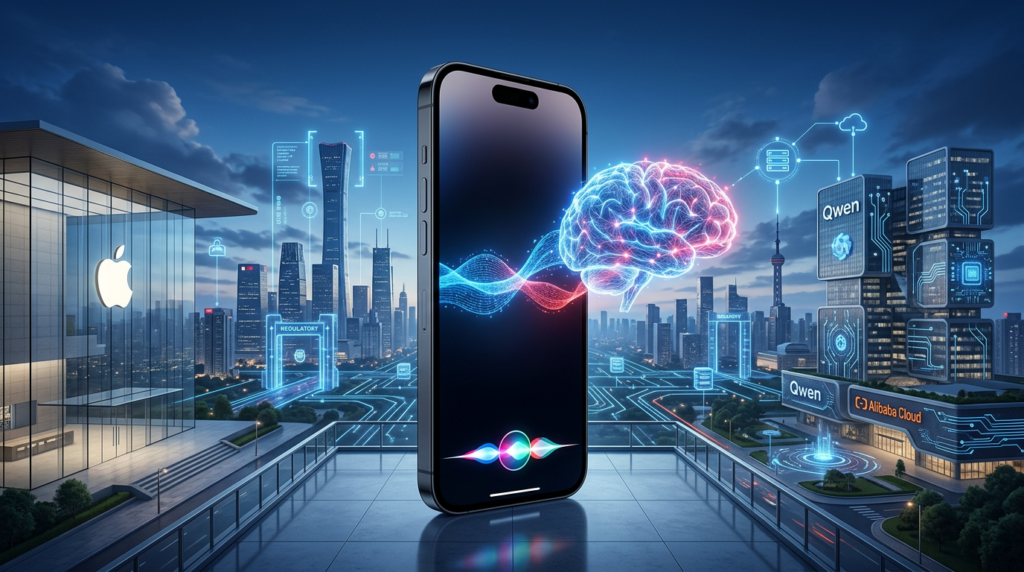
The company has reportedly trained its own large language model specifically for the Chinese market, with technical support from Chinese technology giant Alibaba. The development represents a significant change from Apple’s earlier approach of relying more heavily on third-party Chinese AI models.
The move comes as Apple prepares to introduce its Apple Intelligence features to users in China, a market where the company has faced intense competition from domestic smartphone manufacturers that have moved quickly to add AI capabilities to their devices.
According to Reuters, three people familiar with the matter said Apple developed the China-specific model in partnership with Alibaba. Apple and Alibaba have not publicly commented on the report.
The development could have major implications for Apple’s AI strategy, its relationship with China and the future of AI-powered iPhones.
Why Is Apple Building a Separate AI Model for China?
Apple’s approach to artificial intelligence has always been different from companies that rely heavily on large cloud-based AI systems.
But China presents a unique challenge.
Several major US-developed AI services, including OpenAI’s ChatGPT and Anthropic’s Claude, are not generally available to Chinese users in the same way they are in many other markets.
That means Apple cannot simply reproduce its international AI strategy in China.
Instead, the company has been working with Chinese technology companies to develop an AI experience that can operate within China’s regulatory environment.
The latest development takes that strategy one step further.
Rather than depending entirely on a Chinese partner’s model, Apple has reportedly trained a model of its own with Alibaba’s assistance.
This could give Apple greater control over how its AI features work on Chinese devices.
What Does Alibaba Have to Do With Apple’s AI?
Alibaba is one of China’s biggest technology companies and operates its own artificial intelligence ecosystem, including the Qwen family of AI models.
Apple has already been working with Alibaba on its AI strategy in China.
Reuters previously reported that Apple had selected Alibaba as an AI partner for its Chinese market. Apple also recently provided guidance allowing eligible Mac users in mainland China to connect Alibaba’s Qwen AI service with features such as Siri and Writing Tools, although that guidance was subsequently removed.
The latest report suggests that Alibaba’s role goes beyond simply supplying an existing AI model.
It has reportedly helped Apple train its own China-specific model.
That distinction is important.
Apple could potentially combine its own AI technology with locally developed systems to create an experience specifically designed for Chinese users.
Apple Intelligence Could Soon Arrive in China
Apple Intelligence is Apple’s broader collection of artificial intelligence features.
The company has already introduced AI-powered capabilities in other markets, including tools connected with writing, Siri and other device functions.
However, the rollout in China has faced additional regulatory hurdles.
Reuters reports that Apple Intelligence is expected to launch in China in the coming months following an iOS update.
The Chinese version is expected to use a combination of Apple’s own technology and local AI systems.
Alibaba’s Qwen is expected to play a role, while other Chinese technology could also be incorporated into the broader system.
The exact division of responsibilities between Apple’s own model and third-party technology has not been fully disclosed.
Why China Matters So Much to Apple
China is one of Apple’s most important international markets.
It is also one of its most challenging.
Apple faces fierce competition from companies such as Huawei, which have rapidly expanded their AI capabilities and integrated advanced features into smartphones.
The lack of Apple’s full AI offering in China has therefore become a competitive disadvantage.
A China-specific AI strategy could help Apple close some of that gap.
Instead of asking Chinese consumers to wait for the same AI experience available elsewhere, Apple is attempting to create an approach that fits the country’s regulatory and technological environment.
That could become increasingly important as AI becomes a bigger factor in smartphone purchasing decisions.
Apple’s AI Strategy Is Changing
For years, Apple has taken a relatively cautious approach to generative AI compared with some of its biggest technology competitors.
Companies such as Google, Microsoft and OpenAI have invested heavily in large-scale AI systems and cloud infrastructure.
Apple has focused more heavily on integrating AI into its devices and software while maintaining control over the user experience.
The China-specific model suggests that Apple is willing to become more aggressive where necessary.
The company now appears to be pursuing a dual-track AI strategy in China:
Apple’s own AI technology
Apple’s proprietary model could give the company greater control over its AI experience.
Chinese AI partnerships
Alibaba’s Qwen and potentially other local technologies can help Apple navigate China’s AI ecosystem and regulatory requirements.
This approach could give Apple flexibility while reducing its dependence on a single outside provider.
Could This Help Apple Compete With Huawei?
One of the biggest questions is whether Apple’s new AI strategy can help it regain momentum against Chinese smartphone brands.
Huawei and other domestic manufacturers have moved quickly to incorporate AI into their products.
Consumers increasingly expect smartphones to perform tasks beyond traditional communication.
AI assistants, image processing, writing tools, translation, search and personalized recommendations are becoming part of the smartphone experience.
If Apple Intelligence launches successfully in China, Apple could finally offer Chinese iPhone users a broader set of AI capabilities.
But simply launching AI will not guarantee success.
Apple will have to demonstrate that its technology is useful, fast and competitive with the systems already available on Chinese smartphones.
Why China’s AI Regulations Matter
China has developed a detailed regulatory framework around generative artificial intelligence.
Companies seeking to provide AI services must operate within those rules.
This creates a different environment from markets where US AI companies can offer their services more freely.
For Apple, working with a major Chinese technology company provides an important advantage.
Alibaba understands the local AI environment and regulatory landscape.
At the same time, Apple’s own model could allow the company to maintain more control over its products.
That combination may be one of the reasons the partnership has become so important.
Is Apple’s China AI Model the Same as Alibaba’s Qwen?
Not necessarily.
This is an important distinction.
Reports indicate that Apple has trained its own China-specific large language model, while Alibaba’s Qwen is expected to be incorporated into Apple’s broader AI offering in China.
The precise technical relationship between Apple’s model and Qwen has not been publicly detailed.
Therefore, it would be premature to describe the two systems as identical or assume that one will completely replace the other.
Apple could instead use multiple AI technologies for different functions.
The final architecture should become clearer when Apple officially launches its China-specific Apple Intelligence services.
What Could This Mean for iPhone Users?
For Chinese iPhone owners, the most important question is simple:
What can Apple Intelligence actually do?
If the service launches as expected, users could eventually gain access to AI-powered features integrated into Apple’s software ecosystem.
Potential areas could include:
- Siri improvements
- Writing assistance
- AI-powered productivity tools
- Device-based intelligence
- More personalized interactions
- AI-supported image and text features
- Integration with Chinese AI services
However, the exact feature set and availability may differ from Apple’s international offerings.
Apple has not publicly confirmed every detail of the Chinese rollout.
Could Apple’s China Strategy Influence Its Global AI Plans?
This may be one of the most interesting long-term consequences.
If Apple’s China-specific model performs well, Apple could learn from the experience of developing specialized AI systems for individual markets.
Different countries have different languages, regulations, cultural expectations and data requirements.
A single global AI model may not always be the best solution.
Apple could eventually use a combination of:
Global AI technology
Local models
Apple’s proprietary systems
to deliver AI features around the world.
The China experience could therefore become a test case for a broader international strategy.
A Rare Apple-Alibaba Collaboration
The partnership is also notable because Apple is an American technology giant while Alibaba is one of China’s largest technology companies.
The two companies are operating in an environment where US-China technology competition remains intense.
AI has become one of the most strategically important areas of that competition.
Against this backdrop, collaboration between Apple and Alibaba demonstrates how business relationships can continue even while governments in Washington and Beijing compete over advanced technology.
Reuters described Apple’s planned rollout as a notable example of cooperation between US and Chinese technology companies.
What Happens Next?
The next major development will be Apple’s official rollout of Apple Intelligence in China.
The company is expected to introduce the service following an iOS update, although the exact timing and feature availability remain subject to the rollout process.
Users and investors will be watching several things closely:
1. How powerful is Apple’s China-specific model?
Performance will determine whether Apple can compete effectively with local AI systems.
2. Which AI models will power which features?
The relationship between Apple’s model, Alibaba’s Qwen and other technologies remains an important unanswered question.
3. Will Chinese consumers embrace Apple Intelligence?
The success of the service could influence Apple’s competitiveness in one of its most important markets.
4. Will Apple expand the strategy globally?
If the China-specific approach works, Apple could potentially use similar strategies elsewhere.
What This Means for the Global AI Race
The Apple-Alibaba development is bigger than a single iPhone feature.
It reflects a rapidly changing AI industry in which technology companies increasingly have to consider:
Artificial intelligence capability
Government regulation
Local partnerships
Data requirements
Consumer preferences
Geopolitical tensions
Apple’s decision to develop a China-specific model shows how difficult it can be for a global technology company to maintain exactly the same AI strategy everywhere.
China’s enormous smartphone market makes the stakes particularly high.
Final Takeaway
Apple’s decision to train a China-specific AI model with Alibaba’s support marks a significant shift in its artificial intelligence strategy.
Rather than relying entirely on third-party models, Apple is reportedly taking greater control of the technology it plans to offer Chinese consumers.
The move comes as Apple prepares to launch Apple Intelligence in China and faces intense competition from AI-focused domestic smartphone manufacturers.
For consumers, the biggest question is no longer whether Apple will bring AI to China.
It is how powerful Apple’s China-specific AI will be and whether it can help the iPhone regain ground in one of the world’s most competitive smartphone markets.
The answer could shape Apple’s AI strategy well beyond China.
Frequently Asked Questions
What AI model is Apple building for China?
Apple has reportedly trained a large language model specifically for the Chinese market with support from Alibaba. The model is intended to support Apple’s AI strategy in China.
Is Apple working with Alibaba on AI?
Yes. Apple and Alibaba have been working together on AI services for Apple’s Chinese market. Recent reporting says Alibaba also provided support in training Apple’s China-specific model.
What is Apple Intelligence?
Apple Intelligence is Apple’s suite of AI-powered features integrated into supported Apple devices and operating systems.
When will Apple Intelligence launch in China?
According to people cited by Reuters, Apple Intelligence is expected to launch in China in the coming months following an iOS update.
Will Chinese iPhones get the same Apple Intelligence features?
Not necessarily. Apple’s Chinese AI offering may differ from its international version because of local regulations, available technologies and partnerships.
What is Alibaba Qwen?
Qwen is Alibaba’s family of artificial intelligence models. Alibaba’s technology is expected to form part of Apple’s AI strategy in China.
Why does Apple need a China-specific AI strategy?
China has its own regulatory requirements for generative AI, while several major US AI services are not generally available there. A local strategy allows Apple to adapt its AI offering to those conditions.