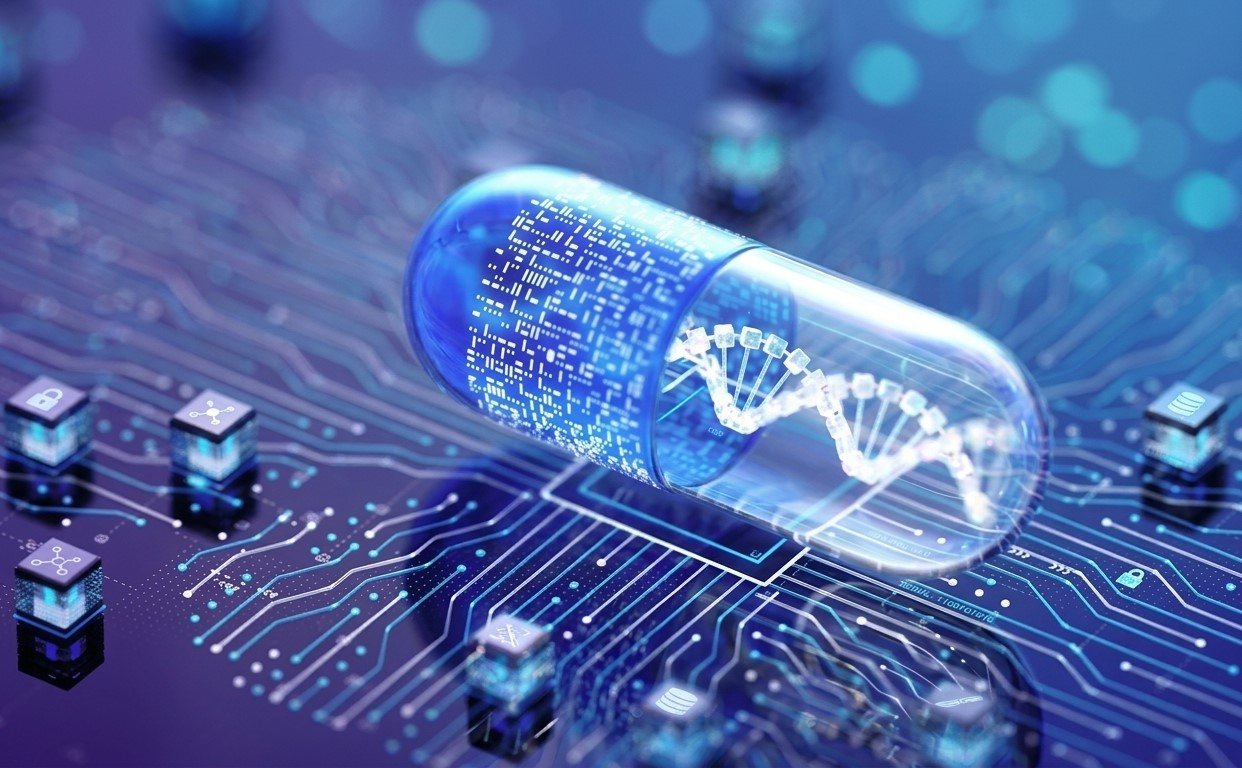
Scientists have created a DNA computer in a drop of water that can perform mathematical calculations using molecules instead of traditional silicon chips. The unusual system, developed by researchers at Maynooth University in Ireland, can perform addition, subtraction, multiplication and division using strands of DNA arranged into a microscopic computing structure.
The research represents a striking DNA computing breakthrough because the system does not require the continuous flow of electricity used by conventional computers. Instead, the researchers designed DNA molecules to interact, reorganize and naturally settle into structures that represent the answers to programmed calculations.
The technology is nowhere near replacing laptops or smartphones. However, it could eventually open new possibilities for molecular computing, biological sensing and extremely dense data storage.
How Can DNA Become a Computer?
When most people think about DNA, they think about genetics, cells and biological inheritance.
Scientists, however, can also treat DNA as a programmable material.
DNA consists of four chemical bases adenine, thymine, cytosine and guanine, commonly represented as A, T, C and G. The way these bases pair and interact allows researchers to design strands that behave according to specific rules.
In the new system, scientists used those molecular interactions as the foundation for computation.
Rather than sending electrical signals through billions of transistors, the researchers program information into DNA sequences. The molecules then interact with one another and form structures according to the rules built into their sequences.
That makes the computer fundamentally different from a conventional electronic machine.
The Computer Really Does Fit Into a Tiny Amount of Water
The physical setup sounds surprisingly simple.
Researchers placed DNA strands, salt and other components into a small amount of water inside a test tube. They then heated and cooled the mixture.
That process allowed the DNA strands to assemble into an organized molecular structure.
According to Maynooth University, the team used a long DNA strand as a scaffold along with hundreds of shorter DNA strands. The resulting structure acts as a molecular computing system.
The important part is what happens next.
The molecules interact with one another, and their final arrangement represents the result of the calculation.
In other words, the physical structure of the molecules becomes part of the computation.
It Can Perform More Than Simple Addition
This is not simply a laboratory demonstration that DNA can represent a number.
The researchers tested 10 different molecular programs.
The system successfully performed several forms of arithmetic, including:
- Addition
- Subtraction
- Multiplication
- Division
- 100-bit calculations
Maynooth University reported that one experiment involved adding numbers in the range of approximately 11 million to 34 million. That calculation could take up to 14 hours, while a much smaller calculation such as 10 plus 3 took about 30 seconds.
Those speeds are extremely slow compared with modern silicon processors.
However, speed is not the main point of the experiment.
The researchers are exploring a completely different way of computing.
Why It Does Not Need Continuous Electricity
One of the most interesting aspects of this DNA computing breakthrough is its energy model.
Traditional computers constantly move electrical signals through transistors. Even when a computer performs a relatively simple operation, the system requires electrical power to control and maintain those operations.
The DNA computer works differently.
The researchers first provide heat to initiate the molecular process. Once the reaction begins, the DNA molecules interact and move toward energetically favorable states.
The researchers describe the system as thermodynamically favored because the molecules naturally move toward the state representing the computation’s result.
That means the computer does not need a continuous electrical power supply to keep the calculation moving.
This does not mean the computer is completely energy-free.
Heating the molecular mixture still requires energy.
Instead, the important difference is that the computation itself is driven by chemical and physical processes rather than continuous electronic switching.
The Secret Is DNA Origami
The researchers used a technique known as DNA origami to construct the molecular computer.
The name sounds playful, but the technique is highly sophisticated.
Scientists can take a long DNA strand and fold it into a particular shape using many shorter DNA strands. These smaller strands act like molecular staples, holding sections of the longer strand in carefully designed positions.
For the Maynooth system, this approach created a microscopic scaffold capable of organizing the DNA molecules involved in the calculation.
Once the DNA structure is assembled, molecular interactions allow the programmed calculation to take place.
This is one reason the project is important beyond the specific arithmetic demonstrations.
It shows that researchers can engineer molecular structures to carry out increasingly complex computational tasks.
A 100-Bit Molecular Calculation
The researchers also demonstrated calculations involving 100 bits.
That is significant because it shows the system can handle information considerably more complex than a basic molecular logic demonstration.
The researchers ran multiple programs and found that the system could be reused for different calculations.
Maynooth University reported that the computer performed as many as 25 calculations in a row during testing.
Still, it is important not to confuse molecular complexity with computer speed.
A modern electronic processor performs enormous numbers of operations extremely quickly.
The DNA computer is currently far slower.
Its significance comes from demonstrating another computational architecture rather than competing directly with today’s CPUs and GPUs.
Why Scientists Are Interested in DNA Computing
The biggest attraction may be the enormous information density possible with DNA.
DNA can store information at a molecular scale.
That makes it fundamentally different from conventional magnetic or semiconductor storage.
Researchers around the world have therefore been investigating DNA not only as a computing material but also as a potential long-term data-storage medium.
The Maynooth University project is part of a broader research effort called DISCO DNA-based Infrastructure for Storage and Computation.
The long-term objective is to understand whether biological molecules can be used for both storing and processing information.
That could become increasingly interesting as global demand for data storage continues to grow.
Could DNA Computers Replace Silicon?
Not anytime soon.
Silicon remains vastly faster and more practical for general-purpose computing.
Your smartphone, laptop or desktop computer can perform billions of electronic operations every second.
The DNA computer demonstrated by the researchers operates on a completely different timescale.
Some calculations take seconds, while larger ones can take hours.
There is therefore no evidence that DNA computers are about to replace conventional processors.
Instead, scientists are looking for areas where molecular computing could offer advantages that electronic computers cannot easily provide.
Could These Computers Work Inside the Human Body?
This is where the research becomes particularly interesting.
The researchers suggest that molecular computers could eventually have applications involving biological environments.
Imagine a molecular system capable of detecting a specific biological signal and then performing a programmed calculation.
Such technology could theoretically help identify disease-related molecular patterns.
It could also potentially support future biological sensors that operate directly inside cells or tissues.
However, these applications remain research possibilities rather than current medical technologies.
The new computer has demonstrated molecular arithmetic in controlled laboratory conditions. It has not demonstrated a working diagnostic computer operating inside a human body.
That distinction is important.
DNA Computing Could Also Help With Data Storage
Another possible application is long-term information storage.
DNA is remarkably dense compared with conventional storage materials.
Researchers have already demonstrated that digital information can be encoded into DNA sequences.
The challenge is making the process practical, affordable and fast enough for real-world applications.
A future system could potentially combine DNA storage and DNA computation.
Instead of moving information from molecular storage into an electronic processor, certain calculations might eventually happen directly within molecular systems.
That is one of the reasons the current research has attracted attention.
The Biggest Problem Is Speed
Despite the impressive demonstration, DNA computing has major limitations.
Speed is one of them.
The Maynooth system can take significantly longer to perform calculations than conventional electronic computers.
Another challenge is controlling millions or billions of molecules with sufficient precision.
Electronic engineers have spent decades developing manufacturing techniques capable of producing extremely reliable semiconductor devices.
Molecular computers are still at an early research stage.
Scientists must determine how to scale them while keeping the molecular reactions predictable.
Another Challenge: Reading the Answer
There is also the problem of reading molecular results.
An electronic computer can immediately send a digital result to a screen.
A molecular computer produces a physical molecular state.
Researchers need techniques capable of detecting and interpreting that state.
The more complicated the computation becomes, the more challenging this process can become.
Therefore, building the molecular computer is only one part of the problem.
Researchers also need efficient ways to communicate with it.
Why This Breakthrough Matters Now
The world is experiencing enormous growth in computing demand.
Artificial intelligence, scientific simulations, cloud computing and data centers are consuming increasing amounts of computational resources.
That has created pressure to find new ways of computing that are more energy-efficient or specialized.
The DNA computing breakthrough from Maynooth University does not solve that problem today.
But it demonstrates that computation does not have to depend exclusively on silicon and electricity.
Nature itself provides enormous numbers of molecular processes that can process information.
Scientists are now learning how to program some of those processes.
A Completely Different Future for Computing
The most fascinating possibility is that the future of computing may not involve one technology replacing another.
Instead, different computing systems could be used for different jobs.
Silicon chips may remain dominant for everyday computing.
Quantum computers may eventually tackle certain specialized problems.
Neuromorphic systems may attempt to mimic aspects of biological brains.
And molecular computers could potentially handle tasks involving biological information, molecular sensing or ultra-dense data.
The DNA computer in a drop of water represents an early step toward that broader future.
This Is Not a Tiny Laptop
The headline sounds almost like science fiction: a computer inside a drop of water.
But it is important to understand what that actually means.
The researchers did not create a miniature smartphone that can browse the internet.
They created a molecular computing system in which DNA structures encode and process information through chemical interactions.
It performs mathematical operations, but it does not currently provide the flexibility or speed of a conventional computer.
That makes the achievement scientifically interesting without requiring exaggerated claims about an imminent technological revolution.
What Happens Next?
The next challenge will be scaling the technology.
Researchers will need to determine whether more complicated algorithms can be performed reliably.
They will also need to improve reaction times, reduce the resources required and develop better methods for reading molecular outputs.
If those problems can be solved, DNA computing could eventually find specialized applications.
Possible areas include:
- Molecular diagnostics
- Biological sensors
- Data storage
- Environmental monitoring
- Specialized scientific computing
- Molecular information processing
For now, these remain research directions rather than commercial products.
The Bigger Picture
The idea that DNA could perform mathematical calculations changes the way we think about computers.
For decades, computing has been closely associated with silicon chips, electrical circuits and transistors.
Now researchers are demonstrating that molecules can also be programmed to process information.
The new DNA computer in a drop of water is still slow compared with conventional machines, but it demonstrates something important: computation can emerge from carefully designed physical and chemical processes.
The researchers themselves describe the work as exploratory science, with applications still uncertain.
That uncertainty is part of what makes the research interesting.
The first computers were enormous machines that occupied entire rooms. Today, powerful processors fit inside phones and watches.
The next transformation may not simply make computers smaller.
It may change what we consider a computer in the first place.
Conclusion
The DNA computer in a drop of water is one of the more unusual computing experiments reported this month.
Researchers at Maynooth University have demonstrated a molecular computer built from DNA strands that can perform addition, subtraction, multiplication and division without requiring a continuous supply of electricity. The system also completed 100-bit calculations and was tested across multiple programs.
The technology is nowhere near replacing silicon processors.
It is slower, more difficult to control and still firmly in the research stage.
Yet the DNA computing breakthrough demonstrates a powerful idea: information processing does not have to happen only through electronic circuits.
It can also happen through molecules.
If researchers eventually learn how to make these systems faster, more reliable and easier to control, DNA computers could find applications in areas where conventional computers are less suitable.
For now, a tiny mixture of water, salt and DNA has provided something much bigger than a calculation.
It has offered scientists another possible path toward the future of computing.
Frequently Asked Questions
What is a DNA computer in a drop of water?
A DNA computer in a drop of water is a molecular computing system that uses programmed DNA strands and their chemical interactions to perform calculations.
Can DNA really perform mathematical calculations?
Yes. The Maynooth University system successfully performed addition, subtraction, multiplication and division, as well as more complex 100-bit calculations.
Does a DNA computer need electricity?
The demonstrated system does not require a continuous electrical power supply for the computation. Researchers use heat to initiate the molecular process, after which the DNA molecules move toward an energetically favorable state.
Is DNA computing faster than a normal computer?
No. Conventional silicon computers are vastly faster. The importance of this research is that it demonstrates a different method of computation rather than a faster replacement for modern processors.
Could DNA computers replace laptops?
There is currently no evidence that DNA computers could replace laptops or smartphones. Their potential is more likely to involve specialized molecular computing, biological sensing and information storage.
Why is this DNA computing breakthrough important?
The DNA computing breakthrough demonstrates that molecular structures can be programmed to process information and perform useful calculations without relying on conventional electronic circuits.