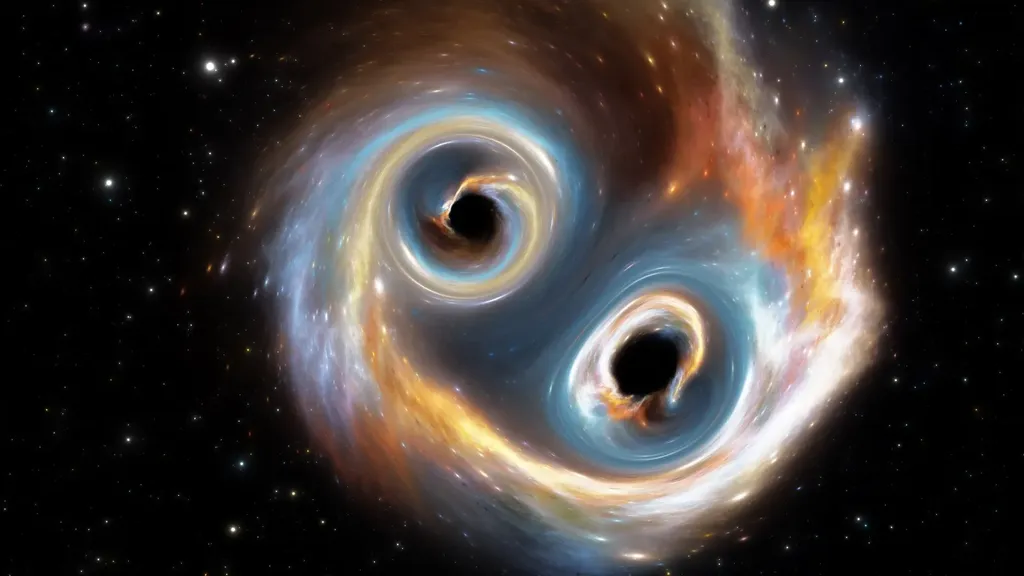
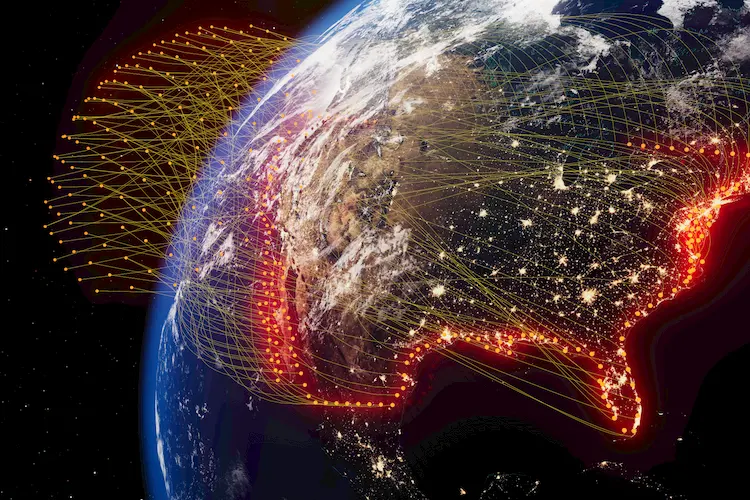
An impossible black hole merger may finally have a possible explanation, but the proposed solution creates another cosmic mystery that scientists cannot yet solve.
LIGO detected the gravitational-wave signal, known as GW231123, in November 2023. The signal came from two enormous black holes that collided roughly 2 billion light years from Earth.
The original analysis suggested that the two black holes weighed roughly 100 and 130 times as much as the Sun. Those enormous masses created a major problem for astronomers because they appeared to occupy a difficult region known as the black-hole mass gap.
Now, researchers have proposed another possibility.
The black holes might not have been as massive as they appeared.
A powerful gravitational lens could have magnified and distorted their gravitational waves during the journey toward Earth.
That possibility could explain the unusual merger. However, it also raises a new question:
What object acted as the cosmic lens?
The Strange Signal That Started the Mystery
On November 23, 2023, LIGO detected powerful ripples moving through spacetime.
Scientists call these ripples gravitational waves.
When enormous objects accelerate violently through space, they create these waves. Black-hole mergers produce some of the strongest gravitational waves that scientists can detect.
GW231123 immediately attracted attention because of the apparent size of its black holes.
The original analysis estimated masses of roughly 100 and 130 solar masses.
After the collision, the resulting black hole appeared to weigh roughly 230 times as much as the Sun.
That result created a serious puzzle.
The black holes seemed too massive to fit comfortably within the standard picture of how stars create black holes.
Their unusually high spins created another challenge.
Astronomers therefore had to ask a difficult question:
How did these black holes become so massive?
What Is the Black Hole Mass Gap?
Scientists understand several ways that massive stars can produce black holes.
When certain massive stars exhaust their nuclear fuel, their cores collapse under gravity. That collapse can create a black hole.
However, extremely massive stars can behave differently.
Some theoretical models suggest that pair-instability processes can prevent stars within certain mass ranges from producing ordinary black holes.
This creates a region that scientists call the black-hole mass gap.
Astronomers generally expect far fewer black holes within this range.
GW231123 appeared to contain objects close to or inside this difficult region.
That result forced researchers to consider unusual formation scenarios.
Scientists Considered Several Explanations
One possibility involves unusual stellar evolution.
Another possibility involves repeated black-hole mergers.
In a dense stellar environment, one black hole could merge with another. The resulting object could then merge again.
Over many generations, this process could create increasingly massive black holes.
Scientists call this process a hierarchical merger.
However, such a scenario requires a suitable environment and a specific history of previous mergers.
Researchers therefore continue to investigate alternative explanations.
The newest idea takes a completely different approach.
Perhaps the black holes never had the enormous masses that the original signal suggested.
Einstein’s Theory May Hold the Key
The proposed explanation connects directly to one of the most important ideas in Einstein’s general theory of relativity.
The Einstein relativity black hole connection starts with a simple principle: mass and energy curve spacetime.
That curved spacetime can alter the path of objects and waves moving through it.
Astronomers call this effect gravitational lensing.
Scientists have observed gravitational lensing many times with light from distant galaxies and stars.
The new research asks whether a similar process could affect gravitational waves.
If so, gravity itself could have changed the way GW231123 looked to LIGO.
What Is Gravitational Lensing?
Imagine viewing a distant object through a giant invisible lens.
The lens does not need glass.
Instead, a massive object between the distant source and Earth can bend spacetime around itself.
Light traveling through that curved region can change direction.
The effect can also magnify distant objects or create multiple images of the same source.
Einstein’s theory predicted this behavior.
Astronomers now use gravitational lensing to investigate distant galaxies, galaxy clusters and dark matter.
Gravitational waves could potentially experience a related effect.
However, gravitational waves differ fundamentally from light because they represent ripples in spacetime itself.
That difference makes the new hypothesis especially interesting.
The New Theory
Researchers created models showing how gravitational lensing could affect the GW231123 signal.
Their calculations suggest that a massive object between Earth and the black hole merger could have magnified the gravitational waves.
That magnification could make the black holes appear more massive than they actually were.
Under this interpretation, the merged black hole could have a mass closer to 140 times the mass of the Sun rather than roughly 230 solar masses.
That difference would significantly change the interpretation of the event.
It could also remove the need for the black holes to possess unusually high spins.
In simple terms, the universe may have made the collision look stranger than it really was.
But There Is a Major Problem
The new explanation still has an important weakness.
Scientists have not directly confirmed gravitational lensing in GW231123.
The researchers created a theoretical model that shows how lensing could explain the observations.
But the model does not prove that lensing actually occurred.
Scientists therefore need more evidence.
They also need to find the object that could have acted as the lens.
That missing object now creates another astronomical mystery.
What Could Have Bent the Gravitational Waves?
The proposed lens could have taken several forms.
It might have involved a compact object with a mass between roughly 190 and 850 times that of the Sun.
It could also involve a larger structure such as a globular cluster.
Neither explanation has received confirmation.
If scientists eventually identify the lens, they could gain valuable information about the matter located between Earth and the black-hole merger.
For now, however, researchers have no definitive answer.
The Universe May Be Playing Tricks on Us
The theory highlights a major challenge in modern astronomy.
Scientists rarely observe distant cosmic events directly.
Instead, they collect signals that have traveled enormous distances through space.
Those signals can interact with matter and gravity along the way.
Light can undergo gravitational lensing.
If the new research proves correct, gravitational waves can also experience significant distortions.
That possibility could change how astronomers interpret future gravitational-wave detections.
Why This Matters for Black Hole Astronomy
Gravitational-wave astronomy remains a relatively young scientific field.
Scientists announced the first direct gravitational wave detection in 2016.
That discovery opened a completely new way to observe the universe.
Traditional astronomy relies heavily on electromagnetic radiation such as visible light, infrared radiation and X-rays.
Gravitational wave detectors provide another source of information.
They allow scientists to study black-hole mergers and neutron star collisions even when those objects produce little visible light.
If gravitational lensing affects gravitational waves, researchers could gain another powerful tool.
Could Lensing Reveal Hidden Objects?
A lensed gravitational wave signal could potentially tell astronomers about objects located between Earth and a distant merger.
Scientists might use unusual magnification or other distortions to search for massive objects that remain difficult to observe.
That possibility could eventually help researchers study compact objects and the distribution of matter across the universe.
Dark matter also makes this possibility especially interesting.
Astronomers already use ordinary gravitational lensing to investigate dark matter.
Future gravitational-wave observations could potentially add another source of information.
However, researchers still need to demonstrate the effect clearly before scientists can use it as a reliable tool.
The Missing Lens Is Now the Bigger Mystery
The proposed explanation may solve one problem while creating another.
If gravitational lensing magnified GW231123, scientists need to identify the lens.
The required object could prove difficult to find.
It might contain a relatively unusual compact object.
It might belong to a dense stellar environment.
Or researchers could eventually discover that another explanation fits the data better.
For now, the missing lens remains an open question.
What Happens If Scientists Confirm It?
A confirmed example of gravitational wave lensing could transform this area of astronomy.
Scientists could search future gravitational wave observations for similar patterns.
They might identify unusual magnification, repeated signals or other signatures that reveal lensing.
Researchers could then study both the original merger and the object that altered its signal.
One gravitational-wave event could therefore provide information about several regions of the universe.
LIGO Could Become Even More Important
LIGO played the central role in detecting GW231123.
The observatory uses laser interferometers to detect incredibly small changes caused by passing gravitational waves.
Those changes can measure less than the width of a proton.
Despite that tiny signal, scientists can reconstruct information about the objects that created the waves.
Future upgrades should make gravitational wave detectors even more sensitive.
Scientists could then detect weaker events and study subtle effects such as possible gravitational lensing.
A much larger collection of black-hole mergers could also reveal whether GW231123 represents an unusual event or part of a larger population.
Does This Mean Einstein Was Right Again?
The answer requires some caution.
Einstein’s general theory of relativity already predicts gravitational waves and gravitational lensing.
The new research does not suddenly prove Einstein’s theory.
Instead, researchers use the theory to explore whether gravitational lensing could explain an unusual gravitational-wave observation.
The mathematical framework supports the possibility.
But scientists still need observational evidence.
That distinction matters because a plausible theoretical explanation does not automatically become a confirmed discovery.
A Mystery Within a Mystery
The impossible black hole merger may therefore look less impossible than scientists originally thought.
A gravitational lens could have magnified the waves and made the black holes appear much more massive.
That explanation could resolve some of the problems surrounding GW231123.
But it immediately creates another mystery.
What bent the gravitational waves?
Scientists do not yet know.
That unanswered question could lead researchers toward an entirely new understanding of distant cosmic objects.
What Scientists Know And What They Don’t
Scientists know that LIGO detected GW231123 in November 2023.
They know that the signal came from a black hole merger roughly 2 billion light-years from Earth.
The original analysis suggested unusually massive black holes.
A newer study proposes that gravitational lensing could have magnified the signal.
The researchers’ model suggests that the final black hole could have weighed around 140 times as much as the Sun.
However, scientists have not confirmed the proposed lens.
They also have not conclusively demonstrated gravitational wave lensing in this event.
Those uncertainties remain important.
The lensing explanation offers a compelling possibility, but researchers still need observational evidence.
The Bigger Picture
The most important outcome may not involve GW231123 alone.
If scientists confirm gravitational wave lensing, they could gain a new method for studying the universe.
Astronomers could use distant black hole mergers as natural probes.
As gravitational waves travel toward Earth, massive objects could alter their signals.
Scientists could then study those distortions to learn more about the intervening universe.
The cosmos could effectively become a giant gravitational laboratory.
Why the Discovery Could Change Astronomy
Astronomy has repeatedly expanded whenever scientists discovered a new way to observe the universe.
Telescopes opened the visible universe.
Radio astronomy revealed objects that ordinary telescopes could not see.
X-ray and infrared observatories exposed different cosmic environments.
Gravitational-wave detectors added another dimension.
A reliable method for detecting gravitational wave lensing could expand that window again.
Scientists could potentially investigate otherwise hidden objects using the way those objects influence spacetime itself.
Conclusion
The impossible black hole merger detected through GW231123 may have a surprisingly elegant explanation.
Instead of requiring two extraordinarily massive black holes with unusual properties, the event may have looked unusually powerful because gravity distorted its signal during the journey toward Earth.
The proposed explanation relies on gravitational lensing, a phenomenon that follows from Einstein’s general theory of relativity.
However, scientists have not yet proven that lensing caused the unusual appearance of GW231123.
Researchers also have not identified the object that would have acted as the lens.
That means the mystery remains open.
In fact, the proposed solution may have created an even more fascinating question.
If a massive object really magnified the gravitational waves, what exactly was that object?
Future gravitational wave observations could provide the answer.
Until then, GW231123 remains a remarkable example of how the universe can challenge scientists with an observation that appears impossible at first and then force them to look at the laws of physics from an entirely new angle.
Frequently Asked Questions
What was the impossible black hole merger?
The impossible black hole merger refers to GW231123, a gravitational-wave event that LIGO detected in November 2023. Its original interpretation suggested unusually massive black holes.
What is GW231123?
GW231123 is the scientific designation for a gravitational-wave signal produced by a black-hole merger roughly 2 billion light-years from Earth.
How could gravitational lensing explain the merger?
A massive object between Earth and the merger could bend and magnify the gravitational waves. That effect could make the original black holes appear more massive than they actually were.
What does Einstein relativity have to do with black holes?
Einstein’s general theory of relativity describes how mass and energy curve spacetime. The theory also predicts gravitational waves and gravitational lensing, which form the basis of the proposed explanation.
Has gravitational wave lensing been proven?
No. Researchers have proposed the explanation through theoretical modeling, but scientists have not yet directly confirmed that GW231123 experienced gravitational lensing.
What is the new mystery?
If a gravitational lens magnified the signal, scientists need to identify the massive object that produced the lensing effect. Researchers have not yet found a confirmed candidate.
Could this change black hole research?
Potentially. If future observations confirm gravitational wave lensing, astronomers could use distorted gravitational-wave signals to investigate objects located between Earth and distant cosmic events.