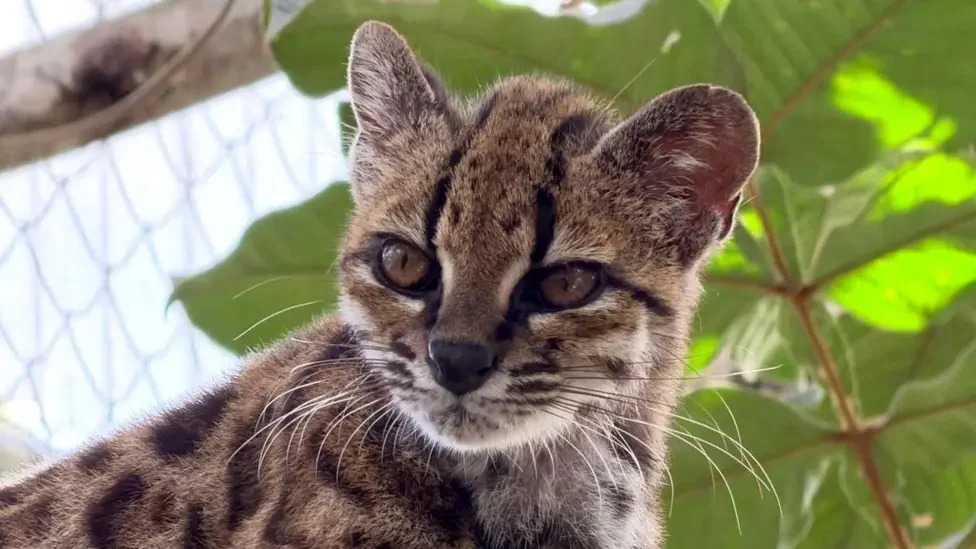
A new wild cat species 2026 discovery has stunned scientists and wildlife enthusiasts after researchers formally identified a tiny spotted feline living in Bolivia’s Yungas cloud forest. Named Leopardus tilcayo, the animal is known as the Tilcayo cat and represents the first new living wild-cat species formally described by scientists in more than a century.
The discovery is remarkable for another reason: the cat was not found during a dramatic expedition into an unexplored jungle. Scientists had actually encountered the animal years earlier. It took detailed genetic research and comparisons with museum specimens to establish that it was something different.
Now, researchers are racing to find out how many Tilcayos may be living in the forests of Bolivia.
Meet the Tilcayo Wild Cat
The Tilcayo wild cat is a small member of the tiger-cat group found across South America.
It is considerably smaller than many people would expect from a wild feline. The known male measures about 18 inches in body length and weighs roughly 3 pounds, making him smaller than many domestic cats. His coat is light brown with distinctive dark rosettes, while his ears are relatively short and rounded.
Despite its small size, the Tilcayo is a genuine wild cat adapted to life in the mountainous forests of Bolivia.
And scientists now believe it represents a lineage that has remained hidden in plain sight for a very long time.
The Discovery Started With a “Strange Cat”
The story of the Tilcayo is unusual.
In 2016, Bolivian biologist Paola Nogales-Ascarrunz was contacted after a wildlife sanctuary received a small cat that had originally been taken in by a local family.
The family had initially believed they were caring for an unusual domestic cat.
But as the animal grew, it became clear that it was not an ordinary house cat.
The animal eventually reached Senda Verde, a wildlife refuge in Bolivia’s Yungas region.
At first, researchers thought the cat belonged to a species already known to science.
That assumption would eventually change.
Scientists Realized Something Was Different
Nogales-Ascarrunz later revisited photographs of the animal while working on research about Bolivia’s wild cats.
The appearance did not seem to match what researchers expected from the species with which it had originally been classified.
That prompted deeper investigation.
Scientists began comparing the animal with other tiger cats from across South America.
The breakthrough came through genetics.
Researchers analyzed DNA from living animals as well as historical specimens preserved in museums. The work revealed that what scientists had previously treated as a single widespread tiger-cat group actually contained multiple genetically distinct species.
One of those lineages was the Tilcayo.
The DNA Changed the Cat Family Tree
The discovery is important because it does more than add another name to a wildlife list.
The research suggests that South America’s tiger cats are more diverse than scientists previously recognized.
The international research team analyzed genetic material from 38 cats from different regions and found evidence for five distinct tiger-cat species within a group that had previously been treated much more broadly.
The Tilcayo lineage itself appears to have separated from related tiger cats roughly 1.4 million years ago.
In other words, this is not a recently evolved animal.
It has apparently been genetically distinct for a very long time.
Scientists simply did not formally recognize it as a separate species until now.
Where Does the Tilcayo Live?
The Tilcayo wild cat has so far been associated with Bolivia’s Yungas cloud forest.
The Yungas is a mountainous forest region on the eastern slopes of the Andes, where the ecosystems connect the Andes with the Amazon basin.
It is a biologically rich but relatively poorly studied environment.
That makes the region especially interesting to researchers.
The discovery of the Tilcayo suggests that there could be more biodiversity hidden within these forests than current scientific records indicate.
Researchers are now installing camera traps in the Yungas to search for Tilcayos living in the wild.
There May Be More Tilcayos Out There
Perhaps the biggest mystery surrounding the new wild cat species 2026 discovery is how many animals actually exist.
At present, scientists have very limited information about the Tilcayo’s wild population.
One male is living under protective care at Senda Verde, and researchers are trying to document animals in their natural habitat.
That means scientists still have major questions to answer.
How large is the population?
Where exactly does the species live?
What does it eat?
How does it reproduce?
How far does it travel?
And perhaps most importantly, how threatened is it?
The answers could determine how conservationists protect the species.
A New Species Does Not Mean a New Animal
There is an important distinction in this story.
Scientists did not suddenly discover an animal that evolved this year.
The Tilcayo has apparently existed as a distinct evolutionary lineage for around 1.4 million years.
What happened in 2026 was that researchers formally recognized and described it as a separate species.
That distinction matters because modern science continues to uncover species that have been present for thousands or millions of years but were previously grouped together with other animals.
Genetic technology is making these discoveries increasingly possible.
Why Genetic Research Was So Important
Wild cats can be difficult to distinguish simply by looking at them.
Several South American tiger cats have similar body shapes, coats and markings.
This can make traditional identification challenging.
DNA analysis provides another layer of evidence.
By comparing genomes from different animals, researchers can identify evolutionary relationships that may not be obvious from physical appearance alone.
In the Tilcayo study, genetic evidence helped demonstrate that the animal represented a distinct lineage.
The research also involved historical museum specimens, showing how collections gathered decades ago can become valuable sources of new scientific discoveries.
The Discovery Rewrites More Than One Species
The research did not only identify the Tilcayo.
Scientists also found evidence for additional diversity among South America’s tiger cats, including a newly recognized subspecies in Peru.
That means the study could change how scientists understand the distribution and evolution of several small wild-cat populations.
A group once viewed as one broad species may actually represent a much more complicated family tree.
This matters for conservation because protecting biodiversity depends on knowing exactly what populations and species exist.
Why Finding the Tilcayo Matters for Conservation
Discovering a species is only the beginning.
The Yungas forests face pressure from deforestation, agriculture, fires and mining.
If the Tilcayo has a very small range, habitat loss could become a serious threat.
Researchers have warned that the species could be vulnerable even though its exact population size is still unknown.
That creates an unusual conservation situation.
Scientists have identified the species, but they are still trying to determine how widespread it is.
Finding more animals in the wild will be crucial.
The Cat That Was Mistaken for a Pet
Perhaps the most surprising part of the story is how ordinary the discovery initially appeared.
The cat that helped scientists identify the species was living under human care after being taken in by a family.
It was not discovered during a high-tech expedition or captured on a remote wildlife camera.
Instead, scientists encountered an unusual-looking animal and eventually realized that its DNA told a much bigger story.
That is a reminder that major scientific discoveries can sometimes begin with something remarkably simple: someone noticing that an animal does not quite fit what scientists already know.
Why It Took More Than 100 Years
The last newly described living wild-cat species was the pampas cat in 1923.
That makes the formal recognition of Leopardus tilcayo a particularly rare event in mammalogy.
Wild cats are relatively well studied compared with many smaller mammals.
They are also charismatic animals that attract significant scientific attention.
Finding a previously unrecognized species within such a familiar group is therefore unusual.
The Tilcayo demonstrates that even well known animal families can still contain surprises.
Scientists Are Now Looking for the Cat in the Wild
The next phase of the research is likely to be even more important than the original discovery.
Researchers are deploying camera traps throughout the Bolivian Yungas to determine whether additional Tilcayos can be documented.
Those cameras could reveal where the animals live, how frequently they appear and whether there is a breeding population.
Scientists may also be able to learn more about the animal’s behavior and habitat requirements.
For now, many basic facts about the species remain unknown.
Could There Be More New Cats?
The researchers believe the methods used to identify the Tilcayo could help uncover additional hidden diversity.
If populations previously grouped into one species are genetically distinct, similar discoveries could potentially occur elsewhere.
That does not mean scientists are about to announce dozens of new wild cats.
But the research demonstrates how genomic analysis can reveal biodiversity that conventional classification may have overlooked.
The forests of South America could therefore hold more taxonomic surprises.
The Tilcayo Is Tiny But Scientifically Huge
The Tilcayo wild cat may weigh only around three pounds, but its discovery has much larger implications.
It shows that Earth’s biodiversity is still not completely catalogued.
It also demonstrates the importance of combining field observations, museum collections and modern genetic analysis.
Most importantly, the discovery brings attention to the Yungas ecosystem itself.
If a previously unrecognized wild cat has survived there for millions of years, protecting the forest could help ensure that the species continues to exist for millions more.
Final Thoughts
The new wild cat species 2026 discovery is one of the year’s most unusual wildlife stories.
Leopardus tilcayo was not a brand new animal. It was a species that had apparently been evolving separately for around 1.4 million years, while scientists had mistakenly grouped it with other tiger cats.
Now, thanks to genetic research, the Tilcayo has its own scientific identity.
The next challenge is finding out how many are still living in Bolivia’s Yungas cloud forests.
For conservationists, that question could be more important than the discovery itself.
The world has officially met the Tilcayo. Now scientists need to find out how much of this tiny wild cat’s world remains.