The idea of an underwater wind farm is moving from science-fiction territory toward serious marine engineering research. Scientists and engineers are exploring ways to combine offshore renewable energy with aquaculture, allowing a floating wind turbine platform or surrounding wind-farm area to support fish, shellfish or seaweed production at the same time. Recent research shows that these multi-use systems are technically promising, although many concepts remain at the pilot or development stage.
The concept is surprisingly simple.
Offshore wind turbines already occupy valuable ocean space.
Aquaculture also needs marine space.
Instead of treating the two industries as competing for the same ocean, researchers are asking whether they can share it.
That could turn a wind farm into something much bigger than an electricity project.
It could become a multi-purpose ocean production system.
What Is an Underwater Wind Farm?
The phrase underwater wind farm can sound as if the entire turbine is submerged beneath the sea.
That is not what scientists are generally proposing.
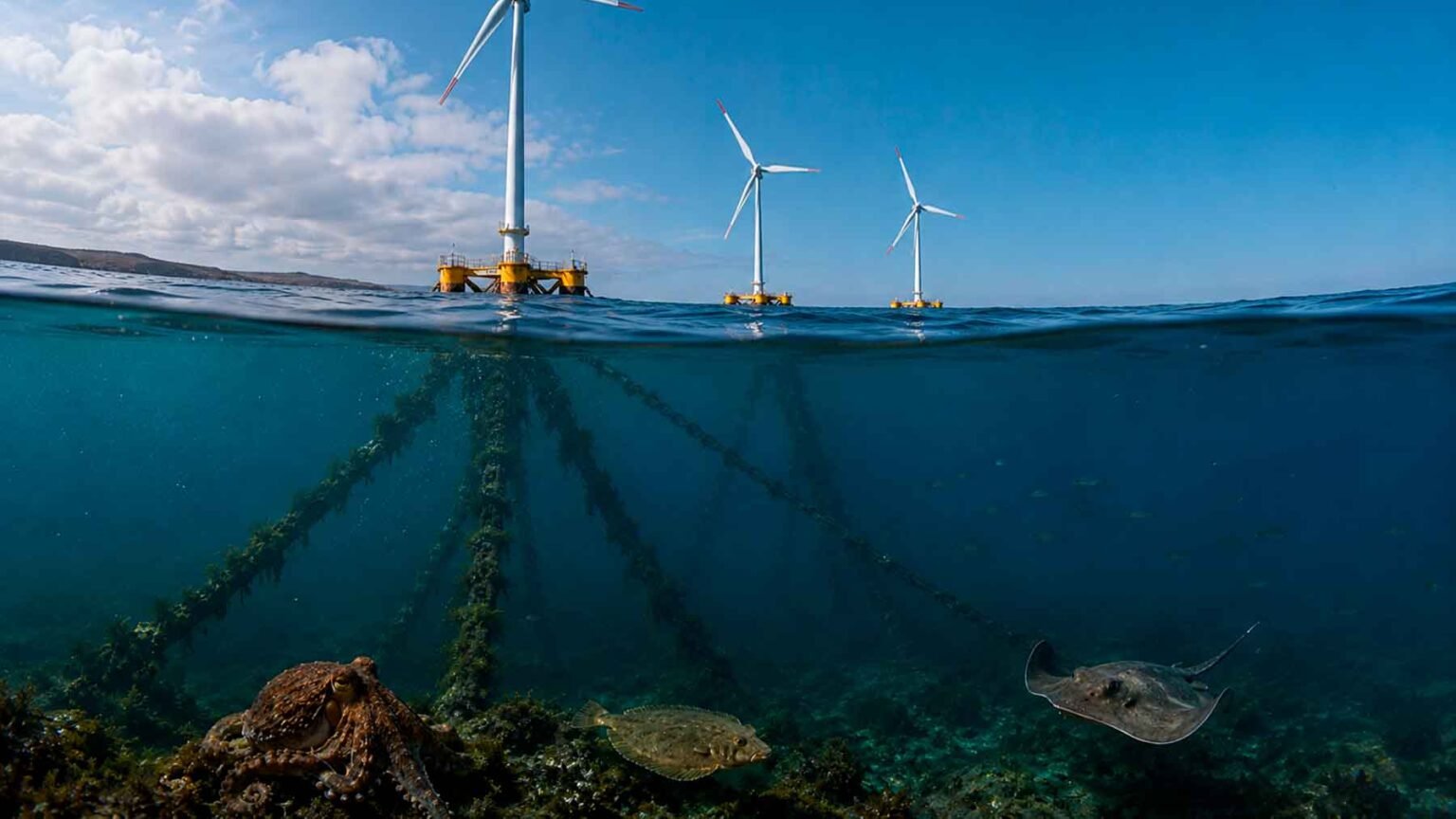
In most concepts, the turbine remains above the water while aquaculture equipment operates beneath or around the floating platform.
Fish cages, mussel lines or seaweed cultivation systems can occupy the surrounding marine area.
A floating platform can therefore become a foundation for several activities at once.
This approach is often described as co-location or a multi-use offshore platform.
A 2026 review in Frontiers in Marine Science examined the growing research into combining offshore renewable energy and aquaculture and found that co-location can offer a lower-risk pathway compared with building completely integrated platforms from scratch.
How a Floating Wind Turbine Could Become an Ocean Farm
Imagine a huge floating platform several kilometers offshore.
At the top stands a wind turbine.
Its blades rotate hundreds of feet above the waves.
Below the water, however, a completely different operation is taking place.
Cages could hold fish.
Longlines could support mussels.
Seaweed could grow on submerged ropes.
Sensors could continuously monitor temperature, oxygen, salinity and water quality.
The same marine space would then perform several jobs simultaneously.
Electricity above the surface.
Food production below it.
That is the basic vision behind floating wind-aquaculture systems.
The Technology Is Already Being Tested
This is not merely a theoretical idea.
Researchers have been developing and testing combinations of offshore wind and aquaculture for years.
One example is the European AquaWind project, which developed a prototype combining a floating wind turbine platform with aquaculture facilities. The system was designed to support fish farming and potentially seaweed or shellfish production while generating renewable electricity.
More recently, researchers have continued developing integrated floating platforms.
A 2026 Ocean Engineering study examined a coupled floating wind-aquaculture system using flexible nets and numerical modeling to better understand how the structures interact with wind and waves.
These studies show that the concept is becoming increasingly sophisticated.
Why Put Farms Inside Wind Farms?
The ocean is becoming increasingly crowded.
Offshore wind developers need large areas where turbines can operate safely.
Fishing fleets need access to productive waters.
Aquaculture requires suitable locations.
Shipping requires navigation corridors.
Marine conservation also needs protected areas.
Consequently, simply giving every industry its own separate section of ocean could become increasingly difficult.
Co-location offers another possibility.
If a wind farm has already been established, parts of the surrounding area could potentially support carefully designed aquaculture operations.
Researchers say this approach could improve the efficiency of marine-space use while creating additional economic opportunities.
A Wind Farm Could Produce More Than Electricity
A conventional offshore wind project has one primary product:
Electricity.
A multi-use offshore platform could potentially produce several.
For example:
- Renewable electricity
- Fish
- Mussels
- Oysters
- Seaweed
- Marine biomass
That changes the economic model.
Instead of thinking about one turbine as an electricity generator, engineers could eventually think about it as part of a larger blue-economy platform.
The concept could become especially attractive as countries search for ways to increase renewable energy and food production without taking more land.
Seaweed Could Be One of the Biggest Opportunities
Seaweed farming is particularly interesting because it does not require freshwater, fertilizer-intensive farmland or large areas of land.
Offshore cultivation can also provide access to nutrient-rich seawater.
Researchers have investigated whether seaweed systems can coexist with offshore renewable-energy infrastructure.
The challenge is that open-ocean conditions are considerably harsher than sheltered coastal waters.
Large waves, strong currents and storms can damage cultivation equipment.
A 2024 engineering study of offshore kelp farming highlighted the importance of designing floating systems and moorings that can withstand extreme environmental conditions.
Therefore, the wind turbine may provide the platform, but the aquaculture equipment still needs serious engineering.
Fish Farming Creates Another Possibility
Fish cages could also operate near floating wind platforms.
However, the engineering becomes more complicated.
A fish cage contains water, fish, nets and supporting structures.
When large waves hit the system, enormous forces can travel through the cage and its mooring lines.
Now imagine attaching that system to a giant floating wind turbine.
The wind turbine itself is already responding to wind and waves.
Adding an aquaculture cage introduces another moving structure.
That is why scientists use sophisticated computer models and physical experiments to understand the interaction.
A 2025 experimental study examined a proposed floating wind turbine and aquaculture cage combination under different wind and wave conditions.
The Biggest Problem Is Not the Wind Turbine
At first glance, the turbine appears to be the most complicated part.
Surprisingly, that may not be the biggest challenge.
The real difficulty could be managing everything around it.
Engineers need to consider:
- Mooring systems
- Underwater cables
- Fishing vessels
- Maintenance ships
- Aquaculture nets
- Storm conditions
- Biofouling
- Navigation
- Emergency access
- Environmental impacts
A wind farm must remain safe for decades.
An aquaculture operation must also remain accessible and productive.
Combining the two requires careful planning from the beginning.
Cables Could Become a Major Issue
Offshore wind turbines are connected to electrical cables running across the seabed.
Aquaculture systems require anchors and mooring lines.
That creates a potential conflict.
An anchor accidentally hitting an electrical cable could cause major damage.
Therefore, future multi-use wind farms would need clearly defined cable corridors and no-anchor zones.
The 2026 review of offshore renewable-energy and aquaculture co-location specifically identifies cable and anchoring risks as important areas for future development.
This is one reason why adding an aquaculture operation to an existing wind farm may not always be as simple as placing cages between turbines.
The Wind Farm Could Even Change the Local Water Conditions
There is another fascinating effect.
Large offshore energy installations can influence local wave conditions.
Researchers studying multi-use marine systems have examined how arrays can create a type of wave-shadowing effect.
In some circumstances, areas behind structures may experience reduced wave energy.
That could potentially create calmer conditions for certain aquaculture operations.
However, the effect depends heavily on turbine arrangement, wave direction and local ocean conditions.
Researchers therefore need detailed site-specific modeling before declaring a location suitable for farming.
What Happens During a Major Storm?
This is perhaps the most important practical question.
Offshore wind turbines are designed to survive severe weather.
Aquaculture equipment must also withstand storms.
But combining the two creates additional interactions.
A storm can push waves against cages.
The cages can create additional drag.
That force travels through mooring lines.
The mooring system then interacts with the floating turbine platform.
Researchers must understand these forces before commercial deployment.
A 2025 experimental study of a floating wind-aquaculture hybrid found that adding nets affects hydrodynamic damping and fluid loads, with the influence changing depending on the sea state.
This demonstrates why the engineering cannot rely on simple assumptions.
Could Wind Turbines Protect Fish Farms?
Possibly but this requires careful qualification.
A wind farm can alter local wave conditions, and the physical structures may provide some environmental changes around the installation.
However, scientists cannot simply assume that every wind farm automatically creates ideal fish habitat.
Each location has different:
- Currents
- Depth
- Temperature
- Oxygen
- Nutrient levels
- Wave patterns
- Marine species
Therefore, aquaculture would need to match the environmental conditions of the specific wind-farm site.
The North Sea Is Becoming a Testing Ground
Europe is particularly interested in combining offshore wind with marine food production.
The 2026 review highlights projects across Europe and Asia that have tested mussels, oysters, seaweed and fish in or around offshore renewable-energy facilities.
One notable development is North Sea Farm 1, a commercial-scale seaweed farm located within an operational offshore wind farm in the Netherlands.
The project is helping researchers evaluate whether seaweed cultivation can operate at commercial scale while sharing space with offshore energy infrastructure.
That represents an important step.
Laboratory experiments can show whether something might work.
Commercial projects can show whether it works economically.
China Is Also Exploring the Technology
China has become another important research center for offshore wind-aquaculture integration.
Research has examined submerged aquaculture cages and hybrid marine platforms in offshore wind environments.
The 2026 literature includes work on fully coupled floating wind-aquaculture systems, including detailed numerical models that examine how flexible nets influence the behavior of the combined platform.
This matters because offshore wind is expanding rapidly in Asia.
If the technology proves commercially viable, large-scale deployment could eventually combine renewable electricity with marine food production.
Could This Help Solve Food Security?
Potentially.
Global demand for seafood continues to create pressure on marine resources.
Traditional fishing cannot expand indefinitely.
Aquaculture has become an increasingly important source of seafood.
At the same time, countries are expanding offshore renewable energy to reduce fossil-fuel dependence.
Combining the two could allow a single area of ocean to contribute to both energy and food production.
Researchers describe this broader approach as part of the emerging blue economy.
However, it should not be presented as a guaranteed solution.
Large-scale aquaculture can itself create environmental challenges.
Feed requirements, waste, disease and ecological interactions must all be managed.
The Environmental Question Is Still Open
A major offshore wind-aquaculture project could create benefits.
It could also create new environmental pressures.
Scientists need to understand what happens to wild fish, marine mammals, seabirds and benthic ecosystems.
They also need to study whether aquaculture equipment changes local currents or sediment movement.
The 2026 review emphasizes that socio-ecological considerations must be included alongside engineering and economic analysis.
That means the future of the technology will depend on more than producing electricity and fish.
It will also depend on proving that the combined system can operate responsibly.
Maintenance Could Become Much More Efficient
There could be another major advantage.
Offshore wind farms already require specialized vessels and crews for maintenance.
Aquaculture operations also require boats and workers.
If both systems operate together, some activities could potentially be coordinated.
A maintenance vessel could potentially serve multiple purposes during the same trip.
Weather windows could also be planned more efficiently.
Researchers are investigating these potential operations and maintenance synergies as part of the wider co-location concept.
If successful, that could reduce some operating costs.
But the Technology Is Not Ready Everywhere
It would be misleading to suggest that every offshore wind turbine can immediately become an underwater farm.
Most integrated concepts remain at pilot, demonstration or development stages.
Different aquaculture species require different conditions.
Floating platforms also behave differently from fixed-bottom turbines.
Storm exposure can vary dramatically between regions.
Regulations can also determine which activities are permitted inside wind-farm zones.
The 2026 review therefore describes the sector as one that is progressing from experimental projects toward larger-scale commercial applications, rather than an already mature global industry.
The Future Could Be a Multi-Layer Ocean
Imagine looking at the ocean from above.
You see rows of enormous wind turbines.
They generate electricity from offshore winds.
Below the surface, however, the ocean is busy with another industry.
Seaweed lines stretch between carefully selected areas.
Fish cages move with the waves.
Shellfish grow on suspended structures.
Sensors monitor the ecosystem.
Autonomous vessels inspect equipment.
One section of ocean performs multiple functions.
That is the long-term vision behind the underwater wind farm concept.
Floating Wind Makes This Even More Interesting
Fixed-bottom wind turbines have foundations attached to the seabed.
Floating wind turbines are different.
Their platforms remain on the surface while mooring systems keep them in position.
This can allow turbines to operate in much deeper water.
Deep-water locations could potentially provide enormous areas for marine activities.
However, the same feature creates engineering challenges.
Mooring lines extend into deep water.
The platform moves with waves.
Aquaculture systems attached to or located near the platform must move safely as well.
A 2026 study of a modular wind-aquaculture platform specifically examined these coupled motions under different wave conditions.
Could One Platform Produce Energy and Food?
That is ultimately the dream.
One floating structure could generate renewable electricity.
Nearby equipment could grow seafood.
The system could also potentially support seaweed cultivation.
In theory, this could create multiple revenue streams from one offshore site.
However, economics will determine whether the idea moves beyond research.
A system may be technically possible but still too expensive to operate.
That is why commercial-scale demonstrations are so important.
The Next Generation of Offshore Wind May Look Very Different
Today’s offshore wind farms are primarily designed around one objective:
Generate electricity.
Tomorrow’s installations could be designed around several objectives.
Energy.
Food.
Marine restoration.
Environmental monitoring.
Carbon-related projects.
Potentially even offshore hydrogen production or other marine industries.
This would represent a fundamental change in how society thinks about offshore infrastructure.
Instead of seeing the ocean as a collection of separate industrial zones, developers could begin designing multi-use marine ecosystems.
What Could Stop the Idea?
Several obstacles remain.
Cost
Floating offshore wind remains expensive compared with many established energy technologies.
Storms
Aquaculture equipment must survive extreme marine conditions.
Maintenance
Combining multiple industries increases operational complexity.
Regulation
Different industries often operate under different rules.
Environmental Impact
Scientists must understand the ecological consequences.
Safety
Fishing and service vessels need safe navigation routes.
Cables and Moorings
Underwater infrastructure must avoid conflicts.
These challenges do not necessarily make the idea impossible.
They simply show why commercial deployment will require careful engineering.
Why This Story Matters Now
The timing is important.
Offshore wind development is expanding.
At the same time, countries are searching for additional seafood-production capacity and more efficient uses of marine space.
The ocean is becoming increasingly valuable.
That makes multi-use infrastructure more attractive.
The latest research in 2026 shows that scientists are moving beyond the basic idea of putting a fish cage next to a turbine.
They are developing sophisticated models that examine the combined structure as a single dynamic system.
That is a major step toward real-world deployment.
Conclusion
The underwater wind farm concept could transform offshore renewable energy from a single-purpose industry into a multi-use ocean system.
Instead of simply generating electricity, a floating wind turbine could become part of an environment where renewable energy and aquaculture operate together.
Research already includes floating platforms with fish cages, seaweed cultivation, shellfish projects and sophisticated models designed to understand how these systems behave under real ocean conditions.
However, the technology is not yet a universal commercial solution.
Engineers still need to solve problems involving storms, mooring systems, underwater cables, maintenance, economics and environmental impacts.
Nevertheless, the direction is clear.
The next generation of offshore wind farms may not simply produce power above the waves. They could also produce food beneath them.
And if the technology proves economically and environmentally viable, the ocean itself could become a new kind of multi-layer infrastructure—where clean energy and sustainable food production share the same space.
Frequently Asked Questions
What is an underwater wind farm?
An underwater wind farm generally refers to a concept in which offshore wind infrastructure shares ocean space with underwater aquaculture systems. The turbines themselves usually remain above the water.
How does a floating wind turbine work with aquaculture?
A floating wind turbine sits on a floating platform secured by mooring systems. Aquaculture equipment such as fish cages, shellfish lines or seaweed systems can potentially operate around or alongside the platform.
Can wind farms really grow seafood?
Experimental and pilot projects have demonstrated the feasibility of placing aquaculture systems within or near offshore wind infrastructure. However, commercial viability depends on location, species, engineering and operating costs.
What can be farmed near offshore wind turbines?
Potential candidates include fish, mussels, oysters and seaweed. Different species require different environmental conditions.
Is the technology commercially available?
Some co-location projects have reached commercial or demonstration scale, but integrated floating wind-aquaculture systems remain an emerging technology rather than a universally established industry.
underwater wind farm, floating wind turbine, offshore wind, ocean farming, aquaculture, floating wind farms, renewable energy, marine technology, seaweed farming, fish farming, clean energy, blue economy, offshore aquaculture, sustainable seafood, ocean innovation, wind energy 2026