A strange Shark Nebula 2026 photograph has turned one of the most mysterious-looking regions of the night sky into an international sensation.
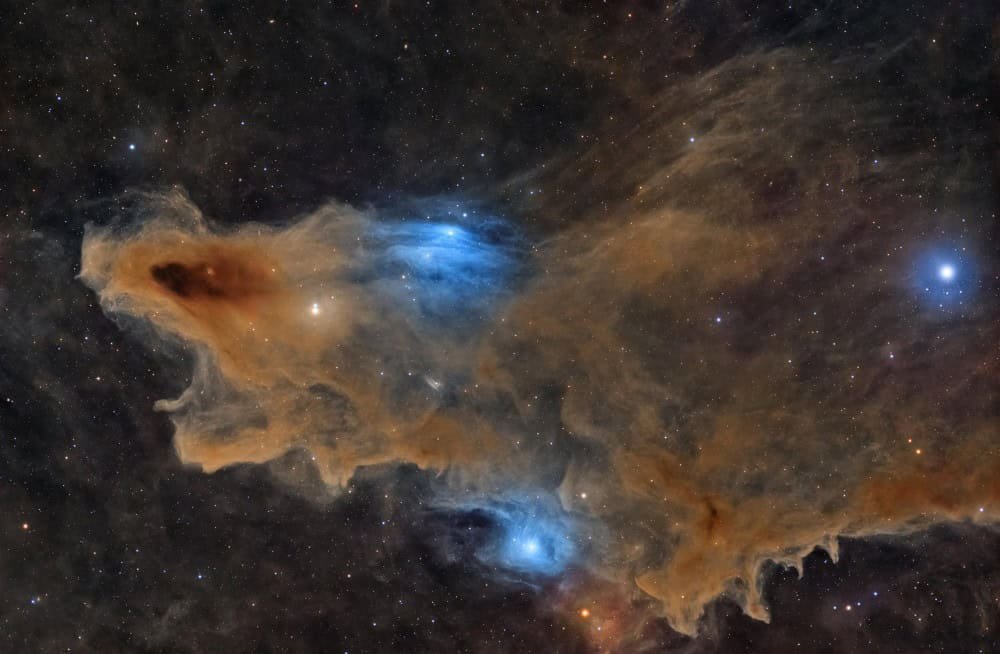
The image, titled The Quiet Predator, was created by Kuwaiti astrophotographer Ali Alobaidly and has won the overall Astronomy Photographer of the Year 2026 competition organized by the Royal Observatory Greenwich.
The photograph shows a dark cloud of cosmic dust that appears remarkably similar to a shark swimming through space.
But the “shark” is not a creature.
It is a vast region of interstellar dust called LDN 1235, located roughly 650 light-years from Earth in the constellation Cepheus.
And the photograph took more than 28 hours of exposure to reveal its extraordinary detail.
Meet the Shark Nebula
The Shark Nebula is a dark nebula.
Unlike bright nebulae that glow strongly because of nearby stars, dark nebulae contain dense clouds of dust that block light from objects behind them.
That darkness creates the shark-like silhouette.
Blue regions surrounding the dark structure come from reflection nebulae, where interstellar dust scatters light from nearby stars.
Together, the dark dust and blue illumination create the impression of a giant predator moving through an ocean of stars.
The official astronomical designation is LDN 1235.
Its familiar nickname comes from its distinctive appearance rather than from any physical connection to sharks.
The Photograph That Won the Prize
Ali Alobaidly photographed the nebula from the Jahra Governorate in Kuwait.
The final image combined approximately 28 hours and 30 minutes of exposure, collected over two nights.
His equipment included an Askar 140 APO telescope, a Sky-Watcher EQ8-R mount and a ZWO ASI2600MM Pro camera.
The enormous amount of exposure time allowed Alobaidly to capture extremely faint structures within the nebula.
The result won both the Stars and Nebulae category and the overall competition prize.
Why the Image Looks Like a Shark
Human beings naturally recognize familiar shapes in clouds, rocks and other complex patterns.
The Shark Nebula takes that effect to an extraordinary level.
Its dark central dust structure resembles a head and open mouth, while surrounding material creates the appearance of a body and fins.
The effect becomes even stronger because of the contrast between the dark dust and the surrounding stars.
Yet the shape has no biological connection to a shark.
The apparent animal exists because of the distribution of dust across an enormous region of interstellar space.
What Is Inside the Nebula?
The Shark Nebula contains extremely dense clouds of interstellar dust.
These clouds can block visible light from stars located behind them.
That makes dark nebulae different from the glowing clouds that dominate many famous space photographs.
The blue areas in Alobaidly’s image are reflection nebulae.
They appear blue because tiny dust particles scatter shorter wavelengths of light from nearby stars more effectively.
The result gives the Shark Nebula 2026 photograph its unusual mixture of darkness, blue light and countless distant stars.
A Cosmic Shark 650 Light-Years Away
The nebula sits approximately 650 light-years from Earth in Cepheus.
That means the light captured in the photograph began its journey toward Earth roughly 650 years ago.
When Alobaidly photographed the object from Kuwait, he was not seeing the nebula as it exists today.
He was recording ancient light that had traveled through space for centuries.
That enormous distance makes the image even more remarkable.
What appears as a small shark-shaped object in a photograph actually represents a huge structure spread across interstellar space.
How Did He Capture Something So Faint?
Astrophotography requires more than simply pointing a powerful telescope at the sky.
Many deep-space objects are extremely faint.
The camera must collect light for long periods, while the telescope tracks the movement of the sky.
Alobaidly’s image used hundreds of individual exposures that were combined into a single final photograph.
According to published equipment details, the image included 168 five-minute luminance exposures along with separate red, green and blue exposures. The total integration time reached 28 hours and 30 minutes.
That long process allowed extremely subtle structures to emerge.
The Astronomy Photographer of the Year 2026
The competition is organized by the Royal Observatory Greenwich and is now in its 18th edition.
The 2026 competition attracted almost 4,000 images from 769 photographers across 66 countries.
That makes Alobaidly’s victory notable beyond the photograph itself.
He became the first overall winner from Kuwait in the competition’s history.
His winning photograph also received the competition’s £10,000 top prize.
The Shark Wasn’t the Only Amazing Winner
The 2026 competition included photographs covering many different parts of astronomy.
Other winning images captured auroras, planets, galaxies, the Sun, the Moon and landscapes beneath the night sky.
One particularly notable winner was 15-year-old Nikolaos Strimpoulis of Greece, who won the Young Astronomy Photographer of the Year award for Mineral Moon.
The range of winning subjects shows how modern astrophotography can reveal everything from nearby lunar events to objects hundreds or thousands of light-years away.
Why This Image Matters
The Astronomy Photographer of the Year 2026 competition is not simply about producing attractive space photographs.
Astrophotography can help communicate astronomical structures that are otherwise difficult for the public to understand.
Images such as The Quiet Predator turn an enormous and distant cloud of dust into something immediately recognizable.
The photograph also demonstrates how advanced amateur and semi-professional equipment can reveal extremely faint deep-space structures.
Modern cameras, tracking mounts, telescopes and image-processing techniques have dramatically expanded what individual photographers can capture.
The Photograph Will Go on Display
The winning photograph is being displayed with the other 2026 competition winners at the National Maritime Museum in London.
The exhibition opened on September 18, 2026, and features the winning and shortlisted photographs from the competition.
Visitors can therefore see the Shark Nebula alongside other award-winning images rather than only viewing it online.
The Real Story Behind the “Shark”
There is something particularly interesting about the winning image.
The Shark Nebula itself is not new.
Astronomers have known about LDN 1235 for years.
What is new is the way Alobaidly’s photograph presents it.
A distant cloud of cold dust becomes visually recognizable as a giant predator drifting among the stars.
That combination of science, technology and human perception is what made the photograph stand out.
What the Shark Nebula 2026 Image Shows Us
The Shark Nebula 2026 photograph offers a reminder that space does not always look the way people expect.
There are no solid oceans or animals in this region of the universe.
Instead, enormous clouds of dust and scattered starlight create shapes that the human eye interprets as familiar objects.
The shark exists as a visual pattern.
The material itself remains a vast and complex part of the interstellar environment.
Conclusion
The Shark Nebula 2026 has become one of the most recognizable astronomy photographs of the year after Ali Alobaidly’s The Quiet Predator won the overall Astronomy Photographer of the Year 2026 prize.
The object itself is a dark nebula known as LDN 1235, located roughly 650 light-years away in the constellation Cepheus.
Its shark like appearance comes from dense interstellar dust blocking the light behind it, combined with blue reflection nebulae surrounding the structure.
Capturing those details required more than 28 hours of exposure.
The final photograph transforms an extremely faint cosmic structure into something almost alive.
There really is a “shark” in space just not the kind that swims in an ocean.
It swims through a sea of stars.
Frequently Asked Questions
What is the Shark Nebula?
The Shark Nebula is the informal name for LDN 1235, a dark nebula made primarily of dense interstellar dust in the constellation Cepheus.
How far away is the Shark Nebula?
LDN 1235 is approximately 650 light-years from Earth.
Who won Astronomy Photographer of the Year 2026?
Kuwaiti astrophotographer Ali Alobaidly won the overall 2026 competition with his photograph The Quiet Predator.
What is the winning photograph called?
The photograph is titled The Quiet Predator and shows the Shark Nebula.
How long did it take to photograph the Shark Nebula?
The final image used approximately 28 hours and 30 minutes of exposure collected over two nights.
Is the Shark Nebula actually a shark?
No. The shark shape comes from the arrangement of interstellar dust and surrounding reflection nebulae. It is a visual resemblance rather than a real animal.
Where can people see the winning photograph?
The winning photographs from the 2026 competition are being exhibited at the National Maritime Museum in London.