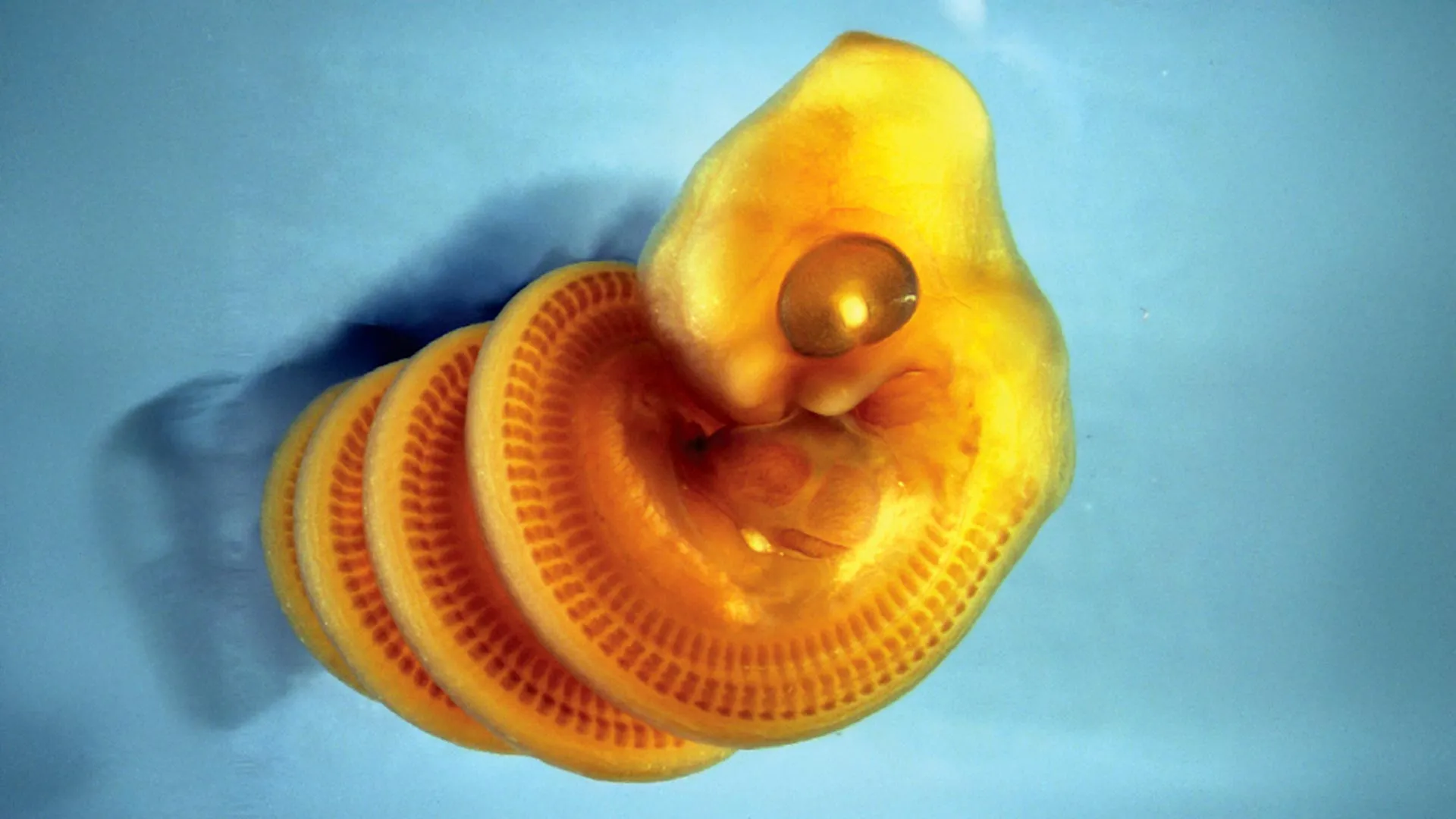
Snake embryos begin developing inside their eggs in one of nature’s strangest shapes: a tightly wound spiral. Now, scientists believe they have solved the mystery behind this unusual spiral development after studying more than 900 embryos from 39 species and using CT scans to examine structures hidden inside the developing animals.
The discovery is fascinating because the embryos begin coiling before they have developed muscles capable of moving them.
So what is making them twist?
The answer appears to involve a remarkable mismatch between the rapidly growing snake body and its slower-growing gut.
And that simple difference may help explain one of the most extraordinary body shapes in the animal kingdom.
A Mystery Hidden Inside Snake Eggs
Before a baby snake ever emerges from its egg, its body has already gone through an unusual transformation.
The developing animal becomes extremely long.
However, there is only a limited amount of space available inside the egg.
Instead of remaining straight, the embryo begins forming a tight coil.
Even more surprisingly, researchers discovered that early in development, the embryos overwhelmingly coil toward the right side, a pattern known as dextral or right-handed coiling.
That raised an obvious question.
Why would thousands of developing snakes independently choose essentially the same direction?
The embryos are not making a conscious decision.
They do not yet have the muscles needed to move themselves.
Therefore, something mechanical must be driving the process.
Scientists Studied More Than 900 Embryos
To investigate the mystery, researchers assembled images representing more than 900 embryos from 39 species of snakes and other limbless reptiles.
The enormous sample helped reveal a consistent pattern.
During the early stages of development, the embryos almost always formed a right-handed coil.
That was important because it suggested that the behavior was not simply random.
There appeared to be a repeatable physical mechanism behind it.
Researchers then turned to CT scanning.
That is where the investigation became even more interesting.
CT Scans Revealed Something Scientists Had Not Seen Before
Inside one of the developing embryos, CT imaging revealed a structure that helped explain the entire process.
Scientists found a section of developing gut extending through the spiral of the embryo, connected to the yolk through blood vessels.
This structure effectively acts like a temporary tether.
The snake’s body is growing rapidly.
The gut, however, develops at a different rate.
As the body lengthens, the tether restricts how the growing structure can extend.
The result is mechanical stress.
Eventually, the body buckles and twists.
That produces the spiral.
Imagine a Strap Being Pulled Longer
One simple way to understand the mechanism is to imagine a flexible strap.
Suppose one part of the strap is being lengthened rapidly while another part remains constrained.
The longer section cannot continue extending in a perfectly straight line.
Instead, it bends.
As the pressure increases, the bend can become a twist.
Something similar appears to happen inside the developing snake embryo.
The rapidly growing body encounters resistance from the slower-growing gut.
The body therefore buckles around the constraint.
That produces the characteristic coil.
Why Does the Embryo Coil to the Right?
This is perhaps the most fascinating part of the discovery.
The coiling is not only common.
It is strongly directional during early development.
Researchers believe the position of the yolk helps determine the direction.
The yolk is positioned toward the embryo’s left side.
As the body grows around the tethered gut, the mechanical force directs the embryo toward the opposite side.
That produces the initial right-handed coil.
In other words, the direction appears to emerge from the physical arrangement of the developing embryo rather than from conscious movement.
The Snake Has Not Yet Learned to Move
This discovery makes the process even more remarkable.
At these early stages, the embryos do not have mature muscles capable of producing the movement required to create the spiral.
That means the first stage of the coil is essentially generated by developmental mechanics.
The body grows.
The gut develops differently.
The surrounding structures create constraints.
And physics does the rest.
This is an important reminder that biological development is not controlled by genes alone.
Physical forces also help shape living organisms.
The Spiral Is Actually a Solution to a Space Problem
Snakes have exceptionally long bodies compared with other vertebrates.
That creates a problem during embryonic development.
A long body needs space.
An egg provides only a limited amount of space.
Therefore, the developing snake needs a way to accommodate its increasing length.
Coiling provides an elegant solution.
Instead of attempting to extend in a straight line, the embryo folds its length into a compact three-dimensional structure.
The spiral essentially allows an extraordinarily long animal to fit inside a relatively small egg.
The Shape Does Not Stay Exactly the Same
The story becomes even more interesting as the embryo gets closer to hatching.
The early right-handed spiral is not necessarily permanent.
As development continues, the yolk becomes smaller.
The embryo also develops stronger muscles and gains more ability to move within the egg.
Some embryos remain in their original right-handed coils.
Others change their position and may eventually coil toward the opposite side.
This explains why the strong right-handed pattern is most obvious during the earlier stages.
Later, active movement becomes more important.
Biology and Physics Are Working Together
The discovery demonstrates an important principle in developmental biology.
An animal’s shape does not emerge simply because genes contain a detailed blueprint saying exactly where every curve should appear.
Genes control growth and development.
However, tissues also interact physically.
They push.
Pull.
Stretch.
Compress.
Bend.
And twist.
Those forces can influence the final shape of an organism.
The snake embryo provides an unusually dramatic example of this process.
Why Snakes Became So Long
The research also connects embryonic development with snake evolution.
Modern snakes have extraordinarily elongated bodies.
That body plan allowed them to develop a remarkable range of lifestyles.
Different snakes can crawl through narrow spaces, climb vegetation, swim through water and move across difficult terrain.
But becoming so long creates developmental challenges.
The embryo needs to build that long body before hatching.
The spiral appears to be part of the solution.
In this sense, the strange shape inside the egg is directly connected to one of the defining features of snakes.
The Discovery Started During the COVID Lockdown
There is also an unusual human story behind the research.
The project began during the COVID-19 lockdown in 2020, when evolutionary biologist Tetsuto Miyashita was looking for a research question his students could investigate without visiting laboratories or museum collections.
He had already been interested in asymmetry in animal bodies.
Then he noticed something unusual about photographs of snake embryos.
They appeared to coil in a consistent direction.
That simple observation eventually developed into a major research project.
Students searched scientific publications and museum databases for images.
More than 900 embryos were eventually assembled for analysis.
A question that began during lockdown ultimately led to an explanation of a long-standing biological mystery.
Museum Collections Played an Important Role
Not all of the embryos were newly collected.
Researchers searched existing scientific literature and museum databases for photographs and specimens.
This demonstrates why natural-history collections remain valuable.
A specimen collected decades ago can become useful again when scientists develop a new question or a new analytical method.
Modern science can therefore extract new information from old collections.
A museum specimen that once seemed ordinary can become evidence for a completely new discovery.
Why This Could Matter Beyond Snakes
At first glance, the discovery might seem specific to reptiles.
However, the underlying principle could have much broader significance.
Developing organs and tissues in many animals grow at different speeds.
Those differences can create mechanical forces.
In humans, for example, organs and tissues also change shape as they grow inside a limited environment.
Researchers studying developmental biology increasingly investigate how physical forces interact with genetic instructions.
The snake embryo provides a particularly clear example because its spiral is so visually obvious.
Nature Loves Spirals
Spirals appear throughout the natural world.
They can be found in:
- Galaxies
- Shells
- Plant growth
- Hurricanes
- DNA structures
- Animal organs
- Horns
- Vines
However, the physical reasons behind different spirals are not always the same.
Some emerge from growth.
Others result from fluid dynamics.
Some are created by gravitational processes.
The snake embryo adds another example: a biological spiral produced partly by unequal growth and physical constraint.
Could Other Animals Develop Similar Structures?
That remains an interesting question.
Researchers may eventually discover that similar developmental mechanics operate in other elongated animals.
Long-bodied reptiles and other organisms could provide useful comparisons.
Scientists could investigate whether different organs become temporary mechanical anchors during development.
If similar mechanisms appear elsewhere, it would strengthen the idea that physical constraints play a larger role in shaping animal bodies than previously appreciated.
This Is More Than a Strange Snake Fact
The discovery may sound like an unusual piece of trivia.
However, it addresses a fundamental scientific question:
How does a developing animal determine its shape?
The answer is not always simple.
Genetic instructions provide the biological framework.
Cellular processes build tissues.
Different structures grow at different rates.
Physical forces then influence how those structures fit together.
The final animal emerges from all of these processes interacting.
The snake embryo provides a remarkable window into that process.
The Discovery Changes How We See the Egg
A snake egg might appear inactive from the outside.
Inside, however, an extraordinary mechanical process is taking place.
The body is rapidly lengthening.
The gut is developing.
Blood vessels connect structures to the yolk.
Tissues interact.
The embryo begins twisting.
Eventually, the developing snake rearranges itself enough to prepare for life outside the egg.
What looks like a simple egg from the outside is actually a highly dynamic developmental environment.
Scientists Still Have Questions
The new research provides a strong explanation for the early coiling pattern.
Nevertheless, scientists still have more to investigate.
For example, they can examine how different snake species vary in their embryonic development.
They can also study how the coiling process interacts with the evolution of extremely elongated bodies.
Another question is how the developing embryo transitions from mechanically driven movement to active muscular movement.
Each answer could reveal more about how snakes evolved their distinctive anatomy.
A Tiny Embryo Reveals a Huge Evolutionary Story
Perhaps the most remarkable aspect of the discovery is its scale.
The researchers were looking at tiny embryos inside eggs.
Yet the mechanism they uncovered helps explain one of the most recognizable characteristics of an entire animal group.
The snake’s long body is not just an adult feature.
Its developmental consequences begin before hatching.
The spiral inside the egg is therefore a glimpse into the evolutionary history written into the animal’s development.
What This Discovery Really Tells Us
The biggest lesson may be surprisingly simple.
Living organisms are shaped by both biology and physics.
Genes help control growth.
But growth creates forces.
Those forces interact with tissues.
And tissues respond to the physical environment around them.
In snake embryos, that interaction creates a spiral.
The result is an elegant example of how complicated biological structures can emerge from relatively simple physical rules.
Conclusion
The mystery surrounding snake embryos has finally become clearer.
Researchers studying more than 900 embryos from 39 species found that young snakes initially coil predominantly toward the right. CT scans then revealed a previously unrecognized gut structure that acts as a tether while the rapidly growing body lengthens.
The resulting mechanical tension causes the body to buckle and twist into a spiral.
As the embryo develops, the yolk shrinks and the muscles mature, allowing some snakes to change their position and reverse their initial coil.
The discovery is more than an explanation for an unusual snake behavior.
It demonstrates how spiral development can emerge from the interaction between growth, anatomy and physical forces.
And perhaps that is the most fascinating part.
Before a snake ever learns to crawl, hunt or strike, its body is already solving an extraordinary engineering problem inside an egg.
It is using growth, space and physics to build one of nature’s most unusual body shapes.
Frequently Asked Questions
Why do snake embryos coil into spirals?
Their bodies grow rapidly while the gut develops more slowly. The resulting mechanical constraint causes the growing body to buckle and twist into a spiral.
Why do snake embryos initially coil to the right?
Researchers believe the position of the yolk and the tethering effect of the developing gut help direct the early coil toward the right side.
What is spiral development?
Spiral development in this context refers to the way the developing snake body curves and coils as it grows inside the egg.
Do snake embryos move themselves into the spiral?
Not initially. The earliest coiling occurs before the embryos have developed muscles capable of producing the movement, indicating that mechanical forces are responsible for the initial coil.
Do snakes remain coiled in the same direction?
Not always. Later in development, stronger muscles and a shrinking yolk give embryos more freedom to move, and some can reverse their original coil.