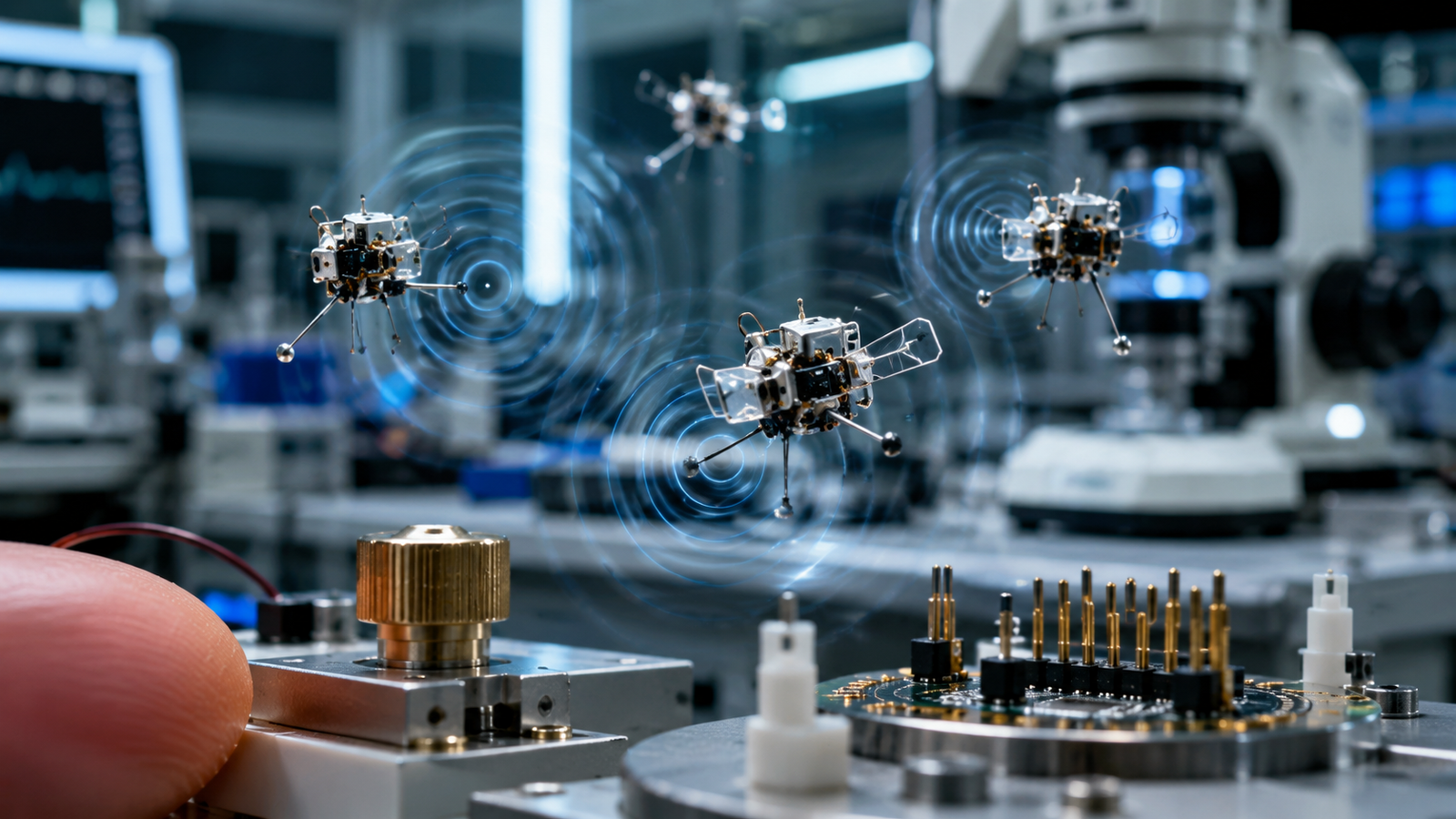
Tiny flying robots could be entering a new era after researchers at Switzerland’s EPFL developed miniature flying machines that use acoustic technology to generate thrust without relying on conventional motors, gears or onboard batteries. The approach uses specially designed acoustic resonators to convert sound energy into directional airflow and mechanical thrust.
The idea sounds almost impossible.
How can sound make something fly?
Normally, a drone needs propellers.
Those propellers require motors.
The motors require electrical power.
And the entire system needs enough energy to keep the machine airborne.
Researchers are now exploring another possibility.
Instead of using traditional mechanical components, they can use carefully engineered acoustic structures to turn sound energy into movement.
That is where sound wave propulsion becomes particularly interesting.
How Can Sound Make a Robot Move?
Sound is more than something humans hear.
At a physical level, sound consists of pressure variations moving through a medium such as air.
When those pressure variations interact with specially shaped structures, they can produce useful physical effects.
The EPFL research uses acoustic resonators designed to exploit this phenomenon.
The basic principle is related to Helmholtz resonance, the same acoustic effect that helps determine the sound produced when air moves through the opening of a bottle.
Researchers designed miniature structures that can transform acoustic energy into airflow.
That airflow can then produce thrust.
The result is a flying machine that does not need a conventional spinning propeller to generate movement.
Why Make Robots This Small?
At normal drone sizes, conventional motors work extremely well.
But shrinking everything creates problems.
A motor becomes harder to manufacture.
A battery becomes disproportionately large.
Mechanical components become difficult to assemble.
Wiring becomes more complicated.
Eventually, the traditional architecture of a drone becomes inefficient.
That is why scientists are investigating completely different approaches.
For tiny flying robots, reducing mechanical complexity could be just as important as reducing physical size.
The Battery Problem
One of the biggest obstacles facing miniature robots is energy.
A smartphone can contain a relatively large battery because there is enough physical space.
A tiny robot does not have that luxury.
As the machine becomes smaller, the battery can take up a significant portion of its available volume and weight.
That creates a difficult engineering trade-off.
More battery means more weight.
More weight means more thrust is required.
More thrust requires more energy.
The cycle becomes increasingly difficult at miniature scales.
Acoustic systems could potentially provide a way around some of those limitations.
The EPFL concept is particularly interesting because the miniature flying systems can receive acoustic energy externally rather than depending entirely on onboard conventional power systems.
This Is Not Just a Smaller Drone
It is tempting to think of these machines as tiny versions of ordinary drones.
That would miss the bigger point.
A conventional drone is essentially a collection of familiar technologies:
- Motors
- Propellers
- Batteries
- Flight controllers
- Sensors
A miniature acoustic robot requires a different engineering philosophy.
Instead of simply shrinking existing components, researchers can redesign the mechanism around the physics that becomes useful at very small scales.
That could eventually produce machines that look and behave very differently from today’s drones.
What Makes Sound Wave Propulsion Different?
Traditional propulsion physically moves air using a propeller or fan.
Acoustic propulsion works through pressure oscillations and carefully engineered resonant structures.
This distinction could become important as robots shrink.
Mechanical systems contain moving components.
Moving components create friction and wear.
They also require precise manufacturing.
An acoustic system can potentially reduce the number of mechanical parts needed for propulsion.
That does not mean acoustic propulsion is automatically better.
It simply creates another route for engineers to explore.
The Technology Has a Long Way to Go
The headline may sound futuristic, but it is important to keep expectations realistic.
These systems are not about replacing commercial passenger drones tomorrow.
The research is focused on extremely small machines and new propulsion principles.
Scaling the technology remains a major challenge.
A system that works for a miniature robot may not automatically work for a larger aircraft.
The amount of thrust required increases dramatically with vehicle size.
Consequently, acoustic propulsion could be most valuable in applications where extremely small robots are desirable.
Could Tiny Robots Eventually Enter Buildings?
This is where the technology becomes particularly fascinating.
Imagine a robot small enough to enter narrow spaces.
It could potentially inspect areas that are difficult for conventional drones to reach.
For example:
- Damaged buildings
- Industrial equipment
- Narrow ventilation spaces
- Underground structures
- Confined research environments
- Hazardous areas
Miniature flying machines could potentially move through spaces that are inaccessible to larger robots.
However, practical deployment would require reliable control, navigation, communication and energy management.
Sound Could Also Become Part of Robot Control
Propulsion is only one possible use.
Sound can also carry information.
Researchers are already investigating tiny robots that use ultrasound for navigation.
A Worcester Polytechnic Institute project, for example, is developing small autonomous flying robots that use ultrasound-based echolocation to navigate in darkness, smoke and other visually difficult environments.
The idea is inspired by bats.
Instead of relying entirely on cameras, the robot can interpret reflected sound waves to understand its surroundings.
That creates an intriguing future possibility.
A tiny robot could potentially use sound for both movement and perception.
Why Bats Keep Inspiring Robotics
Nature has already solved many engineering problems.
Bats can fly through darkness.
They can avoid obstacles,they can identify objects using reflected sound & they can navigate complex environments without relying on human-style vision.
Robotics researchers increasingly study these abilities.
The goal is not necessarily to copy an animal exactly.
Instead, scientists identify useful principles and translate them into engineering systems.
Tiny robots are particularly suitable for this approach because insects and other small flying animals already demonstrate impressive performance at very small scales.
Tiny Robots Could Work in Groups
One robot might have limited capabilities.
Hundreds of tiny robots could be much more useful.
This is the idea behind swarm robotics.
Instead of building one highly sophisticated machine, researchers can create many simpler machines that cooperate.
A swarm could potentially:
- Search a large area
- Map an environment
- Monitor pollution
- Inspect structures
- Locate objects
- Collect environmental data
The challenge is making the robots communicate and coordinate without consuming too much energy.
That is why efficient navigation and low-power technology are extremely important.
Recent research has already demonstrated highly efficient navigation strategies for small flying robots inspired by honeybee behavior.
The Smaller the Robot, the Bigger the Engineering Challenge
Making something smaller does not necessarily make it easier.
In fact, miniature engineering can be extraordinarily difficult.
At very small scales, surface effects become more important.
Manufacturing tolerances become tighter.
Components become harder to assemble.
Energy becomes scarce.
Sensors become difficult to integrate.
Communication becomes challenging.
Every gram matters.
Every millimeter matters.
This is why miniature robotics has become such an important research field.
Could These Robots Replace Conventional Drones?
Probably not.
At least, not across the entire drone industry.
Conventional drones have major advantages.
Carry cameras,Carry batteries,Transport equipment & Fly for relatively long periods.
Tiny robots would have much smaller payloads.
Their strength would be their size.
Instead of replacing large drones, they could perform tasks that large drones simply cannot perform.
That could make the two technologies complementary rather than competitive.
Medicine Could Eventually Become an Application
Miniature robotics frequently attracts attention because of possible medical applications.
Scientists are exploring tiny machines for targeted drug delivery, minimally invasive procedures and biological research.
However, flying acoustic robots are not automatically suitable for medical use.
The human body presents a completely different environment.
Researchers would need to solve major challenges involving biocompatibility, energy delivery, control and safety.
Therefore, medical applications should be considered a long-term possibility rather than an immediate consequence of the current research.
Environmental Monitoring Could Be More Realistic
Environmental monitoring could be another promising area.
Tiny robots could potentially enter difficult locations and collect information about:
- Air quality
- Temperature
- Humidity
- Pollutants
- Industrial emissions
- Confined ecosystems
A swarm could distribute itself across an area and collect data from multiple locations.
That could produce a much more detailed picture than a single sensor.
Search and Rescue Is Another Potential Use
Imagine a building damaged by an earthquake.
Large rescue drones may struggle to enter narrow gaps.
A miniature robot could potentially explore a much smaller space.
If equipped with suitable sensors, future systems could search for signs of survivors or structural hazards.
The acoustic navigation work being developed for dark and visually degraded environments is specifically aimed at applications such as disaster zones and search-and-rescue scenarios.
However, these applications remain research goals rather than established commercial capabilities.
What Happens If the Robots Become Almost Invisible?
This is where the technology could become truly transformative.
As robots become smaller, they become less intrusive.
A large drone immediately attracts attention.
A tiny robot could potentially operate in spaces without significantly disturbing its surroundings.
That could be useful for scientific observation.
It could also raise important questions about privacy and security.
Any technology capable of creating extremely small autonomous flying machines would need responsible rules around where and how those machines can operate.
Could Acoustic Robots Become More Energy Efficient?
Potentially.
One attraction of acoustic systems is the possibility of reducing the number of mechanical components.
The EPFL work demonstrates that acoustic resonators can generate directional airflow and thrust.
However, efficiency depends on the entire system.
Generating the acoustic energy requires power.
Transmitting that energy through air also creates losses.
The robot still needs to remain stable.
Therefore, scientists must evaluate the complete energy budget rather than assuming that removing a motor automatically creates an ultra-efficient flying machine.
The Real Breakthrough May Be the Architecture
The most important part of this research may not be the immediate flying performance.
It may be the architecture.
Scientists are asking whether a robot can be designed around acoustic physics from the beginning rather than adding sound-based technology to a conventional drone.
That shift in thinking could inspire other miniature machines.
Instead of asking:
“How do we make a normal drone smaller?”
Engineers can ask:
“What would a flying machine look like if it were designed specifically for the physics of the miniature world?”
That is a much more interesting question.
A Future Filled With Tiny Machines
The future of robotics may not be dominated only by humanoid robots or large autonomous vehicles.
Some of the most important machines could be almost invisible.
They could fly.
Crawl.
Swim.
Inspect.
Measure.
Communicate.
And work together.
Acoustic propulsion is one possible technology that could help make those machines practical.
Other researchers are exploring magnetic fields, electrostatic forces, flapping wings and other unconventional methods.
The competition between these technologies could determine which approach eventually becomes dominant.
What Comes Next?
Researchers will need to improve several areas before acoustic flying robots can become widely useful.
The most important challenges include:
- Increasing thrust
- Improving flight stability
- Reducing energy consumption
- Developing reliable control systems
- Miniaturizing sensors
- Improving communication
- Increasing flight duration
- Scaling manufacturing
Each improvement could unlock new applications.
The technology therefore represents an early stage rather than a finished product.
Why This Could Change Robotics
The history of technology often follows a similar pattern.
First, scientists demonstrate that something is possible.
Then engineers make it smaller.
Then they make it cheaper.
Finally, someone discovers an application nobody originally expected.
Miniature acoustic robots are currently somewhere between the first and second stages.
Researchers have demonstrated the underlying concept.
The next challenge is turning it into a reliable platform.
If they succeed, tiny flying robots could eventually become a new category of machines rather than simply miniature drones.
Conclusion
The emergence of tiny flying robots powered through acoustic principles represents an unusual direction for robotics.
Instead of relying entirely on traditional motors, gears and onboard batteries, researchers at EPFL are exploring acoustic resonators that can transform sound energy into directional airflow and thrust.
The concept could eventually help engineers build machines that are far smaller and mechanically simpler than conventional drones.
However, the technology is still developing.
Researchers must improve thrust, control, energy efficiency and practical deployment before these machines can move beyond experimental environments.
Nevertheless, the idea is powerful.
The future of flight may not always depend on spinning propellers.
For some of the world’s smallest robots, sound itself could become part of the engine.
And if scientists can continue shrinking the technology while improving its efficiency, the next generation of robots may be small enough to enter places that today’s machines simply cannot reach.
Frequently Asked Questions
What are tiny flying robots?
Tiny flying robots are miniature aerial machines designed to perform tasks such as navigation, inspection, sensing or environmental monitoring while operating at a much smaller scale than conventional drones.
What is sound wave propulsion?
Sound wave propulsion uses acoustic energy and specially designed structures to generate airflow or thrust. Recent EPFL research has explored acoustic resonators that convert sound energy into directional airflow and mechanical thrust.
Do these robots use normal drone motors?
The EPFL technology is designed around acoustic propulsion rather than conventional motors, gears and mechanical propulsion components.
Can sound really make a robot fly?
Yes. At the miniature scale demonstrated in the research, acoustic structures can generate directional airflow and thrust. However, this does not mean sound can simply lift conventional drones without a carefully engineered system.
Where could tiny flying robots be used?
Potential applications include inspection, environmental monitoring, search and rescue, scientific research and exploration of confined environments. Many of these applications remain future possibilities.