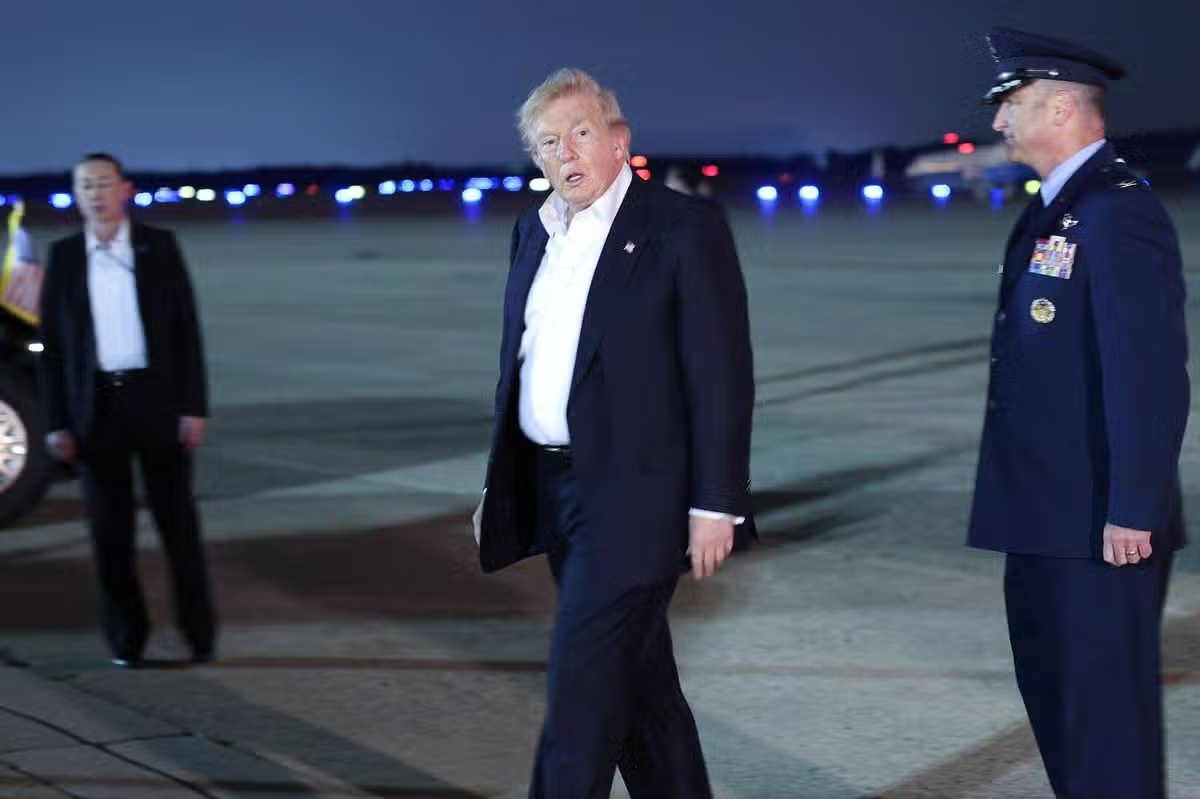
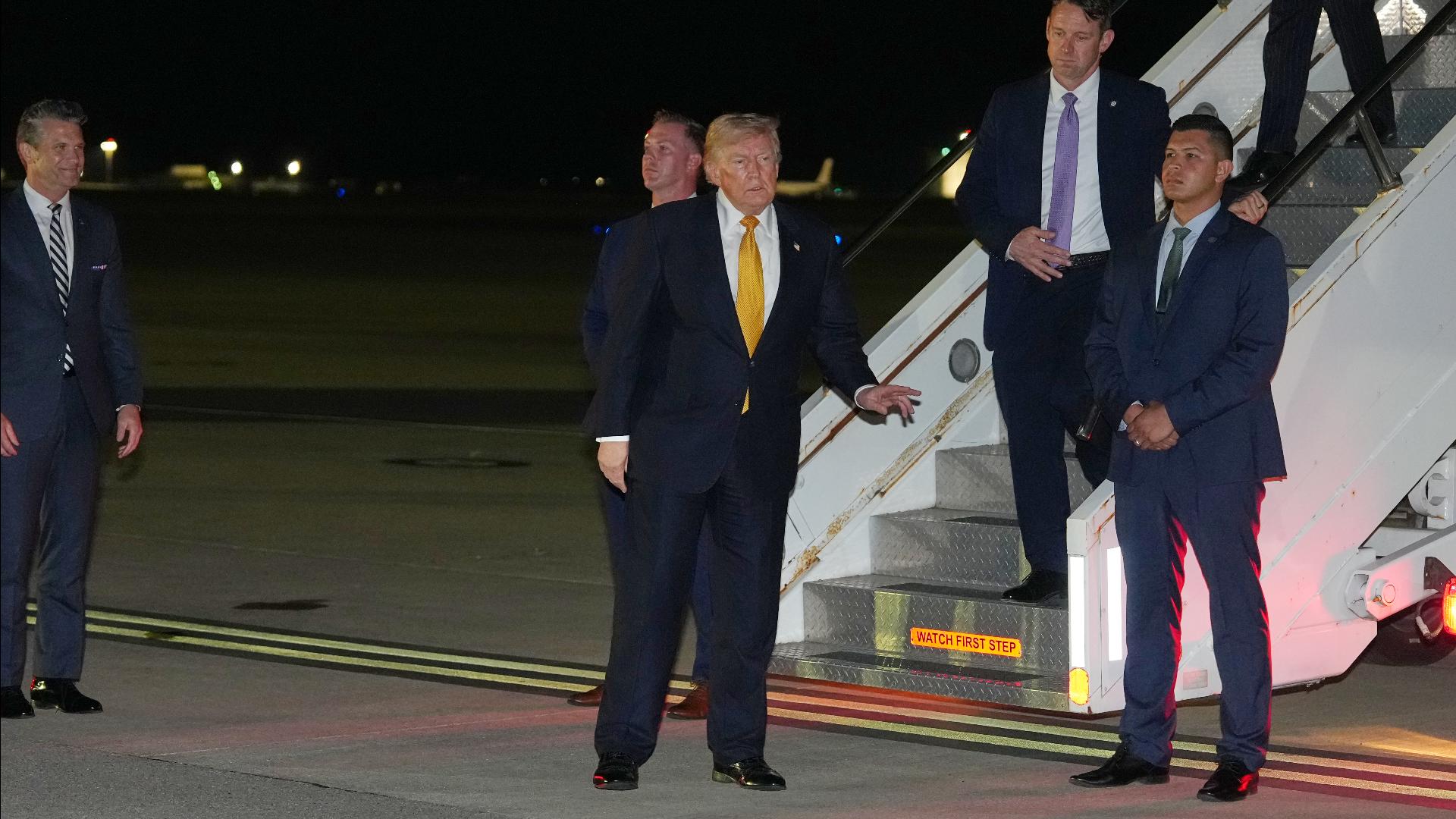
A remarkable security operation involving President Donald Trump has drawn international attention after reports revealed that he was secretly moved from Air Force One using an airport catering vehicle before boarding a different military aircraft in Turkey. Although social media descriptions have characterized the incident as Trump “escaped” Turkey while “hiding in a food truck,” the reported details are more specific: Trump was allegedly moved inside a catering vehicle or container used for airport food and supply operations before boarding a C-32A military aircraft.
According to reporting by The Washington Post, Trump was publicly seen boarding the older Air Force One aircraft after a NATO summit in Ankara. However, the president reportedly did not remain on that aircraft. Instead, he was secretly transferred through an airport catering truck and taken to a smaller U.S. military aircraft.
The unusual operation reportedly took place amid concerns about a credible threat against Trump linked to Iran.
The story has raised questions about presidential security, secrecy, the use of decoy aircraft and the extraordinary measures that can be taken when officials believe a president may face danger.
Trump Appeared to Leave on Air Force One
The operation reportedly began with a scene that appeared completely normal.
Trump was publicly seen boarding an older Air Force One aircraft in Ankara. Cameras captured the president entering the aircraft, giving observers the impression that he would travel aboard the presidential plane.
That appearance was reportedly part of a larger security deception.
According to the reporting, Trump was later transferred away from the aircraft using an airport catering vehicle. He was then taken to a smaller military plane waiting elsewhere at the airport.
The older Air Force One remained the visible aircraft associated with the president’s departure.
This reportedly turned the plane into a decoy.
The Food Truck Transfer
One of the most extraordinary details is the reported use of an airport catering vehicle.
Rather than moving Trump through a normal presidential convoy, security personnel reportedly used a vehicle normally associated with airport catering operations.
The method allowed the president to be moved without attracting the same level of attention that would normally accompany a presidential transfer.
The phrase “hiding in a food truck” has spread widely online, but it is important to distinguish between the sensational wording and the reported facts.
News reports describe an airport catering truck or catering container rather than a conventional street-food truck.
That distinction matters because the vehicle was reportedly part of a carefully planned airport security operation.
Why Would Trump Need a Decoy?
Presidential travel is already surrounded by extensive security.
However, international travel can create additional challenges.
A president’s movements are watched by journalists, intelligence agencies, foreign governments and potentially hostile organizations.
Air Force One is particularly easy to identify.
Its distinctive appearance makes it one of the most recognizable aircraft in the world.
If a potential attacker knows exactly which aircraft carries the president, tracking the president’s movements becomes easier.
A decoy strategy can introduce uncertainty.
If observers believe Trump is aboard Air Force One while he is actually traveling on another aircraft, anyone attempting to follow or target his movements could be misled.
A Secret Military Jet
After leaving the larger aircraft, Trump reportedly boarded an Air Force C-32A.
The C-32A is a military version of the Boeing 757 and is used to transport senior U.S. government officials.
Unlike Air Force One, the C-32A does not have the same instantly recognizable public profile.
That made it suitable for a lower-profile movement.
According to reports, Trump used the aircraft to travel from Turkey toward the United Kingdom.
The operation therefore involved three distinct elements: a public presidential boarding, a secret transfer and a military aircraft departure.
Journalists Were Reportedly Unaware
Perhaps the most striking part of the story is that some journalists and White House personnel reportedly did not know Trump had left the aircraft.
The press pool was aboard the visible Air Force One aircraft.
If reporters believed Trump was still on board, their presence helped reinforce the appearance that the president was traveling on that plane.
This meant journalists unintentionally became part of the decoy operation.
According to reports, some people aboard the aircraft were unaware of the president’s actual location until later.
That level of secrecy highlights how seriously security officials reportedly viewed the threat.
Reported Iranian Threat
The reported operation was connected to concerns over an Iranian threat against Trump.
The Washington Post reported that U.S. officials had received information about a possible threat and that the security operation was designed to protect the president.
The White House has emphasized that Trump faces threats from enemies of the United States and that security officials use multiple protective measures.
However, the existence of a reported threat should not automatically be interpreted as proof that an attack was imminent.
Presidential security teams routinely respond to intelligence assessments before an attack occurs.
Their responsibility is to reduce risk rather than wait for a threat to become an actual attack.
Why Turkey Was Important
The reported incident occurred after Trump’s visit to Turkey for a NATO summit.
Turkey occupies an important strategic position between Europe, Asia and the Middle East.
The country is also a NATO member and has played a significant role in diplomatic efforts surrounding regional conflicts.
Trump’s presence in Ankara therefore attracted considerable international attention.
That made maintaining secrecy around his departure more difficult.
A conventional presidential departure would have been highly visible.
A covert transfer provided another layer of protection.
Air Force One Became the Decoy
The most unusual part of the operation was the reported decision to allow Air Force One to remain the center of attention.
Normally, Air Force One is synonymous with presidential travel.
When cameras show the president boarding the aircraft, observers reasonably assume he is going to travel on it.
In this case, that assumption reportedly became part of the security plan.
Trump’s visible boarding helped create the impression that he remained on the aircraft.
Meanwhile, his actual departure occurred separately.
This is why several reports have described the aircraft as a decoy.
Decoys Have a Long Security History
The use of decoys is not a completely new concept in protecting political leaders.
Governments have historically used alternate vehicles, aircraft and travel routes to make it difficult for potential attackers to determine a leader’s precise location.
The basic principle is straightforward.
If an adversary cannot confidently identify the target’s location, planning an attack becomes more difficult.
The reported Trump operation appears to have applied that principle to modern presidential air travel.
Why the Operation Was Kept Secret
Security operations depend on secrecy.
If too many people know the president’s exact location, the information can potentially leak.
Modern communications make that challenge even greater.
Phones, cameras, social media and aircraft-tracking services can reveal movements within minutes.
Presidential security teams therefore have to control information carefully.
The reported decision to keep even some journalists unaware demonstrates how tightly the operation was reportedly managed.
The Political Reaction
The revelation has generated intense public discussion.
Supporters of the president argue that protecting the commander in chief must remain the highest priority when credible threats emerge.
Critics, meanwhile, have questioned the unusual nature of the operation and the fact that journalists were reportedly left aboard an aircraft being used as a decoy.
Much of the online reaction has focused on the phrase “hiding in a food truck,” which has become a striking shorthand for the incident.
However, the actual reporting describes a security transfer using an airport catering vehicle rather than Trump simply hiding inside an ordinary food truck.
What This Reveals About Presidential Security
The incident provides a rare glimpse into how presidential protection works behind the scenes.
The public usually sees only the visible portion of a president’s movements.
Behind every international trip are extensive plans involving the Secret Service, military personnel, intelligence agencies, local authorities and aviation security teams.
When a threat emerges, those plans can change rapidly.
A president may use a different aircraft, vehicle or route with little warning.
The reported Turkey operation demonstrates how complicated such changes can become.
Why Air Force One Remains Important
Air Force One is more than just a presidential aircraft.
It is also a symbol of American power.
Its arrival at an airport immediately attracts attention.
For security planners, that visibility is both an advantage and a potential weakness.
Everyone knows what Air Force One looks like.
That makes it useful for official appearances but potentially problematic during a covert movement.
Using another military aircraft while Air Force One acts as a decoy can therefore create uncertainty.
What Happens After Such Operations?
Once the president reaches a secure destination, security officials can assess the effectiveness of the operation.
They may review how information was controlled, how personnel moved through the airport and whether the decoy successfully concealed the president’s actual location.
Such reviews can influence future presidential travel.
The revelation of the operation may also encourage security officials to modify procedures because future adversaries now know more about the tactics that were used.
The Bigger Geopolitical Context
The incident occurred during an extremely tense period in U.S.-Iran relations.
Any reported threat involving the president must therefore be viewed within the wider geopolitical environment.
The United States and Iran have been involved in intense disputes over military operations, nuclear issues, sanctions and regional security.
Those tensions have raised concerns about possible attacks against senior political figures.
The reported Turkey operation shows that geopolitical conflicts can directly influence the security arrangements surrounding world leaders.
A Story That Captured Global Attention
Few details of presidential travel are as unusual as the image of a president being moved through an airport inside a catering vehicle.
That is why the story quickly attracted international attention.
The combination of Air Force One, a secret military jet, a catering truck and a reported Iranian threat sounds almost like a scene from a political thriller.
But according to major news reports, the underlying security operation was real, even though some details remain based on reporting from sources rather than a complete public account.
Conclusion
The reported operation surrounding Trump’s departure from Turkey offers an extraordinary look at the lengths security officials may take to protect a U.S. president.
The headline “Trump escaped” Turkey in a food truck captures the dramatic nature of the story, but the facts are more precise. Trump was reportedly seen boarding Air Force One before being secretly transferred using an airport catering vehicle and taken to a C-32A military aircraft.
Air Force One then reportedly served as a decoy, with journalists and some staff remaining aboard without knowing that Trump had already left.
The operation was reportedly connected to concerns about a credible Iranian threat.
Whether described as a secret evacuation, a security deception or a presidential decoy operation, the incident demonstrates the extraordinary complexity of protecting a U.S. president during international travel.
It also highlights the difficult balance between transparency and security.
The public expects to know where its president is traveling, but security officials may sometimes need to conceal that information to prevent potential attackers from exploiting it.
The most important lesson from the incident is therefore not the unusual food-truck detail.
It is the broader reality that presidential travel can change instantly when intelligence officials identify a serious threat.
In such circumstances, an ordinary-looking airport vehicle, a secondary military aircraft and even a highly visible Air Force One can all become pieces of a carefully constructed security strategy.