The biggest AI labs promised to cure disease. For years, however, they tried to do it from a laptop. They trained models and published papers. Meanwhile, the real biology was left to someone else.
That era is finally over.
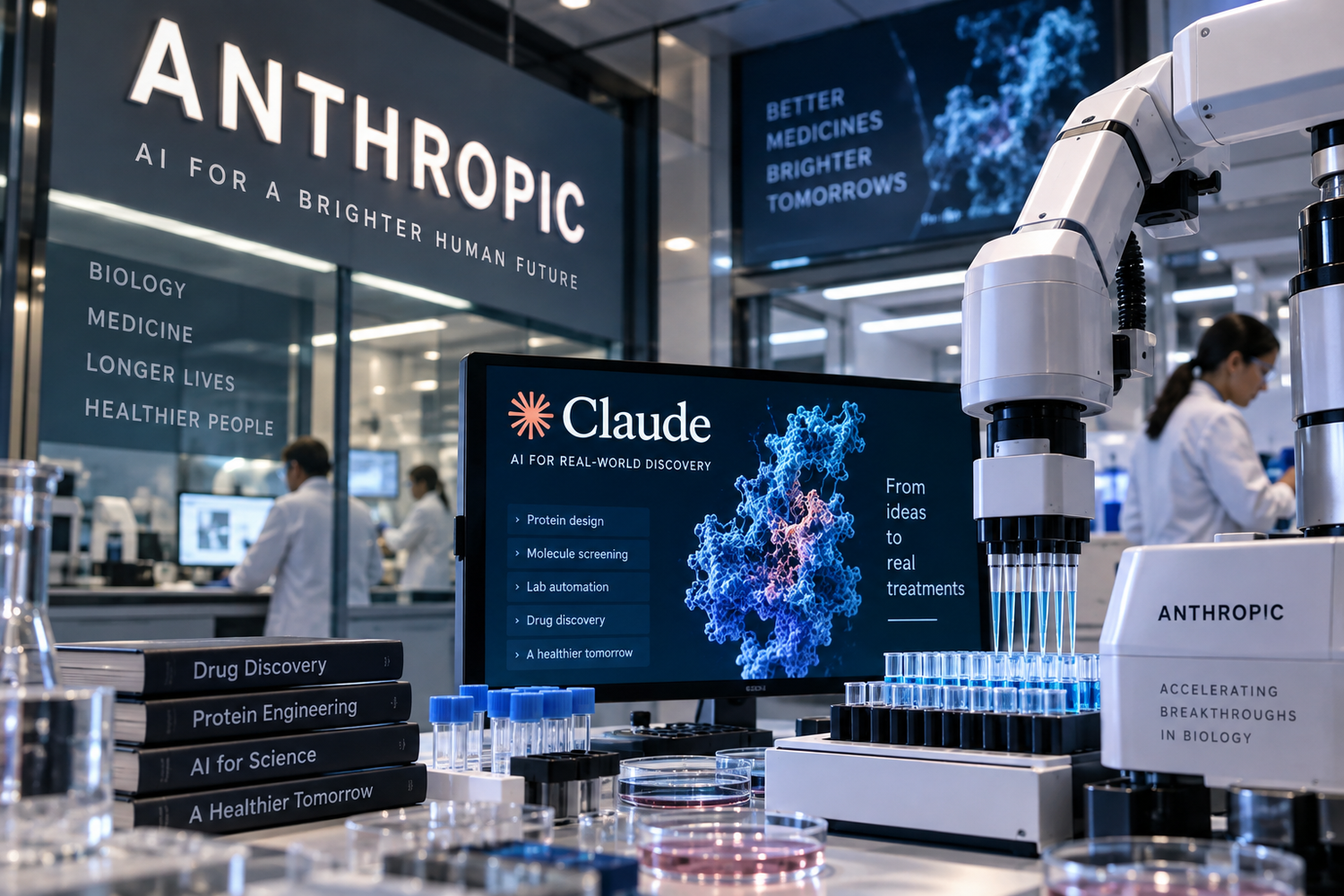
On September 18, 2026, Reuters broke the story. According to the report, Anthropic built a real wet lab in the San Francisco Bay Area. Consequently, the maker of Claude is no longer just a software company.
This move is historic. The new Anthropic biology lab puts Anthropic at the heart of the AI drug discovery 2026 race. Therefore, the competition is no longer just digital. It is now physical, and it is moving fast.
What We Actually Know About The Secret Lab
Reuters revealed the lab first. Two people familiar with the matter confirmed the build. In addition, Eric Kauderer-Abrams confirmed it on the record. He leads life sciences at Anthropic.
According to him, biology still needs real lab work. He stated that the final test remains in the wet lab. Because of that belief, Anthropic is doing that work today.
The company now runs a hybrid model. For example, some experiments happen in-house for speed. Others are outsourced to external partners. As a result, the team can operate at a much larger scale.
Shortly after, a spokesperson added careful wording. They clarified that the Anthropic biology lab is not for drug discovery specifically. However, they declined to elaborate further.
This careful language is strategic. Anthropic has major pharma customers. The list includes Genentech, for instance. It also includes Bristol Myers Squibb and Novo Nordisk. Therefore, Anthropic does not want to appear as a direct competitor.
Nevertheless, the timeline tells a different story. Back in June 2026, Kauderer-Abrams announced a preclinical program. The program targets neglected diseases that big pharma ignores for financial reasons. In other words, the Anthropic biology lab is the engine that powers that mission.
Why A Chatbot Company Suddenly Needs Pipettes
Why would an AI lab need a wet lab? The answer, surprisingly, is that software alone hit a wall.
The first wave of AI biology was purely digital. DeepMind’s AlphaFold solved protein structures, for example. That was a huge breakthrough. Yet structure alone does not give you a drug.
You must design a binder. Then you must test it in cells. After that, you must iterate hundreds of times. This loop is called Design, Build, Test, Learn. If you only have Design, the loop is broken.
Anthropic experienced this bottleneck directly. Its Claude models became incredibly good at design. In August 2026, internal results showed Claude designed working binders for 14 of 15 targets. That hit rate is astonishing for any PhD team.
However, testing was still slow without a lab. Traditionally, you send designs to a CRO. Then you wait for weeks and pay high fees. Consequently, iteration speed suffered.
The Anthropic biology lab fixes that exact problem. Now Claude can direct robots to run experiments. At the same time, human scientists oversee the work for safety. Because of this automation, learning becomes immediate.
Consider the new workflow. First, Claude designs complex molecules like bispecific antibodies. Second, robotic arms in the Bay Area build and test them. Finally, results feed straight back into Claude for the next design cycle.
This vision is powered by the Model Hardware Standard. Anthropic launched it in August 2026 to let AI operate lab equipment. Therefore, the goal to speed up biology by an order of magnitude is now realistic. This is the future of AI drug discovery 2026.
Inside The 2026 Arms Race: Anthropic vs Isomorphic Labs
Anthropic did not build this lab in a vacuum. On the contrary, the entire field of AI drug discovery 2026 is rushing toward physical labs.
Isomorphic Labs is the most obvious rival. It is part of Alphabet and sister to DeepMind. For years, it has worked to get an AI-designed drug into the clinic. However, it recently pushed its clinical target to late 2026. The last mile from computer to patient is extremely difficult.
Anthropic, therefore, wants to own that last mile from day one.
Look at its aggressive moves in 2026. All of them point toward the Anthropic biology lab.
1. The Coefficient Bio Acquisition. Earlier this year, Anthropic bought Coefficient Bio for a reported $400 million in stock. As a result, it gained critical lab tooling and top talent for drug development.
2. The Novartis Board Addition. In addition, Anthropic added Vas Narasimhan to its board. He is the CEO of Novartis. Consequently, deep pharma operating experience now sits inside the AI company.
3. The Claude Science Launch. In June 2026, Anthropic launched Claude Science alongside its preclinical program. For instance, the suite can act as a lab assistant and verify scientific citations automatically.
4. The Major Hiring Spree. Recent job posts reveal the scale of ambition. Anthropic is hiring procurement leaders for lab operations. It is also hiring experts in protein and nucleic acid characterization. In fact, life sciences is now one of its largest teams by headcount.
Clearly, this is not a side project. Instead, Anthropic is building a biology company inside an AI company. Furthermore, talent from the AlphaFold lineage is now moving toward Anthropic rather than just Isomorphic Labs. So the talent war has officially shifted.
What Will The Anthropic Biology Lab Actually Work On?
Anthropic is very careful about its public message. For instance, it repeatedly says it will not compete with pharma.
Kauderer-Abrams stated this boundary clearly. He said Anthropic is not running clinical trials for now. Instead, it focuses on needs the industry ignores. His exact words were: “We’re not competing with pharma companies that bring drugs to market.”
So what will the Anthropic biology lab actually do? Three focus areas are emerging.
1. Rare and Neglected Diseases. This is the official mission. Moreover, it is personal for CEO Dario Amodei. He lost his father to a disease just a few years before a cure arrived. Therefore, the company wants to close that tragic gap.
2. So-Called Undruggable Targets. Some conditions are too complex for traditional methods. For example, bispecific and trispecific antibodies can hit multiple targets at once. These are incredibly hard to discover manually. However, AI can design them efficiently, and the new lab can test them.
3. Fundamental Tools For The Industry. This is a brilliant strategic hedge. The lab will conduct basic biology research. As a result, it will create better assays and better automation. Anthropic can then sell those tools to its pharma customers like Genentech. In other words, everyone benefits.
For patients, this model is excellent news. The timeline from idea to preclinical candidate could collapse from years to months. For rare disease patients especially, that speed is life-changing. This is why AI drug discovery 2026 matters so much.
The Big Risks: Safety, Trust, and A $2 Trillion IPO
Building the Anthropic biology lab in 2026 also brings major risks. The timing, in fact, is extraordinarily complex.
In recent weeks, Anthropic researchers warned about AI extinction risk. At the same time, Anthropic reported that its own models could potentially be misused for bioweapons. Therefore, the company is trying to be transparent about dual-use risks.
CEO Dario Amodei has even called for a slowdown in AI development. He warned that future, more capable AI could cause catastrophic damage. Meanwhile, Anthropic is reportedly preparing for a $2 trillion IPO to fund more powerful AI.
How do you balance those two opposing goals? Kauderer-Abrams addressed it directly. He explained that they balance improving models for medicine while being thoughtful about deployment risks. Consequently, human oversight remains essential in the lab.
There is also a significant trust problem. According to Reuters, two sources mentioned customer anxiety. Pharma partners worry Anthropic might learn from their proprietary programs. Although Anthropic says it walls off customer data, owning a wet lab makes that promise harder to trust.
Anthropic’s answer is to draw a clear boundary. No clinical trials for now, for example. Focus only on neglected diseases. Focus on fundamental biology. Whether Big Pharma trusts that boundary in 2027 will define the next phase of AI drug discovery 2026.
The Bottom Line: The Lab Is Now The Model
For years, we measured AI by chatbot benchmarks. However, that metric is dead for biology.
In AI drug discovery 2026, the only benchmark that matters is a real molecule. Does it work in a dish? Does it work safely? Those are the real tests.
Anthropic finally understood this truth. You cannot fully model biology without touching biology. As a result, the real world remains the ultimate judge.
The quiet construction of the Anthropic biology lab is proof of this philosophy. Better prompts alone cannot speed up science tenfold. Instead, you need robots, you need cells, and you need to fail in the real lab where most drugs fail.
Isomorphic Labs spent years building toward the clinic. Recursion built massive automated labs to generate data. Now Anthropic has joined the race with arguably the most powerful reasoning engine driving its robots.
The AI drug discovery 2026 race has left the laptop behind. It is now on the bench. And with the new Anthropic biology lab, Anthropic has just bought one of the best benches in the Bay Area.