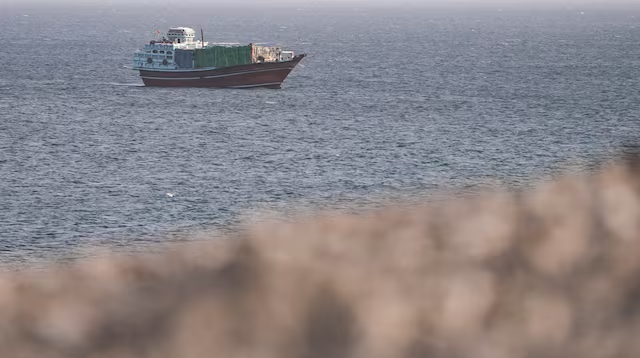
The Saudi Arabia oil export crisis has entered a new phase, and the latest development is not simply about another pipeline attack.
Saudi Arabia spent months trying to reduce its dependence on the Strait of Hormuz by moving crude through its East West Pipeline toward the Red Sea.
That strategy has now come under serious pressure.
After attacks disrupted the pipeline and fighting intensified along Yemen’s Red Sea coast, Saudi Arabia has shifted more exports back toward terminals inside the Gulf.
That means more crude once again has to move through the very chokepoint the kingdom had been trying to avoid.
At the same time, oil producers are using an expensive workaround: transferring crude between tankers near Oman before sending it toward international markets. Reuters reports that ship-to-ship transfers could handle around 2.5 million barrels per day in September, compared with about 1.4 million barrels per day in August.
The global oil system is still functioning.
But it is becoming much more complicated and much more expensive.
Saudi Arabia Had a Backup Plan
The Strait of Hormuz has always been one of the biggest vulnerabilities for Gulf oil exporters.
Saudi Arabia therefore developed its East-West Pipeline to move crude from the eastern oil fields toward Yanbu on the Red Sea.
That route gave Saudi Arabia an alternative to sending every barrel through Hormuz.
The strategy became especially valuable during the Iran war.
However, attacks in September disrupted the pipeline and stopped some crude shipments through Yanbu.
Saudi Arabia then increased exports from its eastern Gulf terminals instead. Reuters reported that Saudi Aramco loaded about 14 million barrels onto seven very large crude carriers at Ras Tanura on September 20.
The change is significant.
The kingdom’s alternative route was supposed to reduce exposure to Hormuz.
Instead, the latest disruptions are pushing more Saudi oil back toward it.
Hormuz Is Becoming the Main Route Again
Saudi Arabia is not abandoning its efforts to keep exports moving.
It is adapting.
Satellite and tanker-tracking data cited by Reuters showed Saudi oil moving through Hormuz averaged around 2.9 million barrels per day over a recent six-day period, compared with about 700,000 barrels per day in August.
That is a major change in the export pattern.
It also exposes Saudi shipments to the same security risks that have affected other Gulf producers during the war.
The problem is therefore not simply whether oil can leave Saudi Arabia.
The problem is how much it costs to move that oil safely.
The Floating Oil Bridge
One of the most unusual responses has developed off Oman.
Tankers are increasingly transferring crude from one vessel to another outside the most dangerous parts of the shipping route.
This process is known as ship-to-ship, or STS, transfer.
One tanker can carry crude away from the Gulf, while another receives the cargo farther offshore.
The system creates a kind of floating bridge between Gulf oil producers and international markets.
Reuters reports that around 2.5 million barrels per day could move through STS transfers around the Gulf of Oman during September.
Before the current war, this method played a much smaller role in Gulf oil exports.
Now it has become an important part of the emergency logistics system.
But the Workaround Is Extremely Expensive
Keeping oil moving does not mean keeping costs under control.
Reuters reports that benchmark freight rates for very large crude carriers carrying Gulf oil toward China have climbed above $30 per barrel, an unprecedented level according to LSEG data cited in the report.
That creates a difficult calculation for producers.
They can continue exporting.
But each shipment becomes more expensive.
Higher freight costs can eventually affect refiners, traders and consumers.
The oil itself does not have to disappear from the market for the war to create economic damage.
Transportation costs alone can transmit the shock.
Why Saudi Arabia Cannot Simply Avoid Hormuz
Saudi Arabia has more export infrastructure than many other Gulf producers.
However, alternative routes have physical limits.
The East-West Pipeline can move large volumes, but the Red Sea route has become increasingly vulnerable as the conflict spreads into Yemen.
The Bab el-Mandeb Strait has also become more dangerous.
The Houthis have expanded their control along parts of Yemen’s Red Sea coast and captured strategic positions near the maritime route.
That creates a difficult choice.
Use the Red Sea route and face growing security risks.
Or send more oil through Hormuz and accept another set of risks.
The Strait Is Still Not Operating Normally
The latest data shows why the situation remains fragile.
Reuters reported on September 22 that only five commodity vessels crossed Hormuz on Saturday, while none were recorded on Sunday in Kpler’s tracking data. The previous weekend had recorded 31 crossings.
Before the war, more than 130 vessels a day passed through the strait.
Hormuz also handles roughly one-fifth of global crude oil and liquefied natural gas shipments.
Therefore, even a partial reduction in traffic can have consequences far beyond the Gulf.
Oil Prices Are Sending a Mixed Signal
Interestingly, oil prices have not simply continued climbing.
On September 21, Brent crude fell to around $100.34 per barrel as markets responded to hopes for possible U.S. – Iran diplomacy and signs of recovering Saudi exports.
On September 22, Brent recovered to around $101.48, while WTI rose to about $96.65 in early trading.
The price movement shows how quickly expectations can change.
If diplomacy progresses, traders could anticipate more normal shipping.
If talks fail and attacks intensify, the market could quickly reassess supply risks.
The Real Problem Is the Cost of Normality
The most important development may therefore be hidden behind the oil price.
The world is still receiving Gulf crude.
But producers are using longer routes, additional tankers and ship-to-ship transfers.
Military protection is also becoming more important.
That means the global oil system can continue operating while becoming increasingly inefficient.
The difference matters.
A market does not need to lose millions of barrels every day to experience a major disruption.
It can also suffer when every barrel becomes harder and more expensive to deliver.
What Happens If the War Continues?
If the conflict continues for months, producers may expand offshore transfers and develop additional export arrangements.
Shipping companies could also demand higher insurance premiums.
Refiners may adjust where they source crude.
Asian buyers could become increasingly important because Saudi Arabia has shifted more sales toward Asia after disruptions to Red Sea exports.
That could gradually reshape the flow of Middle Eastern oil.
However, none of these solutions fully removes the underlying security problem.
Diplomacy Could Change Everything
The latest oil-market developments are happening alongside possible U.S.-Iran diplomacy.
Reuters reported on September 22 that investors were watching for potential talks between Washington and Tehran around the United Nations General Assembly.
At the same time, Iran has set conditions for renewed negotiations, while regional tensions remain high.
A credible agreement could reduce shipping risks quickly.
But until an agreement produces actual changes on the ground, traders and shipping companies still have to operate under wartime conditions.
Conclusion
The Saudi Arabia oil export crisis is no longer just a story about one damaged pipeline.
It is becoming a test of how much complexity the global oil system can absorb.
Saudi Arabia built alternative routes to reduce its exposure to Hormuz.
Now attacks and instability around the Red Sea are pushing more crude back through Gulf terminals and the same chokepoint the kingdom had hoped to bypass.
At the same time, ship-to-ship transfers near Oman are creating a new floating network for keeping crude moving.
The system works.
But it comes at a huge cost.
With tanker freight rates soaring and Hormuz traffic still far below normal levels, the world’s oil supply chain is operating under conditions that would have seemed extraordinary before the war.
The next major question is therefore not simply whether Saudi Arabia can export oil.
It is whether the region can keep exporting at anything close to normal cost while the war continues.
Frequently Asked Questions
What is the Saudi Arabia oil export crisis?
It refers to the disruption of Saudi Arabia’s normal oil-export routes after attacks affected its East West Pipeline and wider Red Sea shipping security.
Why is Saudi Arabia sending more oil through Hormuz?
Damage and disruption to its Red Sea export route have encouraged Saudi Arabia to increase crude loadings from terminals on the Gulf side.
What are ship to ship oil transfers?
They involve transferring crude from one tanker to another, often offshore, allowing producers to keep exports moving when normal port or pipeline routes face disruption.
How much oil is moving through ship to ship transfers?
Reuters, citing Kpler, reported that around 2.5 million barrels per day could be transferred through the Gulf of Oman in September.
Is Hormuz fully closed?
No. Some vessels continue to transit the strait, but traffic remains dramatically below pre war levels.
Could the crisis push oil prices higher?
It could, particularly if shipping disruptions intensify. However, prices are also responding to diplomatic expectations and changing Saudi export volumes, so the direction remains uncertain.