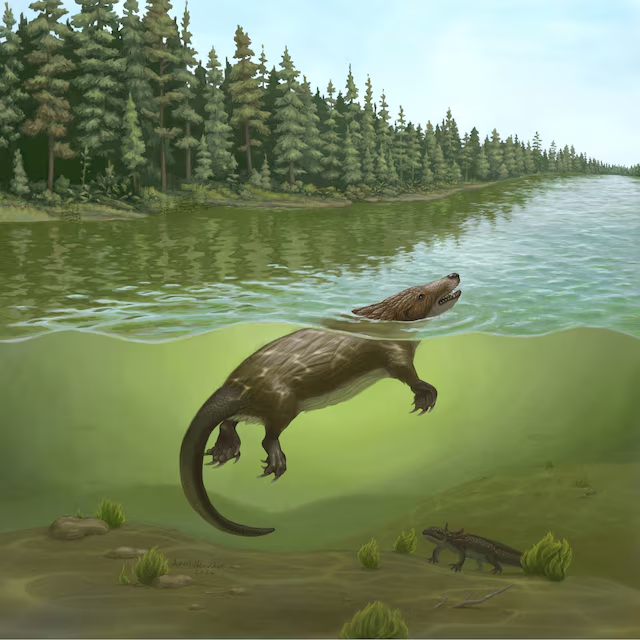
The discovery of a Jurassic semiaquatic mammal is giving scientists a remarkable new look at life during the age of dinosaurs. About 165 million years ago, a small, furry mammal relative called Megacauda sungei lived in what is now Inner Mongolia, China. Its broad, flattened tail, powerful limbs and specialised teeth suggest that it could swim and hunt prey in water.
The 165-million-year-old mammal fossil is important for another reason: it preserves unusual details of the animal’s throat, helping researchers understand how early mammal relatives developed the ability to swallow food in a way similar to modern mammals.
Published in the scientific journal Nature on October 7, 2026, the research adds to evidence that early mammal relatives were already exploring different habitats while dinosaurs dominated the land. They were not simply small animals hiding from larger predators. Some had developed specialised ways to find food and survive in environments that their relatives did not use.
Meet Megacauda sungei, the Jurassic Swimmer
The animal’s scientific name, Megacauda sungei, means approximately “big tail.” Researchers chose the name because its wide, flattened tail appears to have played an important role in its movement through water.
The creature measured roughly half a metre from its nose to the tip of its tail and weighed around one to two kilograms. That made it comparable in overall size to a modern platypus, although it did not have the platypus’s distinctive bill.
Unlike an ordinary land-dwelling mammal, Megacauda possessed a combination of features that point towards a semiaquatic lifestyle. Its tail was broad and flattened, while its limbs and feet suggest that swimming formed an important part of its behaviour.
The fossil also preserves evidence of fur and other delicate structures. Such details are particularly valuable because soft tissues rarely survive for millions of years.
Scientists classify Megacauda among the docodonts, an extinct group of early mammal relatives. These animals were not identical to modern mammals, but their fossils help researchers reconstruct the evolutionary steps that eventually produced the extraordinary diversity of mammals living today.
What Did the Ancient Mammal Eat?
The teeth of Megacauda provide important clues about its diet.
Researchers identified backward-curving tooth cusps that may have helped the animal grip slippery prey. That feature would have been useful if it hunted small aquatic animals.
Even more intriguing, the fossil preserves tiny fragments of vertebrate bones in the animal’s stomach region. These remains support the interpretation that Megacauda ate small vertebrates rather than relying entirely on plants or insects.
Its likely prey included small aquatic animals such as salamanders, along with other creatures available in its environment. Fish and invertebrates may also have formed part of its diet, although the fossil cannot establish every item on its menu.
This combination of anatomical evidence and preserved stomach contents gives scientists a stronger basis for reconstructing the animal’s behaviour than appearance alone could provide.
The discovery suggests that some early mammal relatives had already developed specialised hunting strategies during the Jurassic Period.
How Did It Swim?
Scientists examined the fossil using detailed imaging and three-dimensional reconstructions to investigate how its skeleton may have functioned.
The broad tail appears to have helped with movement in water. Researchers also interpreted the animal’s limbs as suitable for swimming, with its hind limbs potentially assisting steering.
Its body shape has drawn comparisons with modern semiaquatic animals, including otters and platypuses. However, these comparisons describe similarities in lifestyle and anatomy rather than proving that Megacauda was a direct ancestor of either animal.
The evidence supports a semiaquatic lifestyle, but it does not establish exactly how fast the creature swam or how much time it spent on land.
Researchers have also suggested that it may have used burrows along waterbanks for shelter. That remains a possible explanation for its behaviour, rather than a directly observed fact.
Nevertheless, the combination of its tail, limbs and teeth paints a convincing picture of a small predator that could exploit both aquatic and terrestrial environments.
The Fossil’s Biggest Surprise Was Inside Its Throat
The swimming adaptations make Megacauda fascinating, but the structure of its throat may be even more important for understanding mammalian evolution.
The Jurassic semiaquatic mammal preserves unusually informative evidence of the bones and structures associated with its pharynx, the passage connecting the mouth and throat.
Modern mammals use specialised throat structures to coordinate swallowing and breathing. These structures also support suckling in young mammals, allowing infants to feed on milk.
Scientists have long investigated when these important features evolved. Fossils rarely preserve the delicate anatomy needed to answer the question clearly.
The Megacauda specimen offers unusually valuable evidence that key elements of the mammalian throat were already developing among early mammal relatives during the Middle Jurassic.
That finding pushes our understanding of these anatomical adaptations deep into the age of dinosaurs.
It does not mean every feature of the modern mammalian throat had already reached its present form. Instead, the fossil reveals an important stage in a much longer evolutionary process.
Why Swallowing Matters in Mammalian Evolution
Swallowing may seem like a basic biological function, but it involves a complicated coordination of muscles, bones and soft tissues.
Animals must move food from the mouth into the digestive system while protecting the airway. Mammals also need to suckle as infants, which places additional demands on the structures around the mouth and throat.
Changes in these systems helped early mammal relatives process different kinds of food and develop new feeding strategies.
Over evolutionary time, greater flexibility in feeding contributed to mammals occupying a wide range of ecological niches. Modern mammals include aquatic hunters, underground burrowers, tree-dwelling species, grazing animals and highly specialised predators.
The 165-million-year-old mammal fossil provides a rare opportunity to examine this process before modern mammal groups diversified into many of their familiar forms.
It also demonstrates why scientists value fossils that preserve more than teeth and isolated bones. A nearly complete skeleton, combined with unusually preserved anatomical details, can reveal how an animal moved, ate and interacted with its surroundings.
What Was Life Like When This Mammal Swam?
During the Jurassic Period, dinosaurs dominated many terrestrial ecosystems. Yet the ancient world contained far more than dinosaurs.
Early mammal relatives occupied a variety of environments and developed different ways of obtaining food. Some adapted to life in trees, while others lived close to the ground. The discovery of Megacauda adds further evidence that some explored aquatic environments.
Its habitat was located in what is now Inner Mongolia, China. At the time, the region supported a rich community of ancient animals, including amphibians and other vertebrates that could have served as prey.
A small semiaquatic hunter faced potential threats from larger predators. Although scientists cannot reconstruct every encounter it experienced, its size suggests that avoiding danger would have been an important part of survival.
Its likely ability to move between land and water may have offered access to different food sources and shelter.
The discovery therefore challenges the simplistic idea that early mammal relatives all lived in the same way. Their ecological diversity was already expanding long before the emergence of modern mammals.
Is This Animal an Ancestor of the Modern Otter?
Not directly, based on the evidence currently available.
The otter comparison comes from its possible swimming behaviour and the shape of its tail. Megacauda belonged to an extinct group of early mammal relatives known as docodonts.
Modern otters belong to a much later branch of mammalian evolution. The similarities between the two animals do not establish a direct ancestral relationship.
Instead, the comparison illustrates how different animals can develop similar body features when they face similar environmental challenges. A broad tail and effective swimming movements can be useful for hunting in water, even when the animals evolved along separate evolutionary paths.
This distinction matters because scientists use fossils to reconstruct relationships through multiple lines of anatomical and evolutionary evidence, rather than relying on visual resemblance alone.
Megacauda is best understood as an early mammal relative with specialised aquatic adaptations—not a Jurassic version of a modern otter.
What This Discovery Means for Science
The fossil contributes to two major areas of research.
First, it expands the known range of habitats occupied by early mammal relatives. Its anatomical features indicate that semiaquatic lifestyles emerged surprisingly early in mammalian evolutionary history.
Second, its preserved throat structures provide evidence about the development of feeding and swallowing mechanisms associated with mammals.
Together, these findings show that early mammal relatives were experimenting with different ways of living while dinosaurs remained prominent in the world’s ecosystems.
The research also highlights the importance of exceptionally preserved fossils. Scientists cannot observe extinct animals directly, so they must combine skeletal anatomy, microscopic evidence, geological context and comparisons with living species to reconstruct ancient life.
Even a single well-preserved specimen can change scientific understanding when it reveals structures that researchers rarely find in the fossil record.
Future discoveries may help clarify how widespread semiaquatic behaviour was among early mammal relatives and how their feeding anatomy changed over time.
Conclusion
The discovery of the Jurassic semiaquatic mammal Megacauda sungei offers a remarkable glimpse into the lives of early mammal relatives around 165 million years ago.
Its flattened tail, specialised teeth and limb structure suggest that it swam and hunted in water while living alongside dinosaurs. Meanwhile, its unusually preserved throat anatomy provides important evidence about the early development of mammalian swallowing and feeding mechanisms.
The 165-million-year-old mammal fossil does not rewrite the entire history of mammalian evolution, nor does it prove that the animal was a direct ancestor of modern otters or platypuses. Instead, it reveals how diverse and specialised some early mammal relatives had already become.
Long before mammals spread into today’s oceans, forests, grasslands and cities, some of their ancient relatives were already exploring life in the water.
That is what makes this discovery so significant: the evolutionary story of mammals was becoming surprisingly diverse while the dinosaurs still ruled the planet.
Frequently Asked Questions
What was the Jurassic semiaquatic mammal called?
It was named Megacauda sungei, an extinct member of the docodont group of early mammal relatives.
How old is the 165-million-year-old mammal fossil?
The animal lived approximately 165 million years ago during the Middle Jurassic Period. Researchers place it within a broader age range of around 168–163 million years.
Where was the fossil discovered?
The fossil came from Inner Mongolia, in what is now northern China.
Did Megacauda live like a modern otter?
It appears to have been adapted for swimming and hunting in water, making an otter a useful comparison. However, it was not a modern otter or a confirmed direct ancestor of one.
What did this ancient mammal eat?
Its teeth and preserved stomach-region remains suggest that it ate small vertebrates. It may also have hunted other small aquatic animals.
Why is the fossil important?
It provides evidence of an early semiaquatic lifestyle among mammal relatives and preserves rare details of throat anatomy that help researchers study the evolution of mammalian feeding and swallowing.