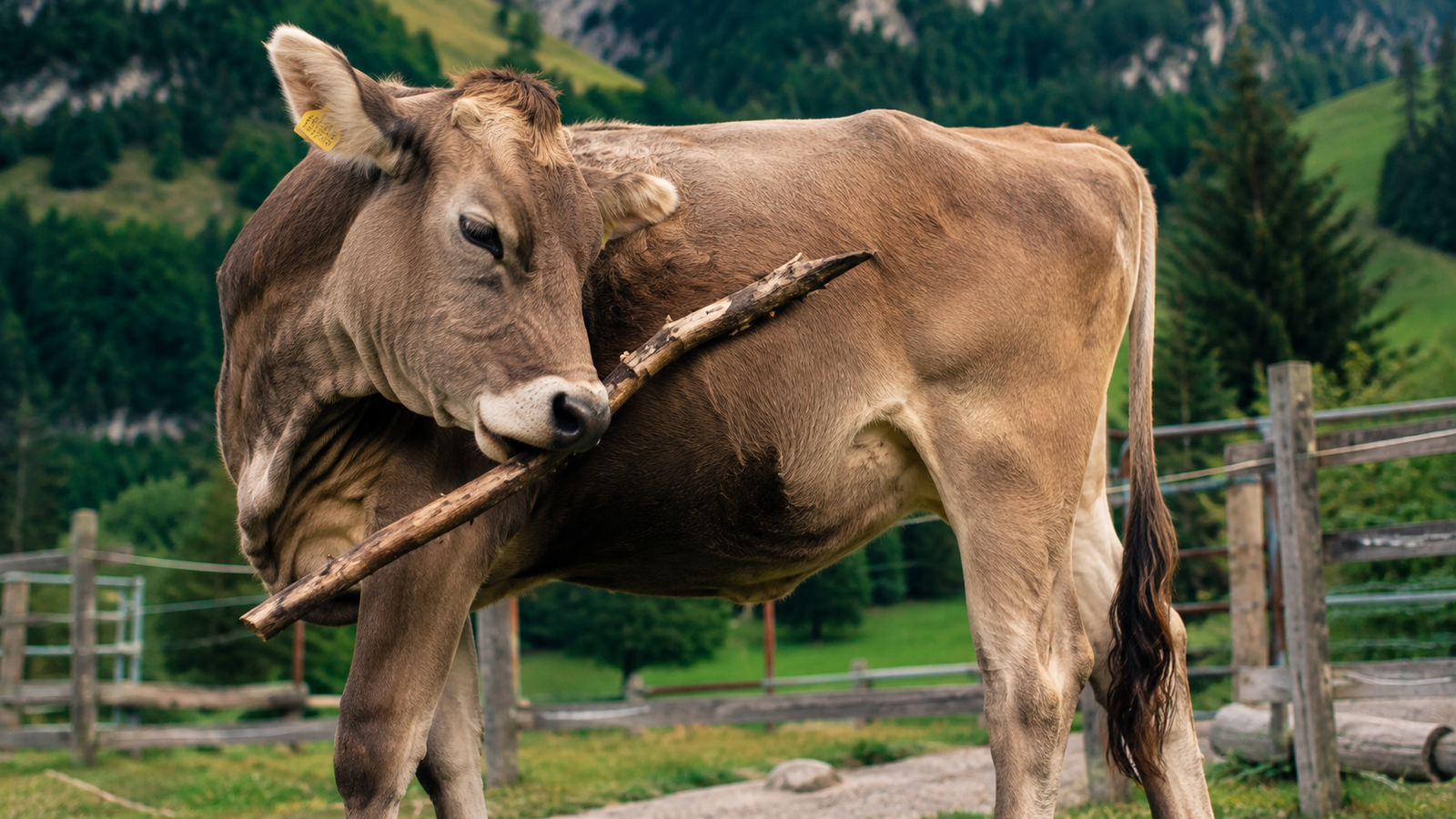
A tool-using cow in Austria has attracted international attention after researchers observed the animal deliberately using objects to scratch parts of its body that it could not easily reach on its own. The behavior has surprised scientists because intentional tool use is often associated with animals known for more advanced problem-solving abilities.
The cow, named Veronika, lives in Nötsch im Gailtal, Austria.
At first, there may appear to be nothing unusual about her behavior.
Cows scratch themselves.
Animals regularly find ways to relieve irritation.
But researchers noticed something different.
Veronika was not simply rubbing herself against an object.
She appeared to deliberately pick up objects and use them as tools.
That distinction has attracted attention because it raises a bigger question:
How intelligent are cattle?
The Cow Found a Way to Reach Difficult Places
According to reports of the research, Veronika used a fallen tree branch to scratch parts of her body.
She also reportedly used a deck brush to reach areas that were difficult to scratch directly.
The remarkable part was the apparent flexibility of her behavior.
Instead of using only one object in one fixed way, she adjusted how she held and moved the object depending on the part of her body she wanted to reach.
That suggests something more complicated than random interaction with the environment.
It indicates that the cow may have understood a relationship between:
object → movement → physical result.
That is exactly the type of behavior scientists find interesting when studying animal cognition.
What Counts as Tool Use?
Not every animal interaction with an object qualifies as tool use.
For scientists, intentionality matters.
If an animal accidentally touches a branch and scratches itself, that does not necessarily demonstrate tool use.
The more interesting behavior occurs when an animal deliberately selects an object and uses it to accomplish a particular goal.
For example, some animals use sticks to obtain food.
Others use stones to break objects.
Some use leaves or other materials for specific tasks.
Veronika’s behavior is different because the apparent goal was self-care rather than obtaining food.
That makes the observation particularly interesting.
Cattle May Be More Clever Than People Think
Cows are often underestimated when people discuss animal intelligence.
They are commonly viewed as calm grazing animals.
However, research has already shown that cattle can learn, remember locations and respond to different environmental conditions.
They can also form social relationships.
The new observation adds another possible ability:
flexible object manipulation.
That does not mean cows suddenly belong in the same cognitive category as chimpanzees or dolphins.
Scientists need much more evidence before making such a claim.
Nevertheless, the behavior suggests that cattle cognition deserves closer examination.
Why Using a Tool Is Significant
Tool use requires several mental steps.
First, an animal must recognize that an object can be useful.
Second, it must understand how to manipulate that object.
Third, it needs to connect the action with the desired outcome.
Finally, it may need to adjust its behavior when the first attempt does not work.
That last point is particularly interesting.
If Veronika changed the way she held or moved an object depending on where she wanted to scratch, she was not simply repeating a single movement.
She was adapting.
That could indicate a degree of problem-solving flexibility.
The Discovery Could Change How We Study Farm Animals
Most animal cognition research has historically focused on species such as:
- chimpanzees,
- orangutans,
- crows,
- parrots,
- dolphins,
- elephants.
These animals have produced famous examples of tool use and problem solving.
Farm animals have received less public attention.
Yet cows live in complex social and physical environments.
They interact with people, other animals, objects, fences, feeding systems and changing surroundings.
That makes them interesting subjects for cognitive research.
Veronika’s behavior could encourage scientists to investigate cattle more carefully.
Could Other Cows Do the Same Thing?
That is one of the biggest unanswered questions.
Perhaps Veronika is unusual.
Perhaps many cattle can use objects but nobody has watched them closely enough.
Or perhaps the behavior appears only under certain conditions.
Researchers will need to observe more animals to determine whether the behavior is widespread.
They could also conduct controlled experiments.
For example, researchers might provide cattle with different safe objects and observe whether they deliberately select particular tools for particular tasks.
If several cows demonstrate similar flexibility, the scientific importance of the behavior would increase.
The Difference Between Learning and Intelligence
Another important question is whether tool use automatically proves intelligence.
Not necessarily.
Animals can learn complicated behaviors through repetition.
A behavior may become automatic after many attempts.
Scientists therefore need to determine whether an animal understands the function of an object or simply learns that a particular action produces a particular sensation.
That distinction is difficult to establish.
Researchers must therefore examine the behavior carefully.
They need repeated observations.
They need controlled experiments.
And they need to rule out simpler explanations.
The Cow May Have Solved a Simple Engineering Problem
Think about what Veronika apparently faced.
There is an itchy area on her body.
Her mouth or legs cannot comfortably reach it.
There is an object nearby.
She picks it up.
She positions it against her body.
Then she moves it until she reaches the desired location.
That is essentially a tiny engineering problem.
The solution is simple.
But the cognitive process behind finding that solution may be surprisingly interesting.
The animal has identified a limitation and found an external object that helps overcome it.
Animals Constantly Solve Problems We Don’t Notice
Humans tend to notice animal intelligence only when it looks spectacular.
A crow bending a wire attracts attention.
A chimpanzee using a stone gets studied.
An octopus opening a container becomes a viral video.
But everyday problem solving may be much more common.
Animals have to navigate their environments constantly.
They search for food.
Avoid danger.
Find shelter.
Interact with other animals.
And sometimes manipulate objects.
The Austrian cow provides another reminder that intelligence does not always appear in dramatic laboratory experiments.
Sometimes it can appear in something as ordinary as scratching an itch.
Could Tool Use Improve Animal Welfare?
There may also be a practical side to the discovery.
If cattle naturally enjoy manipulating objects or using tools, farms could potentially provide safe enrichment activities.
Animal enrichment is already used in many settings to encourage natural behaviors and reduce boredom.
Understanding how cattle interact with objects could help farmers design better environments.
For example, safe scratching structures already provide physical stimulation.
More research could determine whether certain objects encourage exploration and problem solving.
That could make the discovery relevant beyond academic science.
Scientists Need More Evidence
The most important thing to remember is that one remarkable animal does not rewrite everything we know about cattle.
A single observation can generate a scientific hypothesis.
It cannot prove a broad theory by itself.
Researchers need to see whether the behavior can be repeated.
They need to compare Veronika with other cattle.
They need to determine whether the animals deliberately choose tools.
And they need to understand whether the behavior is learned, inherited or influenced by the environment.
Those questions could lead to fascinating future studies.
Why This Story Could Go Viral
Animal stories naturally attract attention.
But this one combines several powerful elements.
There is a surprising animal.
There is an unusual behavior.
There is a scientific mystery.
And there is a bigger question about intelligence.
People who normally do not read scientific research may still want to know:
“Can cows actually use tools?”
That makes the story particularly suitable for social media and Google Discover-style content.
The strongest angle is not to claim that cows have suddenly become geniuses.
Instead, the story should focus on how one unusual behavior is forcing scientists to look more closely at a species that people may have underestimated.
What This Could Mean for Animal Intelligence Research
The study of animal intelligence has changed dramatically over the past few decades.
Scientists once viewed many animals primarily through instinct.
Modern research has demonstrated much more flexibility.
Animals can learn.
Remember.
Communicate.
Plan.
Solve problems.
And sometimes use tools.
The possible addition of cattle to that conversation would be significant.
It would reinforce an increasingly important idea:
Intelligence is not limited to the animals humans traditionally consider clever.
A New Question for Scientists
The discovery creates a simple but fascinating research question:
How many other animals are solving problems around us without attracting our attention?
That question goes beyond cows.
Researchers could look for similar behaviors in sheep, goats, horses and other domesticated animals.
Farm environments may contain countless opportunities for animals to manipulate objects.
Some behaviors may have been dismissed as meaningless simply because researchers did not recognize their potential significance.
Veronika’s behavior could encourage scientists to watch more carefully.
Conclusion
The story of the tool-using cow is remarkable because it challenges a familiar assumption about farm animals.
Veronika, a cow in Austria, was observed deliberately using objects such as branches and a deck brush to scratch parts of her body that were difficult to reach. Reports indicate that she adjusted her movements depending on the area she was trying to reach.
That does not prove that cattle possess human-like intelligence.
It does, however, provide an intriguing example of flexible animal behavior.
The discovery could encourage researchers to investigate animal intelligence in cattle more closely and determine whether tool use is unique to Veronika or represents a broader ability among the species.
For now, one thing is clear.
The next time someone describes cows as simple animals that merely stand around eating grass, Veronika provides a surprisingly good reason to think twice.
Sometimes scientific discoveries begin with something as ordinary as an animal trying to scratch an itch.
animal intelligence, cow intelligence, animal behavior, animal cognition, cattle behavior, scientific discovery, animal tools, cognitive science, Austria cow, unusual animal behavior, science news 2026, animal research, surprising discoveries