A spacetime crystal sounds like something from science fiction, but physicists have developed a mathematical description of a theoretical state in which the geometry of space and time forms a repeating, crystal-like pattern. Under the right conditions, that unstable state could either disappear or collapse into a microscopic black hole after a very small change in energy.
The research comes from scientists at TU Wien and Goethe University Frankfurt. Their work does not mean that researchers have physically created a tiny black hole or discovered an actual crystal floating somewhere in the universe.
Instead, the breakthrough is mathematical.
The researchers found an analytical way to describe a phenomenon that had previously been explored mainly through numerical simulations.
That distinction is important because it changes the question from “Did scientists find a black hole?” to something much more interesting:
Can the mathematics of spacetime explain how an extremely tiny black hole could form?
What Exactly Is a Spacetime Crystal?
Ordinary crystals are familiar.
Salt, ice and many minerals contain atoms arranged in repeating structures.
A spacetime crystal is very different.
It does not consist of ordinary atoms arranged in a physical lattice.
Instead, the idea describes a situation where the curvature of spacetime itself develops a repeating pattern across space and time.
According to Einstein’s general theory of relativity, matter and energy influence the geometry of spacetime.
A massive object such as a star creates a much stronger curvature than a small object.
The researchers investigated what could happen under an extremely delicate set of conditions where this curvature becomes organized into a repeating structure.
That unusual configuration sits near the boundary between two possible outcomes.
It can disappear.
Or it can collapse.
The Tiny Change That Could Trigger Collapse
This is the part of the research that makes the story particularly fascinating.
Imagine a system balanced almost perfectly on a knife edge.
A tiny change could send it in a completely different direction.
The researchers describe the spacetime crystal as an unstable intermediate state.
If the system loses the right conditions, the structure can dissolve and return to ordinary spacetime.
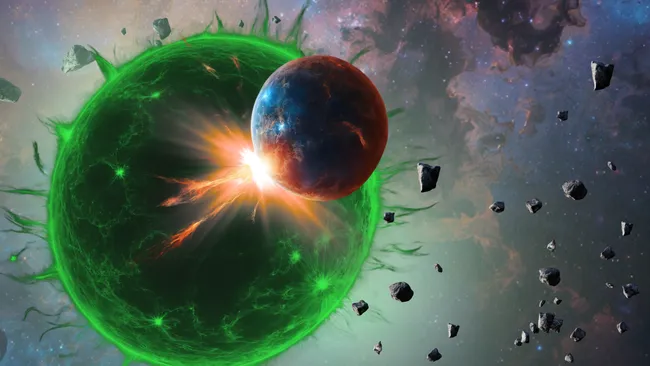
However, if enough additional energy is introduced, the system can move toward gravitational collapse and form a microscopic black hole.
This behavior is known as critical collapse.
The basic concept is not entirely new.
What is new is the mathematical treatment developed by the researchers.
Scientists Have Been Chasing This Problem for Decades
The story goes back much further than the latest research.
In 1993, physicist Matthew Choptuik used computer simulations to demonstrate remarkable behavior associated with critical gravitational collapse.
Those simulations showed that systems approaching black-hole formation could display a distinctive repeating pattern known as discrete self-similarity.
For decades, researchers struggled to describe this behavior analytically.
The latest work from Christian Ecker, Florian Ecker and Daniel Grumiller provides an analytical family of solutions for this type of critical collapse. The research was published in Physical Review Letters in May 2026.
That is why the latest coverage has attracted attention.
The researchers have not merely produced another computer simulation.
They found mathematical expressions that allow the phenomenon to be studied analytically.
Why Would a Black Hole Be So Small?
When people hear the words microscopic black hole, they may imagine a miniature version of the giant black holes found at the centers of galaxies.
The reality is very different.
Astrophysical black holes can have masses many times greater than the Sun.
They can form when massive stars collapse or when enormous objects merge.
A theoretical microscopic black hole would be dramatically different.
Physics does not require every black hole to be an enormous astronomical object.
Under certain extreme conditions, theory allows gravitational collapse on vastly smaller scales.
The researchers’ work examines how such a collapse could emerge from a critical state in spacetime.
This Does Not Mean Tiny Black Holes Are Being Created on Earth
This point deserves emphasis.
The study is theoretical.
Scientists have not produced a dangerous microscopic black hole in a laboratory.
The research describes mathematical solutions to equations governing gravity and matter.
The scientists are using the mathematics to understand what general relativity permits under extreme conditions.
Therefore, there is no reason to interpret the research as a warning that a tiny black hole could suddenly appear near us.
The interesting question is instead whether similar conditions might have existed naturally in the early universe.
Could the Early Universe Have Created Them?
Possibly.
The early universe was an extraordinarily hot and dense environment.
Matter and energy were compressed into conditions very different from those seen today.
Scientists have long considered whether unusual gravitational structures could have formed shortly after the Big Bang.
One possibility involves primordial black holes.
Unlike ordinary stellar black holes, primordial black holes could theoretically have formed from extreme density fluctuations in the early universe rather than from collapsing stars.
The new mathematical framework could potentially help researchers investigate certain mechanisms associated with these extreme conditions.
However, the researchers have not shown that primordial black holes definitely formed through this process.
That remains an open question.
The Surprising Trick: Add More Dimensions
Perhaps the strangest part of the research is how the scientists solved the mathematical problem.
Our everyday universe has four dimensions:
- Three dimensions of space
- One dimension of time
But the researchers considered the equations in a limit involving a very large number of dimensions.
In the limit where the number of dimensions becomes extremely large, some complicated equations become much easier to handle.
The team could then use the resulting mathematical structure to gain information about the four-dimensional universe we actually inhabit.
At first, this sounds backward.
Why would adding dimensions make a problem easier?
In mathematics and theoretical physics, however, changing the dimensional setting can sometimes reveal structures that are difficult to see directly.
That is exactly what happened here.
The Mathematics Behind the Mystery
The paper is titled “Analytic Discrete Self-Similar Solutions of Einstein-Klein-Gordon at Large D.”
It was authored by Christian Ecker, Florian Ecker and Daniel Grumiller.
The work uses a large-D expansion, where D represents the number of spacetime dimensions.
The researchers found an infinite family of analytical solutions for the Einstein-massless-Klein-Gordon equations in this limit. They then compared the results with numerical critical solutions at finite dimensions.
That may sound highly technical.
However, the practical meaning is relatively simple:
Scientists found a new mathematical tool for studying the moment when gravity approaches black-hole formation.
Why This Could Matter for Black-Hole Physics
Black holes are among the most extreme objects in the universe.
They challenge our understanding of gravity, matter, information and spacetime.
Yet scientists still do not have a complete theory that combines general relativity with quantum mechanics.
That creates a major problem.
General relativity works exceptionally well for large-scale gravity.
Quantum mechanics works exceptionally well at microscopic scales.
Black holes sit at an uncomfortable intersection between the two.
Understanding critical collapse and microscopic black holes could therefore provide useful clues about where current theories work and where new physics might be needed.
The new method does not solve quantum gravity.
However, it gives physicists another mathematical route for studying extreme gravitational behavior.
What Happens to the Spacetime Crystal?
The spacetime crystal is not expected to remain stable indefinitely.
Researchers describe it as an intermediate state.
There are essentially two possible directions.
Path One: The Structure Dissolves
If the system moves away from the critical condition in one direction, the organized spacetime pattern can disperse.
The result is ordinary spacetime with matter and energy moving freely.
Path Two: Gravity Takes Over
If the system receives a small enough additional energy disturbance in the opposite direction, gravitational collapse can occur.
The result can be a microscopic black hole.
This dramatic sensitivity is what makes critical phenomena so interesting to physicists.
A tiny change can produce a completely different outcome.
Think of It Like Water Freezing
The researchers use an everyday analogy to explain the concept.
Consider water near its freezing point.
A tiny temperature change can cause a dramatic transformation.
The liquid becomes a solid.
Its molecules suddenly organize themselves into a regular structure.
The transition from one state to another can happen quickly once the critical point is crossed.
The gravitational system investigated by the researchers has a somewhat similar mathematical character.
The spacetime crystal represents a highly organized state near a critical threshold.
A small change can determine whether the system disperses or collapses.
Of course, the physics is vastly more complicated than freezing water.
The analogy simply helps illustrate the idea of critical behavior.
Could These Tiny Black Holes Survive?
Not necessarily.
Theoretical microscopic black holes could be extremely short-lived.
Some theoretical models predict that very small black holes would lose energy through Hawking radiation and eventually disappear.
Therefore, even if microscopic black holes formed in the early universe, many may not have survived until today.
Others, depending on their properties and formation conditions, could potentially survive much longer.
Scientists are still investigating these possibilities.
The new research focuses on the formation process, rather than proving that surviving microscopic black holes exist today.
Why Scientists Care About Primordial Black Holes
Primordial black holes are particularly interesting because they could potentially explain some unexplained phenomena in cosmology.
Researchers have investigated whether certain populations of primordial black holes could contribute to dark matter.
However, observations place strong constraints on many possible primordial-black-hole scenarios.
The new work does not establish primordial black holes as dark matter.
Instead, it provides a mathematical framework that could help researchers explore how critical gravitational collapse behaves under extreme conditions.
That could become useful when studying models of the early universe.
Could We Ever Detect One?
That remains an enormous challenge.
A microscopic black hole would be dramatically smaller and potentially far less energetic than the black holes astronomers routinely observe.
Scientists cannot simply point a telescope toward one and expect to see it.
Instead, researchers would need to search for indirect effects.
Depending on the model, those effects could involve radiation, gravitational signatures or unusual astrophysical events.
At present, there is no confirmed observation of a naturally occurring microscopic black hole produced through the mechanism described in this study.
Why the Discovery Is Important Even Without an Actual Black Hole
Science does not always advance by discovering a physical object.
Sometimes the breakthrough is finding a better way to describe something that theory already suggests may exist.
That is what makes this research significant.
The possibility of critical collapse has been studied for decades.
Numerical calculations provided important evidence.
Now researchers have developed an analytical approach that can describe a family of these self-similar solutions.
That can make future theoretical investigations more systematic.
It may also allow scientists to test ideas that would otherwise require extremely demanding numerical calculations.
The Research Could Open New Questions
Every successful mathematical method creates new questions.
For example, scientists can now investigate how closely the large-dimensional analytical solutions correspond to the behavior expected in four-dimensional spacetime.
They can also examine how the solutions change when additional approximations are introduced.
The researchers say their method is stable and can be systematically improved depending on the desired precision.
That means the current paper may be only the beginning.
Future studies could determine how useful the method becomes for more realistic gravitational systems.
The Biggest Mystery May Be the Universe Itself
The strange idea of a spacetime crystal highlights something remarkable about modern physics.
Space may not simply be an empty stage where objects move.
According to Einstein’s theory, spacetime is dynamic.
Matter and energy influence its geometry.
That geometry influences how matter moves.
Under extreme circumstances, the geometry itself can behave in ways that are difficult to visualize.
A crystal-like pattern forming in spacetime is one example.
A black hole emerging from that state is another.
These ideas challenge our everyday understanding of what space actually is.
Could This Help Explain the First Black Holes?
The early universe may have contained conditions capable of producing gravitational structures very different from those we see today.
If critical collapse occurred frequently enough under those conditions, it could have produced populations of primordial black holes.
The new analytical framework may help physicists investigate those possibilities.
However, scientists still need much more evidence.
The mathematical model is a tool.
It is not proof that the early universe actually produced black holes through this exact mechanism.
That distinction is essential.
The Most Important Word Is “Theoretical”
The headline “Scientists Discover a Strange Spacetime Crystal” is attention-grabbing, but readers should understand what was actually discovered.
Researchers did not find a physical crystal made of space.
They did not observe a microscopic black hole forming.
They did not create one in a laboratory.
Instead, they derived an analytical description of a theoretical critical-collapse phenomenon that had previously been studied numerically.
That is still an important scientific achievement.
In fact, accurately explaining the distinction makes the story more interesting rather than less.
The researchers have found a new mathematical window into an extreme corner of Einstein’s theory.
What Comes Next?
The next stage will involve testing how well the analytical solutions connect with the physical four-dimensional universe.
Researchers can also explore whether the method can be extended to other gravitational systems.
If it proves successful, the approach could become another useful tool in theoretical black-hole research.
Meanwhile, astronomers continue searching for evidence of primordial black holes and other unusual gravitational phenomena.
The two areas could eventually meet.
Theory may predict a signature.
Observations may search for it.
And if the signature is ever found, scientists could have a much stronger case for how these strange objects formed.
A New Way to Think About Black Holes
Black holes are often imagined as the final products of catastrophic cosmic events.
Massive stars collapse.
Galaxies merge.
Objects disappear beyond event horizons.
The new research presents another possibility.
A black hole could emerge from a delicately balanced gravitational state in which spacetime itself becomes organized into a repeating pattern.
That is an extraordinary concept.
It suggests that black-hole formation may sometimes be understood not only as a violent collapse, but also as a critical transition between different states of spacetime.
Conclusion
The spacetime crystal described by physicists from TU Wien and Goethe University Frankfurt is not a physical crystal discovered floating through space. It is a theoretical structure that emerges in mathematical descriptions of critical gravitational collapse.
The remarkable part is what can happen at the edge of this critical state.
With one outcome, the structure can dissolve.
With a small change in energy, it can instead move toward gravitational collapse and potentially form a microscopic black hole.
The researchers’ work provides an analytical description of self-similar critical-collapse solutions that had previously been known mainly from numerical studies. Their paper was published in Physical Review Letters in May 2026.
The research does not prove that microscopic black holes are currently forming around us.
It does not confirm that primordial black holes exist.
Instead, it gives physicists a new mathematical tool for investigating some of the most extreme possibilities allowed by gravity.
And that may ultimately be the most exciting part.
Somewhere between ordinary spacetime and a black hole, physics may contain a strange, unstable state where space and time briefly organize themselves like a crystal.
Scientists have now found a better mathematical way to describe that boundary.
Frequently Asked Questions
What is a spacetime crystal?
A spacetime crystal is a theoretical state in which the curvature of spacetime develops a repeating, crystal-like pattern across space and time. It is not an ordinary crystal made of atoms.
Can a spacetime crystal become a microscopic black hole?
According to the theoretical model, a critical spacetime configuration can either disperse or move toward black-hole formation after a small change in energy.
Did scientists actually create a microscopic black hole?
No. The research is theoretical and mathematical. It describes how such a collapse could occur under specific conditions.
Who conducted the research?
The work was carried out by researchers from TU Wien and Goethe University Frankfurt, including Christian Ecker, Florian Ecker and Daniel Grumiller.
When was the research published?
The paper, Analytic Discrete Self-Similar Solutions of Einstein-Klein-Gordon at Large D, was published in Physical Review Letters in May 2026.
Could this research explain primordial black holes?
It could provide a useful mathematical framework for studying possible black-hole formation in extreme early-universe conditions, but it does not prove that primordial black holes formed through this mechanism.